
AgentClara
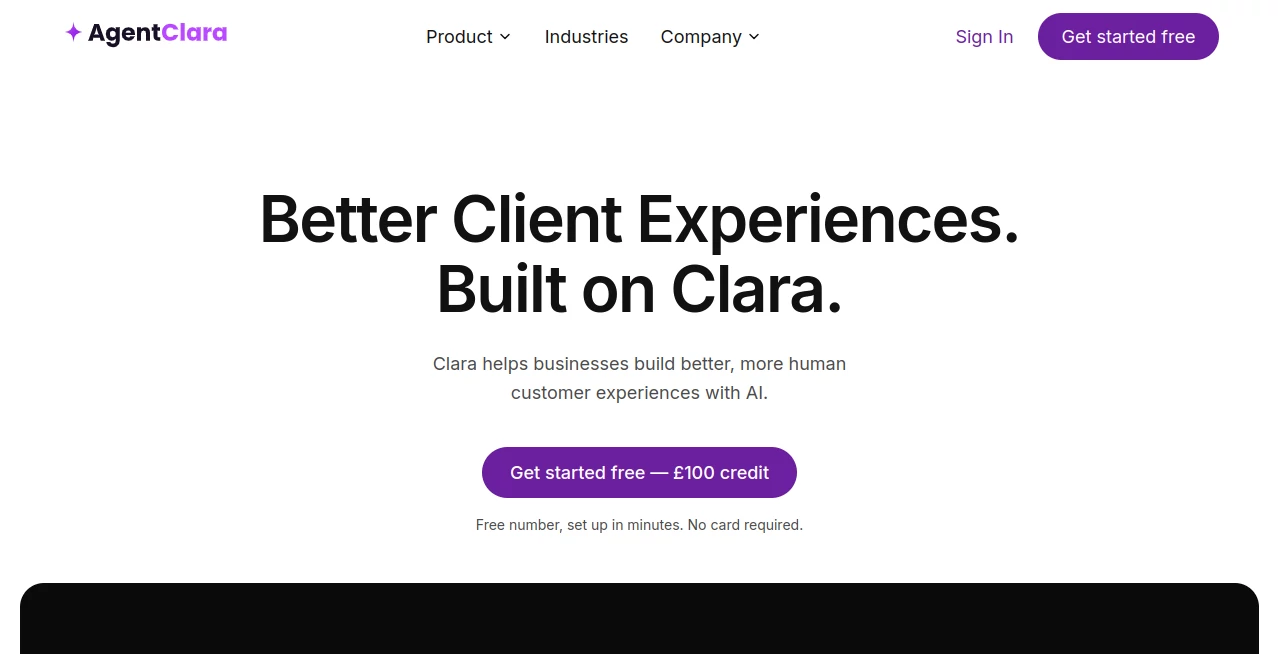
What is AgentClara?
Agent Clara is an AI-powered customer experience platform designed to help businesses handle customer conversations without making people wait for an answer. It combines conversational AI with voice, messaging, email, and business-system integrations, giving companies a way to answer questions, manage routine requests, and take action around the clock.
What makes the platform particularly interesting is that it is built around more than simple question-and-answer conversations. The agent can work with a company's knowledge, policies, processes, and brand identity, allowing it to respond in a way that is more closely aligned with how the business actually operates.
For a busy company, this can make a noticeable difference. A customer calling after hours can receive an answer, an appointment can be rescheduled without waiting for staff, and a conversation that needs human attention can be handed over with useful context instead of forcing the customer to start again.
Key Features
- AI-powered customer conversations across phone, chat, SMS, messaging, and email.
- Natural voice interactions designed to handle interruptions and real-time conversations.
- Personalisation based on a company's brand, knowledge, policies, and workflows.
- Appointment reminders, booking, rescheduling, and customer-detail updates.
- Integration with existing business software and internal systems.
- Human handoffs with conversation summaries and intelligent routing.
- Analytics and conversation monitoring for ongoing optimisation.
- Multilingual customer interactions for businesses serving different markets.
User Interface
The experience is built around the customer's conversation rather than a complicated collection of controls. Businesses can shape the agent around their own information, processes, goals, and communication style, while the implementation team handles much of the technical integration.
For customers, the interface can be as simple as a phone conversation or a message. That simplicity is important. People generally do not want to learn how an AI system works; they simply want an answer or a task completed without unnecessary steps.
Accuracy & Performance
Performance is supported by a multi-model approach in which different AI models can be used for different tasks. The platform also uses supervision, guardrails, conversation monitoring, and quality checks to keep responses aligned with business rules.
In practical terms, this approach is useful for customer-service situations where speed matters but consistency matters just as much. The system is designed to understand context, respond in real time, and take action rather than stopping at a generic answer.
Capabilities
The platform can be configured as a business-specific AI agent rather than a generic chatbot. Companies can provide their own knowledge and policies, define goals and guardrails, and connect the agent to systems such as CRM platforms, calendars, booking software, and other operational tools.
Its voice capabilities are especially useful for businesses that receive a high volume of phone enquiries. The agent can answer calls, understand customer requests, provide information, qualify enquiries, manage bookings, and transfer conversations when a human needs to step in.
It can also work beyond the phone. Customers can interact through messaging and email, creating a more consistent experience across different communication channels.
Security & Privacy
Security is a significant part of the platform's positioning. Business interactions are protected with controlled integrations, monitoring, and guardrails designed to keep the agent within defined policies.
Personal information is encrypted and masked, while business data is intended to remain within the company's controlled environment. The platform states that customer data is used to support the company's own agent rather than being shared across companies or used to train outside models.
The company also highlights compliance requirements and frameworks including GDPR, HIPAA, SOC 2, ISO 27001, and ISO 42001, making security and governance an important consideration for organisations dealing with sensitive customer information.
Use Cases
Customer Support: Businesses can use the agent to answer common questions, resolve routine issues, and provide assistance outside normal working hours.
Appointment Management: Clinics, service businesses, and other appointment-based organisations can use conversational interactions for booking, cancellation, rescheduling, and reminders.
Lead Qualification: Instead of simply recording a new enquiry, the agent can have a conversation, understand the customer's needs, and help qualify the opportunity before passing it to a sales or service team.
After-Hours Reception: Companies that cannot afford to miss calls can use an always-on AI receptionist to respond when employees are unavailable.
Healthcare and Wellness: Healthcare and wellness organisations can use conversational automation for suitable customer-service workflows, appointment interactions, and frequently requested information while keeping human staff involved when required.
Service Businesses: Trades, professional services, and other companies that spend much of the day away from a desk can use voice automation to answer enquiries and capture opportunities without interrupting their work.
Pros and Cons
- Pros: Natural voice conversations, multi-channel support, business-system integrations, appointment management, human handoffs, custom business knowledge, multilingual interactions, and strong attention to security.
- Pros: The platform goes beyond answering questions and can perform practical actions inside connected business systems.
- Pros: Ongoing monitoring and optimisation can help businesses improve the agent as customer interactions accumulate.
- Cons: It is primarily aimed at businesses rather than casual individual users looking for a simple personal chatbot.
- Cons: Setting up a sophisticated business agent and connecting it to internal systems requires more planning than installing a typical consumer AI application.
- Cons: Businesses with very simple customer-service needs may not need the full range of capabilities offered by the platform.
Pricing Plans
Public fixed pricing is not clearly presented on the main product pages. The platform appears to follow a business-oriented, tailored implementation model, with customers encouraged to discuss their requirements and strategy with the team.
This approach makes sense for organisations that need integrations, customised conversation flows, business-specific knowledge, and ongoing optimisation. The final cost is therefore likely to depend on factors such as business requirements, integrations, usage, and the level of support required.
How to Use the Platform
Start by identifying the customer interactions you want to automate. This could be incoming phone calls, appointment requests, frequently asked questions, lead qualification, or routine support tasks.
Next, provide the relevant company knowledge, policies, services, and communication preferences. The agent can then be shaped around the business's identity and operating rules.
The next step is connecting the required systems. Depending on the workflow, this may include CRM software, calendars, booking platforms, communication systems, or other internal tools.
Once the agent is configured, businesses can monitor conversations and results, identify areas that need improvement, and refine the experience over time. Human escalation can remain part of the workflow for situations that require staff involvement.
Comparison with Similar Tools
Many AI customer-service products focus primarily on website chat or automated replies. This platform takes a broader approach by combining voice conversations with messaging, email, business integrations, and task execution.
The difference becomes more apparent when a customer needs something done rather than simply answered. A traditional chatbot might explain how to change an appointment, while a connected AI agent can potentially handle the rescheduling process itself.
It is also designed with human handoffs in mind. When automation reaches its limit, the conversation can be routed to a member of the team with a summary of what has already happened. That creates a smoother transition and avoids making customers repeat their story.
Conclusion
For businesses dealing with a steady stream of customer calls and messages, AI becomes much more useful when it can actually participate in the workflow. This platform takes that idea seriously by combining conversational interactions with scheduling, customer support, system integrations, and automated actions.
Its strongest appeal is likely to be organisations where missed calls, slow responses, repetitive questions, or overloaded reception teams have a direct effect on revenue and customer satisfaction. Instead of treating AI as another chat window, it positions the technology as an active extension of the business.
Businesses looking for an always-on customer experience layer, particularly those with phone-heavy operations or appointment-based services, may find this approach considerably more practical than a basic chatbot.
Frequently Asked Questions (FAQ)
What type of businesses can use the platform?
It is designed for a broad range of industries, including financial services, travel and hospitality, automotive, healthcare and wellness, retail, education, SaaS, and government organisations.
Can the AI handle phone calls?
Yes. Voice interaction is one of its core capabilities. The agent is designed to conduct natural conversations, understand customer requests, handle interruptions, and take appropriate actions.
Can it schedule appointments?
Yes. Appointment booking, reminders, cancellations, and rescheduling are among the workflows the platform is designed to support.
Can it connect to existing business software?
Yes. The platform is designed to integrate with existing business systems, including CRM platforms, calendars, booking systems, and other tools needed to complete customer workflows.
Can a customer be transferred to a human?
Yes. When a situation requires human involvement, the conversation can be handed to a team member with relevant context and a summary to make the transition smoother.
Does it support multiple languages?
Yes. The platform supports multilingual customer interactions, allowing businesses to provide service to customers in different languages.
Is customer data protected?
The platform states that personal information is encrypted and masked and that business data is used to power the company's own agent rather than train outside models. It also provides security controls, monitoring, and compliance-focused safeguards.
Does the platform replace human employees?
It is designed primarily to support teams by handling repetitive interactions and routine tasks. Human employees can remain involved whenever a conversation requires judgement, specialised assistance, or personal attention.
How long does implementation take?
The company states that many businesses can become fully operational within approximately two to four weeks, depending on the required call flows, data training, and system integrations.
AI Scheduling , AI Customer Service Assistant , AI Voice Assistants .
These classifications represent its core capabilities and areas of application. For related tools, explore the linked categories above.

AgentClara Alternatives Product

Chatref

Qwen3 TTS
MeetAssist

vo4 ai

Customer Fee…

Weblo AI

AthenaChat

Chatzy AI

Omni Voice