
AI Poker Simulator
What is AI Poker Simulator?
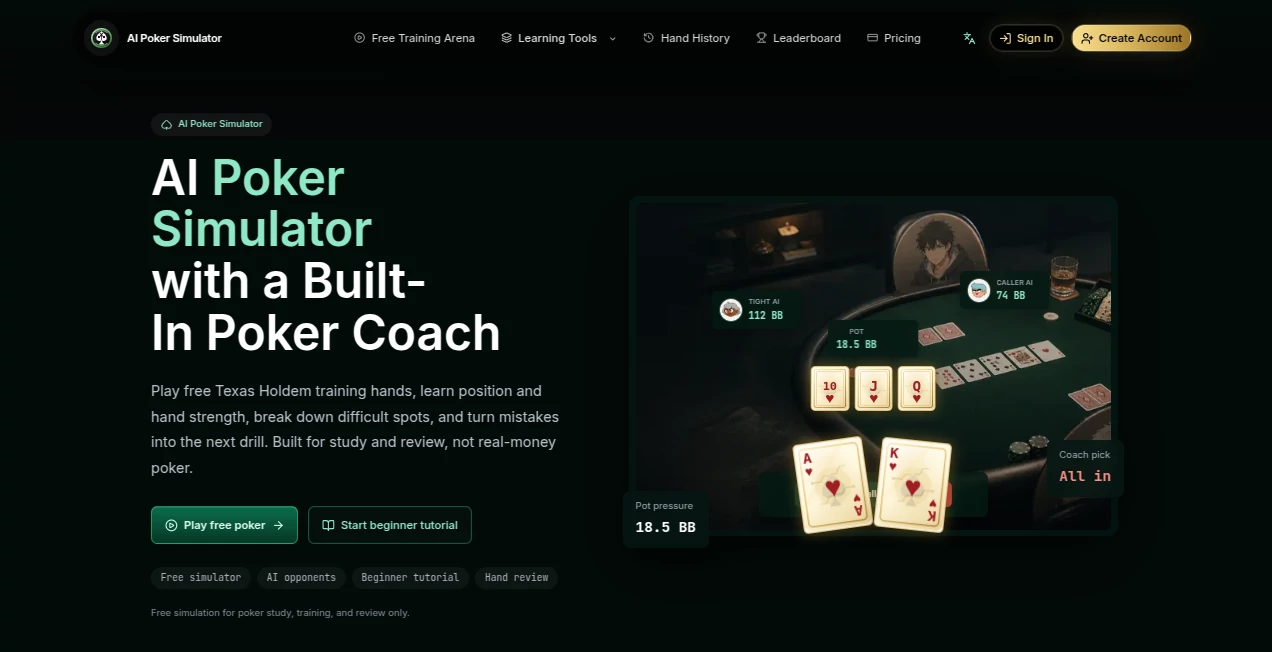
AI Poker Simulator is a browser-based Texas Holdem training platform built for players who want to practice their decisions without putting real money on the table. Instead of focusing on gambling, it creates a structured environment where users can play simulated hands, face AI opponents, study poker concepts, and review difficult decisions.
The platform is designed around a simple learning cycle: play a hand, identify a difficult spot, understand the decision, and use the lesson in the next training session. That approach makes it useful for both complete beginners and players who already understand the basics but want more deliberate practice.
New players can start with guided 1v1 lessons covering rules, position, hand strength, betting, and settlement. More experienced users can move directly into the training arena, explore GTO preflop ranges, or examine saved hands after a session.
Key Features
- Free daily Texas Holdem training with 2,000 training chips.
- AI opponents designed for simulated poker practice.
- A beginner-friendly 1v1 tutorial for learning the fundamentals.
- Full simulated hands with position, betting rounds, and showdown flow.
- An action assistant for breaking down difficult decisions.
- GTO preflop range training for 6-max 100bb situations.
- Saved hand history and review features.
- Advanced training scenarios for players who want more challenging practice.
- AI Coach explanations, hand reviews, and session-level analysis on the Coach plan.
- Browser-based access without requiring an application download.
User Interface
The interface is centered around a familiar poker table, making it relatively easy for players to understand what is happening during a simulated hand. Important information such as position, pot size, blinds, stacks, cards, and available actions is presented around the table rather than hidden behind complicated menus.
One particularly useful touch is the way poker terminology is explained during training. Concepts such as position, pot odds, board texture, equity, continuation betting, and bet sizing can be explored in the context of an actual hand. This gives beginners a practical reason to learn each term instead of simply memorizing definitions.
For an experienced player, the interface stays focused on the decision itself. You can concentrate on the action line and return to the analysis when a particular hand deserves closer attention.
Accuracy & Performance
The platform is built around simulated Texas Holdem hands rather than real-money gameplay. Its training environment considers elements such as position, board texture, pot pressure, stack size, opponent action, and betting decisions when presenting a poker situation.
The GTO range section provides basic preflop baselines for 6-max games at 100bb stacks, giving players a reference point when studying opening and response ranges. The hand review system also makes it possible to revisit decisions instead of relying entirely on memory after a session.
It is best viewed as a study and practice environment rather than a guarantee of perfect poker strategy. Poker decisions depend heavily on context, and players can use the simulator most effectively as part of a broader learning routine.
Capabilities
The main strength of the platform is the combination of playing and reviewing. Users can complete simulated hands against AI opponents, pause to examine difficult situations, and then turn confusing decisions into focused practice.
The action assistant helps organize a current situation by looking at information such as position, cards, pot, stack, and opponent action. The review workflow goes a step further by allowing players to study saved hands and identify recurring weaknesses.
For more advanced study, the platform includes GTO range training and additional scenarios covering range reading, heads-up situations, and scenario-based drills. This gives users a natural path from learning the rules to working on more structured decision-making.
Security & Privacy
The service is positioned specifically as an off-table training platform. It does not provide real-money poker, betting, rake, or gambling services, which keeps the purpose focused on education and simulation.
According to the pricing information, payments are handled through established third-party payment providers and full card numbers are not stored by the platform. Hand and AI-task information can be used to provide study history, billing functionality, and requested analysis.
Players should also note the platform's responsible-use restriction: AI Coach and AI Solver outputs are intended for training, replay, and review, not for making decisions during a live or online poker game.
Use Cases
Learning Texas Holdem: Complete beginners can use the guided 1v1 tutorial to learn the basic rules, hand strength, position, betting, and settlement before entering a larger simulated table.
Decision Practice: Players can repeatedly face AI opponents and practice making decisions without the financial pressure associated with real-money games.
GTO Study: Players interested in structured strategy can use the basic 6-max 100bb preflop range library as a reference for studying common situations.
Hand Review: A confusing hand does not have to disappear after the session. Saved hand history and review tools make it possible to return to important decisions and turn them into future drills.
Strategy Development: More experienced players can work through advanced scenarios involving range reading, heads-up play, and different decision-making situations.
Pros and Cons
- Pros: Free daily training, AI opponents, beginner lessons, GTO range study, hand history, decision assistance, browser access, and a clear focus on poker education.
- Pros: The combination of playing and reviewing creates a more useful practice routine than simply playing simulated hands repeatedly.
- Pros: The terminology explanations can make difficult poker concepts easier for newer players to understand.
- Cons: It is designed for off-table training and cannot be used as a real-money poker platform.
- Cons: Advanced AI analysis depends on the paid Coach system and its credit allowance.
- Cons: Players looking only for casual entertainment may find the study-focused approach more structured than a conventional poker game.
Pricing Plans
The platform offers a free way to begin training, with free users receiving 2,000 training chips each day. Training chips are separate from AI credits, so the daily practice balance and AI analysis allowance work independently.
The Train Annual plan is listed at $120 per year, with unlimited training hands, the basic GTO preflop range library, saved hand history, deterministic review, beginner tutorials, and advanced training access. The listed regular annual value is $144, making the annual option a two-month saving compared with monthly billing.
The Coach Annual plan is listed at $290 per year. It includes everything in Train Annual plus 150 AI credits each month, AI Coach explanations, hand reviews, session leak summaries, and AI Solver advice for off-table study. Additional Coach credit packs are also available, while monthly subscription credits do not roll over.
AI credit usage is straightforward: detailed Coach explanations use 1 credit, hand reviews use 2 credits, session reviews use 6 credits, and AI Solver advice uses 3 credits. This structure makes the basic training plan suitable for players who mainly want practice, while the Coach plan is better suited to users who want deeper AI-assisted analysis.
How to Use the Simulator
Start by opening the training environment in a web browser. Beginners should begin with the 1v1 tutorial, where the fundamentals are introduced through short guided hands.
Once the basic concepts are familiar, move into the training arena and play complete Texas Holdem hands against AI opponents. Pay attention to your position, the board, pot size, stack sizes, and the opponent's action rather than focusing only on whether you win the hand.
When a decision feels unclear, use the action assistant to structure the situation. After finishing a session, return to important hands through the review tools and identify decisions that deserve another round of practice.
A useful routine is to choose one specific weakness at a time. For example, a player who frequently struggles with continuation bets can review relevant spots, study the underlying concepts, and then deliberately practice similar situations in another session.
Comparison with Similar Tools
Many poker training products concentrate on a single part of the learning process. Some focus mainly on GTO charts, while others provide hand calculators, quizzes, or traditional poker gameplay. This platform takes a broader approach by connecting simulated play, decision assistance, GTO ranges, beginner education, and hand review in one training workflow.
That combination is especially useful for players who learn better by doing. Instead of reading a strategy explanation and immediately forgetting it, users can encounter a similar situation at the table, make a decision, review it, and then practice the concept again.
It also differs from real-money poker services because the objective is not to provide a gambling environment. The emphasis remains on repetition, analysis, and skill development away from live play.
Conclusion
For anyone looking to build better Texas Holdem habits, this training platform offers a practical alternative to simply playing more hands. Its strongest idea is the connection between practice and review: play against AI opponents, identify difficult decisions, understand what happened, and use that knowledge in another training session.
Beginners benefit from the guided learning path, while more experienced players can explore GTO ranges, advanced scenarios, saved hand histories, and AI-assisted analysis. The free daily training option also makes it easy to test the experience before committing to a subscription.
Overall, it is a focused poker study environment for players who want structured repetition rather than real-money action. Used as intended, it can turn individual poker mistakes into specific training opportunities and make practice more deliberate.
Frequently Asked Questions (FAQ)
Is the simulator free to use?
Yes. Free users receive 2,000 training chips each day and can use the platform for simulated poker training. Paid plans provide additional access and features.
Can beginners use it?
Yes. The beginner 1v1 tutorial introduces rules, position, hand strength, betting, and settlement before users move into the full training arena.
Does it offer real-money poker?
No. The platform is designed for study, simulation, training, and hand review. It does not provide real-money poker, betting, rake, or gambling services.
What is the AI Coach used for?
The AI Coach provides explanations and analysis for poker study. Depending on the plan and available credits, it can explain decisions, review hands, and summarize session-level weaknesses.
What is the GTO Range Vault?
It provides basic GTO preflop range baselines for 6-max 100bb situations, giving players a structured reference for studying common preflop decisions.
Do I need to install an application?
No. The training environment is browser-based, so users can open it on the web and start practicing without downloading a dedicated application.
Can the AI Coach be used during live poker?
No. The service is intended for off-table training, replay, and review. Its AI Coach and AI Solver features should not be used to make real-time decisions during live or online poker games.
How do AI credits work?
Different AI features consume different amounts of credits. Detailed Coach explanations cost 1 credit, hand reviews cost 2, session reviews cost 6, and AI Solver advice costs 3 credits.
These classifications represent its core capabilities and areas of application. For related tools, explore the linked categories above.
AI Poker Simulator details
Website unavailable — View Alternatives
Pricing
- Freemium
Apps
- Web App
Categories

AI Poker Simulator Alternatives Product

StarBattle O…

Museland

Project Geni…
Robux Tax Ca…
GCS Cheats

TriviaFlow

Raise Animal…

Lessgames
CFB27 Nation