
Artificial Analysis
What is Artificial Analysis?
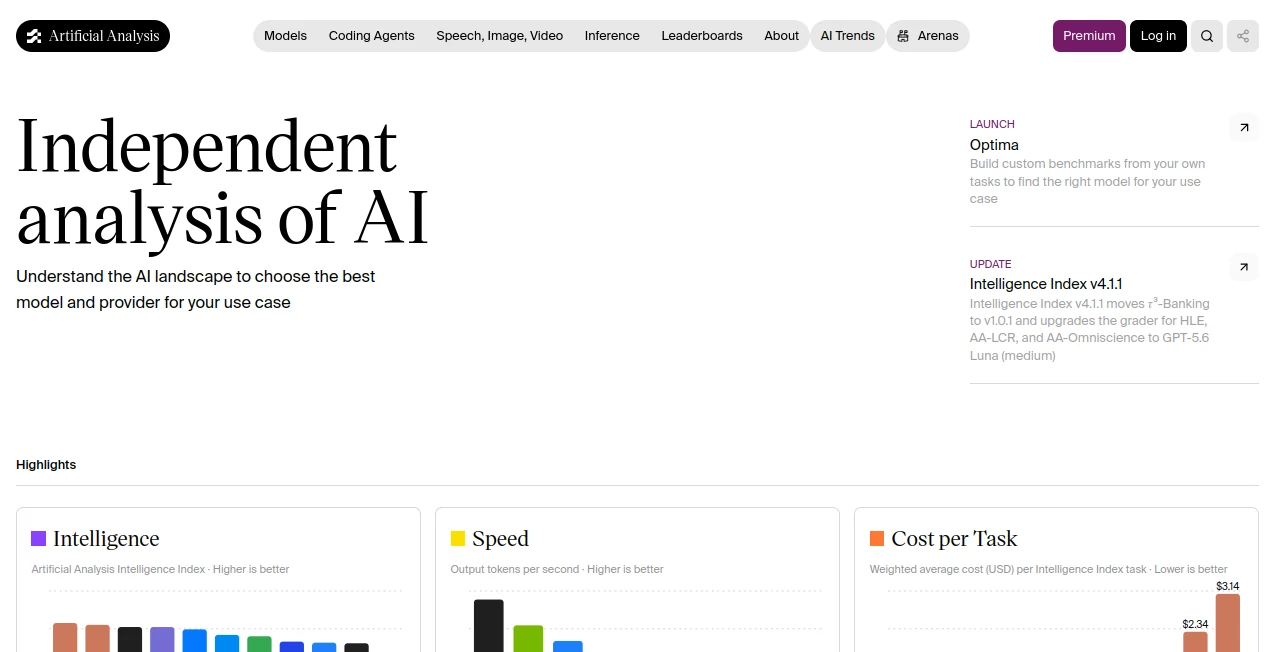
Artificial Analysis is an independent platform built to help people understand the rapidly changing AI landscape and choose models and providers based on measurable performance rather than marketing claims. Instead of simply presenting a list of popular models, the platform brings intelligence, speed, latency, cost, context window, and other technical metrics together in one place.
For developers, AI researchers, businesses, and anyone comparing models before making a technical decision, this approach is particularly useful. A model that produces impressive benchmark scores may not necessarily be the best choice for a production application if it is expensive or slow. Having those factors side by side makes the decision much more practical.
The platform also goes beyond traditional language-model comparisons. Its coverage includes coding agents, image and video models, speech systems, AI providers, benchmarks, and capability-specific evaluations, giving users a broader view of the modern AI ecosystem.
Key Features
- AI model comparisons based on intelligence, cost, speed, latency, and context window.
- Artificial Analysis Intelligence Index for evaluating model intelligence across multiple standardized evaluations.
- Coding Agent Index for comparing end-to-end software engineering performance.
- Image and video leaderboards covering text-to-image, image editing, text-to-video, image-to-video, and video editing.
- Speech evaluations covering text-to-speech, speech-to-text, and speech-to-speech systems.
- Provider comparisons showing differences in pricing and inference performance.
- Capability-specific evaluations covering areas such as coding, tool use, long-context reasoning, business, finance, legal, and healthcare.
- Detailed model pages that allow individual models to be compared with competing systems.
- Custom benchmarking capabilities for evaluating models against tasks that matter to a particular organization or workflow.
User Interface
The interface is designed around comparisons and data visualization rather than unnecessary decoration. Models can be explored through leaderboards, charts, filters, and dedicated comparison views. This makes the platform feel more like a research dashboard than a conventional AI directory.
The layout is especially helpful when comparing several models at once. Users can move between intelligence, price, speed, latency, context size, and other measurements without having to collect the information manually from different provider websites.
Accuracy & Performance
One of the strongest aspects of the platform is its emphasis on standardized evaluation. The Intelligence Index combines multiple evaluations, including GDPval-AA, τ³-Banking, Terminal-Bench, SciCode, Humanity's Last Exam, GPQA Diamond, CritPt, AA-Omniscience, and AA-LCR.
Performance is not limited to a single score. The platform measures factors such as output tokens per second, time to first token, end-to-end response time, token usage, and cost per task. That broader perspective is valuable because real-world AI performance depends on more than benchmark intelligence alone.
For example, a team building a customer-facing application may care more about response speed and operating cost than a small difference in benchmark scores. A research team, on the other hand, may prioritize reasoning quality and long-context performance. The available metrics make those trade-offs easier to see.
Capabilities
The platform covers a remarkably broad portion of the AI model ecosystem. Users can investigate language models, coding agents, image and video systems, speech models, inference providers, and specialized capability indexes.
Its benchmarking section is particularly useful for understanding how models perform in specific areas. Evaluations cover coding, tool use, long-context reasoning, multimodal tasks, instruction following, faithfulness, writing, business, finance, legal work, and medical applications.
Another useful capability is provider analysis. Instead of looking only at the advertised model price, users can examine pricing and inference characteristics across different providers. This can be valuable when selecting an API provider for a production workload where both economics and response speed matter.
Security & Privacy
The service primarily functions as an analytical and benchmarking platform rather than a general-purpose AI assistant where users continuously submit private business documents or personal conversations. Its core value comes from model evaluation, publicly relevant performance data, benchmarks, and provider analysis.
Businesses should still review the platform's current policies and terms before submitting proprietary information to any optional benchmarking or custom evaluation feature. For sensitive workloads, it is sensible to understand exactly what information is transmitted, stored, or processed before running private evaluations.
Use Cases
- AI model selection: Compare competing models before choosing one for an application or internal workflow.
- API cost analysis: Examine model pricing and estimated task costs before committing to a provider.
- Developer research: Investigate coding performance, context windows, latency, and output speed.
- AI procurement: Give technical and business teams a common source of comparative performance data.
- Benchmark research: Explore individual evaluations instead of relying only on an overall leaderboard position.
- Production optimization: Find models that offer a useful balance between intelligence, speed, and operating cost.
- AI market research: Follow the changing competitive landscape across model creators and inference providers.
- Custom evaluations: Build benchmarks around tasks that more closely reflect a company's actual requirements.
Pros and Cons
Pros
- Excellent breadth of AI model and provider data.
- Combines intelligence, speed, latency, cost, and context metrics.
- Useful standardized evaluations rather than relying solely on vendor claims.
- Strong coverage of language, coding, image, video, and speech models.
- Detailed comparisons are valuable for both technical and business decisions.
- Capability-specific benchmarks provide more context than a single overall score.
- Regularly updated as new models and evaluations become available.
Cons
- The amount of information can feel overwhelming for users who are new to AI benchmarking.
- Benchmark results do not automatically predict performance for every individual real-world workload.
- Some advanced metrics require a basic understanding of AI model pricing and inference terminology.
- Rapid changes in the AI market mean rankings can become outdated as new models are released.
Pricing Plans
The public platform provides access to a substantial amount of model comparison and benchmarking information without requiring users to purchase a conventional AI subscription simply to explore the available data.
Its value is primarily in the research and analytical information it provides. For organizations interested in more advanced evaluation workflows, custom benchmarking features can provide a more tailored way to test models against their own requirements. Because product offerings can change as the platform develops, users should check the current service options before making a purchasing decision.
How to Use It
- Open the model comparison area and identify the models you are considering.
- Review intelligence scores alongside cost, output speed, latency, and context window.
- Filter models according to factors such as reasoning capability, open weights, or multimodal support.
- Open an individual model to inspect its detailed performance information.
- Compare the model against alternatives rather than relying on a single leaderboard position.
- Review relevant specialized benchmarks if your project has a particular requirement such as coding, finance, legal work, or long-context reasoning.
- Check provider information when API availability, pricing, or inference speed is important.
- For more specialized projects, consider creating a custom benchmark based on your own tasks.
Comparison with Similar Tools
Many AI comparison websites focus mainly on model rankings or provide a simple list of benchmark scores. This platform takes a broader approach by combining model intelligence with practical operational measurements such as price, output speed, latency, token usage, and context window.
It also stands apart through its coverage of multiple AI categories. A developer researching language models can move into coding-agent evaluations, while someone investigating multimodal systems can explore image and video leaderboards. Speech evaluations and provider analysis add another layer that is not always available in conventional model directories.
The result is particularly useful for users who want to understand the trade-offs behind a model choice. Rather than asking only “Which model is best?”, the platform encourages a more useful question: which model offers the right combination of quality, speed, cost, and capability for this particular job?
Conclusion
For anyone trying to make sense of the increasingly crowded AI model market, this platform offers a practical research environment built around measurable evidence. Its combination of intelligence benchmarks, cost analysis, speed measurements, provider comparisons, and specialized evaluations makes it much more useful than a basic model leaderboard.
The biggest advantage is the ability to evaluate AI systems from several angles at once. A model can be highly intelligent but expensive, inexpensive but slow, or extremely fast while offering weaker performance on demanding tasks. Seeing these differences clearly can save developers and businesses considerable time when choosing technology.
Whether you are selecting an API for a new application, researching the latest frontier models, comparing coding agents, or simply trying to understand where different AI systems stand, this is a strong resource to keep in your research workflow.
Frequently Asked Questions (FAQ)
What is the main purpose of this platform?
Its primary purpose is to provide independent analysis and comparison of AI models and providers using measurements such as intelligence, price, speed, latency, context window, and specialized benchmark performance.
Can I compare different AI models?
Yes. Users can compare models across several dimensions and open individual model pages for more detailed performance information.
What does the Intelligence Index measure?
The Intelligence Index combines results from multiple evaluations designed to measure different aspects of model capability, including reasoning, coding, knowledge, agentic work, and long-context performance.
Does the platform measure AI model speed?
Yes. Output speed is measured in tokens per second, while latency and end-to-end response time provide additional information about how quickly models respond.
Can I compare AI model costs?
Yes. The platform provides token pricing and weighted cost-per-task measurements, helping users understand the economic side of model selection.
Is it useful for developers?
Absolutely. Developers can investigate coding performance, API pricing, context windows, inference speed, model providers, and specialized benchmarks before integrating a model into an application.
Does it cover image, video, and speech models?
Yes. In addition to language models, the platform includes image and video leaderboards as well as speech evaluations covering areas such as text-to-speech and speech-to-text.
Can businesses evaluate models using their own tasks?
Yes. Custom benchmarking capabilities are available for organizations that want to evaluate models against tasks that better represent their own workflows and requirements.
Large Language Models (LLMs) , AI Testing & QA , AI Research Tool , AI Analytics Assistant .
These classifications represent its core capabilities and areas of application. For related tools, explore the linked categories above.
Artificial Analysis details
Website unavailable — View Alternatives
Pricing
- Free
Apps
- Web App
Categories

Artificial Analysis Alternatives Product

IntoTheBlock

Hirescope.te…

Toflow AI

Fina Money

Sound Level …

freellm

CitedSpy

Elicit

JSON to TOON…