















Athena
Verified Blue CheckMark
Verified Blue CheckMark products are featured above free or unverified listings.
This badge indicates authenticity and builds trust, giving your product higher visibility across the platform.
Upgrade to get verified
Verified Blue CheckMark products are featured above free or unverified listings. This badge indicates authenticity and builds trust, giving your product higher visibility across the platform.
Upgrade to get verified
What is Athena?
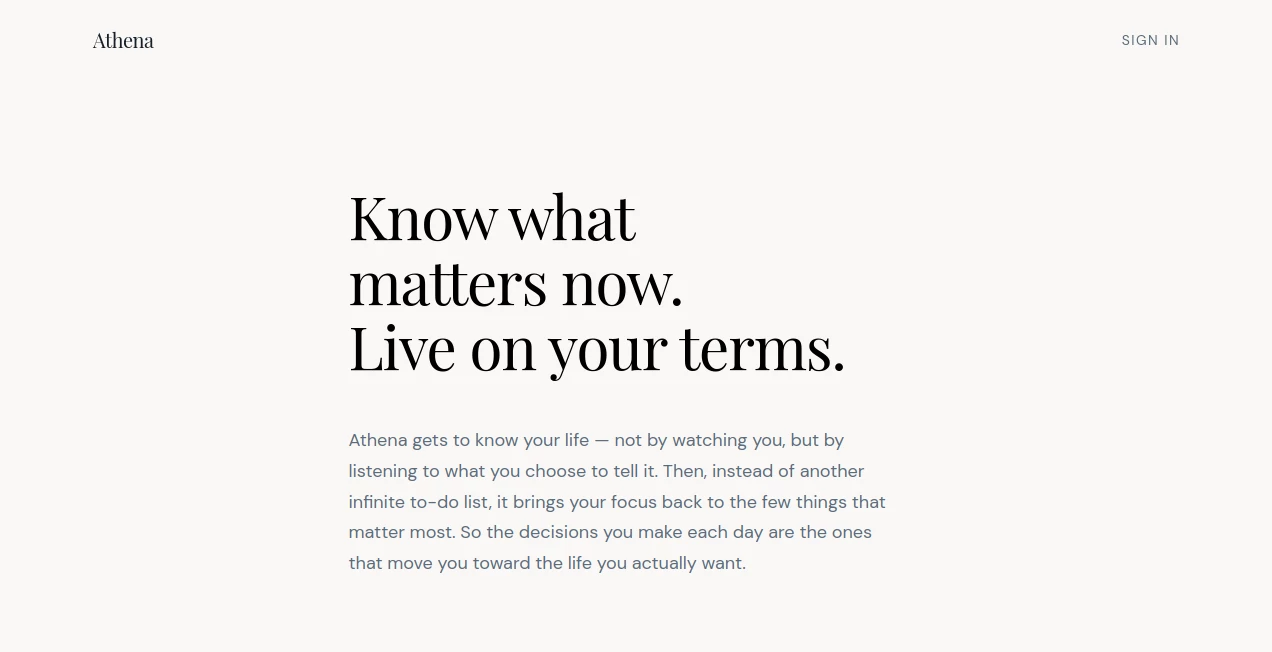
Athena is a personal intelligence assistant designed to help people keep track of what genuinely matters in their lives, rather than simply adding another task list or calendar to an already crowded routine. Its approach is refreshingly simple: instead of trying to monitor everything, it focuses on the priorities, decisions, plans, and unresolved thoughts that the user has deliberately shared.
The idea is particularly useful for people whose days are filled with messages, meetings, projects, and constantly changing priorities. Rather than allowing older commitments to disappear under newer notifications, the assistant brings important threads back into view at the right moment.
One of its most interesting features is the combination of a concise morning briefing and an evening question. The morning briefing highlights what deserves attention, while the evening interaction gives the user a chance to record what actually happened. Over time, this creates a practical record of priorities and progress without requiring the discipline of maintaining a traditional journal.
Key Features
User Interface
The experience is built around simplicity rather than a complicated productivity dashboard. Users can sign in with an email code and interact with their personal information without needing to maintain a large collection of lists or manually organize every detail.
The philosophy behind the interface is important. The system is not intended to overwhelm users with everything it knows. Instead, it attempts to present a smaller amount of information that is relevant to the current moment. For someone who has tried conventional productivity systems and eventually stopped using them because they became another source of work, this approach can feel much more natural.
Accuracy & Performance
The assistant's usefulness comes from how it treats time and context. A priority from several weeks ago should not necessarily receive the same attention as something the user identified yesterday. The system is designed to consider whether an item is still active and whether it deserves to appear in a current briefing.
Another thoughtful design choice is its handling of possible connections. Rather than confidently presenting an assumed relationship between two pieces of information, it can treat the connection as a question for the user. This reduces the risk of an assistant turning a plausible guess into something that looks like a fact.
Capabilities
Athena can act as a lightweight personal memory layer for decisions, plans, important people, rules, and other information that a user wants to remember. The morning briefing can surface neglected priorities, while the evening question creates a small feedback loop between what was important yesterday and what deserves attention tomorrow.
The service also provides an MCP connection for Claude. This allows a user to send selected information from a Claude conversation into the personal memory system. Importantly, the information is proposed for storage rather than being silently added. The user can review the proposed memories and decide which pieces should actually be kept.
This makes the tool useful beyond conventional note-taking. Imagine telling an AI assistant during a long conversation that an upcoming business decision is especially important. Instead of leaving that thought buried inside an old chat, the relevant information can be reviewed and intentionally added to a personal memory system.
Security & Privacy
Privacy is a central part of the product's design. Information sent through the Claude connection is not automatically treated as permanent memory. The user reviews the proposed information before it becomes part of the stored record.
The service also states that it does not read a user's Claude conversations directly. Only information intentionally sent through the connection is received. Users can export their information or delete it, and the service states that stored information is not used to train an AI model.
This limited-access philosophy is one of the more compelling aspects of the product. Instead of giving an assistant unrestricted access to email, calendars, and private conversations, the user remains the primary source of what enters the system.
Use Cases
Athena is well suited to people who have important ideas and commitments scattered across conversations, notes, and their own memory. Entrepreneurs can use it to keep track of decisions and business priorities. Researchers can use it to preserve important conclusions from ongoing work. Professionals managing several projects can use the briefings to bring neglected threads back into focus.
It can also be useful as an alternative to traditional journaling. Rather than sitting down with a blank page every night, the user receives a specific question connected to something that actually matters. A short answer can then become useful context for a future briefing.
For example, if someone decides that completing a quarterly review is their most important objective, the system can bring that priority back into the morning briefing and later ask whether meaningful progress was made. That small loop can be much easier to maintain than writing a lengthy journal entry every evening.
Pros and Cons
Pros:
- Focuses on personal priorities instead of creating another generic task list.
- Morning briefings help bring important but neglected items back into view.
- The evening question makes reflection quick and specific.
- Users have control over what becomes part of their stored memory.
- Claude can be connected through MCP for a more practical memory workflow.
- New users can start with a free account using an email code.
Cons:
- The approach may feel less useful for people who primarily need conventional task management.
- Its value depends on users deliberately sharing the information they want remembered.
- People looking for a full calendar, project-management suite, or traditional note-taking application may need additional tools.
- The concept is intentionally selective, so it is not designed to capture every piece of information automatically.
Pricing Plans
The service is currently available with free access, making it possible to try the core experience without committing to a paid subscription. The sign-up process uses an email code, which keeps the initial setup straightforward.
Because the product is built around personal memory rather than a large collection of conventional productivity features, its value is better judged by using the daily briefing and reflection workflow over time. Someone who quickly forgets priorities or repeatedly loses useful thoughts inside old conversations may find the concept considerably more valuable than a simple notes application.
How to Use Athena
Getting started is straightforward. First, create an account using your email and complete the verification process. Once inside, begin by telling the assistant about things that genuinely matter to you: important decisions, ongoing plans, personal rules, commitments, or priorities that you do not want to lose.
Make a habit of checking the morning briefing before the day's noise takes over. It is designed to help identify what deserves attention rather than simply showing a chronological list of everything that exists.
In the evening, answer the question presented by the assistant. A sentence or two is enough. The point is not to write a polished journal entry. It is to give the system a small amount of useful context that can influence what gets surfaced later.
Users who work with Claude can also connect the service through MCP. When something useful emerges during a Claude conversation, it can be sent for review. The proposed memory can then be accepted or discarded before it becomes part of the personal record.
Comparison with Similar Tools
Traditional task managers are excellent at telling users what they have to do, but they generally depend on the user to keep the task list current. Calendar applications are good at showing where a person needs to be, while note-taking applications are useful for storing information. Journaling tools, meanwhile, provide a place for reflection but usually depend on the user deciding what to write every day.
This product takes a different position. Its central question is not simply what is scheduled or what remains unfinished, but what the user has previously said matters and whether that priority is still receiving attention.
That distinction makes it particularly interesting for people who already have enough productivity software but still feel that important thoughts disappear between conversations, meetings, and busy days.
Conclusion
Athena takes a restrained approach to personal AI. Instead of promising to manage every part of a person's life, it concentrates on something more specific: remembering what the user considers important and bringing that information back when it can actually help.
The morning briefing, evening question, selective memory system, and Claude integration work together around that idea. The result is less like another productivity dashboard and more like a quiet personal layer that helps important decisions and priorities stay visible.
For anyone who has ever written down an important goal, forgotten about it for three weeks, and only remembered it when it was almost too late, this is a genuinely appealing use of AI. Its strongest quality may be its restraint: it does not need to know everything to be useful.
Frequently Asked Questions (FAQ)
What is Athena used for?
It is designed to help users remember important priorities, decisions, plans, and personal information, then surface relevant context through morning briefings and evening questions.
Is it a traditional task manager?
No. Its focus is personal intelligence and memory rather than conventional task management. It is intended to help users understand what deserves attention rather than simply display a list of tasks.
Can it work with Claude?
Yes. It supports an MCP connection that allows users to send selected information from Claude conversations for review and possible storage.
Does it automatically read Claude conversations?
No. The service states that it cannot read conversations directly. Information is received when the user intentionally sends it through the connection.
Do users control what is stored?
Yes. Information sent through the Claude integration is presented as a proposal, allowing the user to review individual pieces before confirming them as memory.
Can stored information be deleted?
Yes. The service states that users can delete their stored information and can also export their data.
Is the service free?
Yes. New users can sign up for free using an email verification code.
Who is it best suited for?
It is particularly interesting for founders, professionals, researchers, and other people who manage many ideas and commitments and want a lightweight way to keep important priorities from disappearing over time.