


















Axis Intel
What is Axis Intel?
Anyone who has booked a trip to an unfamiliar city knows the drill: a dozen browser tabs, a government advisory page that hasn't been updated in months, a Reddit thread full of conflicting opinions, and still no clear sense of whether that neighborhood near your hotel is actually fine to walk through at night. Travel safety information has always existed, it's just been scattered across embassies, news outlets, and crowdsourced forums that don't talk to each other. This platform was built to close that gap by pulling government advisories, crime data, and incident reports into one dashboard, so travelers get a single, consolidated read on where they're headed instead of piecing it together themselves.
Key Features
User Interface
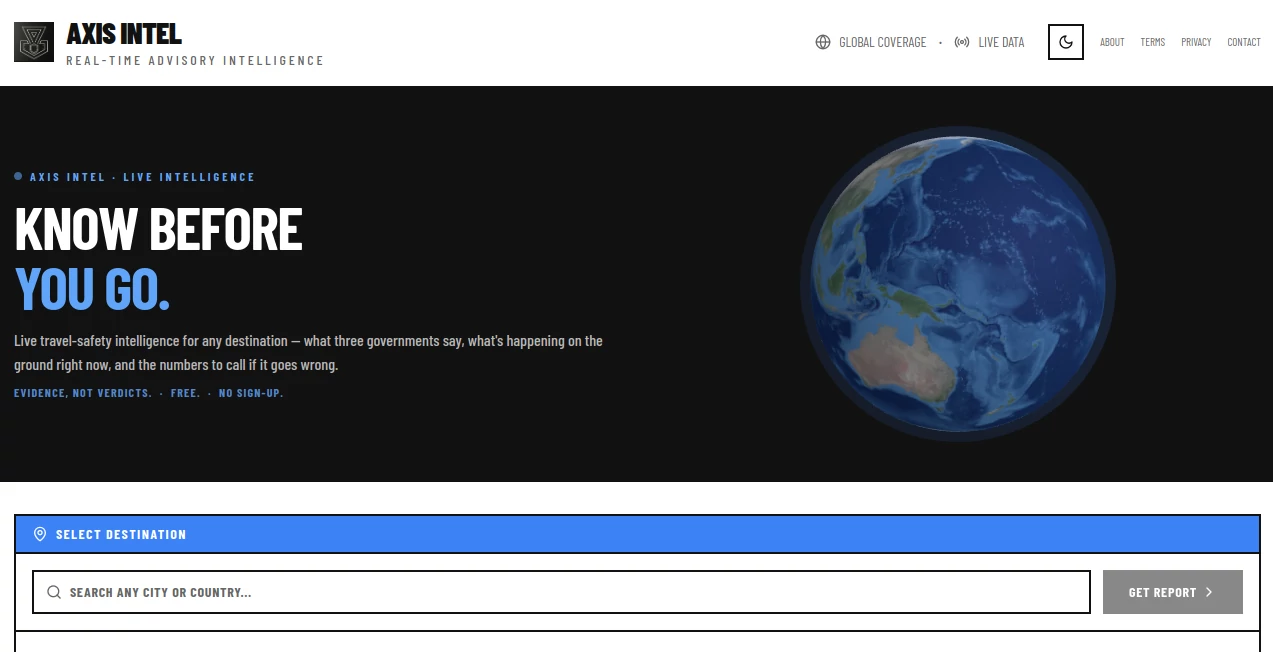
The dashboard is built around destination lookups rather than buried menus. You search a city or country and the interface surfaces the relevant safety profile directly, with sections for advisories, crime metrics, and emergency contacts laid out so you're not hunting for the one number you actually need at 11pm in an unfamiliar airport. It reads more like a safety briefing than a government PDF, which matters when you're trying to make a fast decision before a flight.
Accuracy & Performance
The strength of the system is in its sourcing rather than any single proprietary score. By aggregating advisories from multiple national governments alongside neighborhood-level crime metrics, it avoids the blind spot of relying on just one country's perspective — a risk rating that only reflects, say, U.S. State Department language can miss nuance that a UK or Australian advisory picks up, and vice versa. Updates are framed as continuous, with live incident tracking layered on top of the static advisory data.
Capabilities
Beyond the core risk assessments, the platform includes detailed threat analysis broken down by destination, email alert subscriptions so you're notified when conditions change for a place you've saved, and a verified emergency contact directory — local police, embassies, medical services — pulled together so you're not searching for an international dialing code while something is actually going wrong. Neighborhood-level ratings push the granularity further than most country-wide advisories ever bother to.
Security & Privacy
Account access sits behind standard login and password-reset flows, and a published privacy policy and terms of service are available directly from the platform, which is worth checking before connecting an email for alert subscriptions. As with any service that aggregates third-party government and crime data, it's sensible to treat its output as a strong starting point for situational awareness rather than a replacement for official embassy guidance in genuinely volatile situations.
Use Cases
- A solo traveler checking neighborhood-level crime data before booking accommodation in an unfamiliar city
- A corporate travel manager monitoring advisories for employees on international assignments
- A family planning a trip who wants emergency contact numbers ready before departure, not after
- A frequent business traveler who wants email alerts the moment a destination's risk profile shifts
- A digital nomad comparing safety profiles across several cities before deciding where to base next
Pros and Cons
Pros:
- Combines multiple national government advisories instead of relying on one country's viewpoint
- Neighborhood-level crime metrics go beyond the country-wide generalizations most advisories offer
- Verified emergency contact directory removes the scramble to find local numbers during an actual emergency
- Email alerts mean you don't have to manually recheck a destination's status before every trip
- Single consolidated dashboard instead of a dozen government and news sites
Cons:
- Requires JavaScript and an account to access the full dashboard experience
- Aggregated data is only as current as its underlying government and crime-data sources
- Best treated as a planning aid alongside, not a full substitute for, direct embassy or consular guidance in high-risk situations
Pricing Plans
The platform offers account registration with an upgrade path available directly from the dashboard for travelers who want expanded access to alerts, monitoring, or additional destinations. Exact plan tiers and pricing are best confirmed on the upgrade page within the app, since they're tied to your account region and usage level.
How to Use Axis Intel
- Register for an account or log in if you already have one
- Search for the destination you're traveling to, by city or country
- Review the consolidated advisory summary, crime metrics, and neighborhood-level ratings
- Save emergency contact numbers for that destination before you travel
- Subscribe to email alerts so you're notified if the risk profile changes ahead of your trip
Comparison with Similar Tools
Government travel advisory pages are authoritative but narrow — each one reflects a single country's diplomatic and security assessment, updated on its own schedule, with no crime-level granularity. Crowdsourced travel safety forums go the other direction, offering local color and anecdote but no structured data you can actually trust at a glance. This platform sits between the two: it keeps the structure and credibility of official government sourcing while adding the granularity — neighborhood ratings, live incident tracking, direct emergency contacts — that a single advisory page was never designed to provide.
Conclusion
Travel safety research shouldn't require opening fifteen tabs and cross-referencing three governments' worth of advisories the night before a flight. By pulling that information into one dashboard and adding neighborhood-level detail most advisories skip entirely, this tool turns a tedious research chore into something you can actually check in a few minutes. For anyone who travels internationally with any regularity — solo travelers, families, or corporate travel teams — having that consolidated view, plus emergency contacts ready to go, is the kind of preparation you don't think about until you need it.
Frequently Asked Questions (FAQ)
What kind of data does it pull from?
It aggregates advisories from multiple national governments along with neighborhood-level crime metrics, combined into a single destination profile.
Does it cover specific neighborhoods, not just countries?
Yes, safety ratings go down to the neighborhood level rather than stopping at a country-wide advisory.
Can I get notified if a destination's risk level changes?
Yes, email alert subscriptions are available so you're updated automatically rather than having to recheck manually.
Does it include emergency contact information?
Yes, verified emergency contacts such as local police and embassy numbers are available for destinations covered by the platform.
Do I need an account to use it?
Yes, the full dashboard experience requires registration and login.
AI Life Assistant , AI Research Tool , AI Analytics Assistant , AI Trip Planner .
These classifications represent its core capabilities and areas of application. For related tools, explore the linked categories above.

Axis Intel Alternatives Product

Sellerview.ai

JSON to TOON…

SearchSpot

HelloDay.ai

FeatureShark

Stinglo

AI Dream Ana…

Preuve AI

Greek Numero…
