BillSense
What is BillSense?
BillSense is a free Australian energy comparison tool that helps households find out whether they are paying more than they need to for electricity or gas. Instead of asking users to complete a long comparison form, it takes a different approach: upload a recent bill, let the service read the relevant rates and usage figures, and receive a ranked comparison in around 30 seconds.
The idea is refreshingly practical. Energy plans can be difficult to compare because the cheapest option depends on usage, tariff structure, supply charges, network zone, and other details hidden in an existing bill. A plan that looks inexpensive at first glance may not actually be the best fit for a particular household.
This tool focuses on the numbers that matter. It compares the rates and usage information from a user's bill with current market plans published through the Australian government's energy plan registry, then estimates annual costs based on actual usage. The result is designed to answer a simple question: are you overpaying, and could another plan leave you with a lower annual bill?
Key Features
- Free electricity and gas bill comparison without requiring an account.
- Upload support for PDF, JPG, PNG, and WebP files.
- Manual entry is available for users who prefer not to upload a bill.
- Comparison based on actual usage and tariff information.
- Current plan data sourced from the government's Energy Made Easy registry.
- Plans are matched to the relevant distribution network zone.
- Results are ranked by estimated annual cost rather than simply by retailer commission.
- Support for electricity and gas comparisons.
- Filters for solar, concession, green energy, and business ABN plans.
- Solar feed-in credits can be included when calculating estimated costs.
- Stale plans can be flagged or excluded based on data freshness.
- Near-duplicate plans from the same supplier can be consolidated.
- No sales calls or mandatory email registration.
User Interface
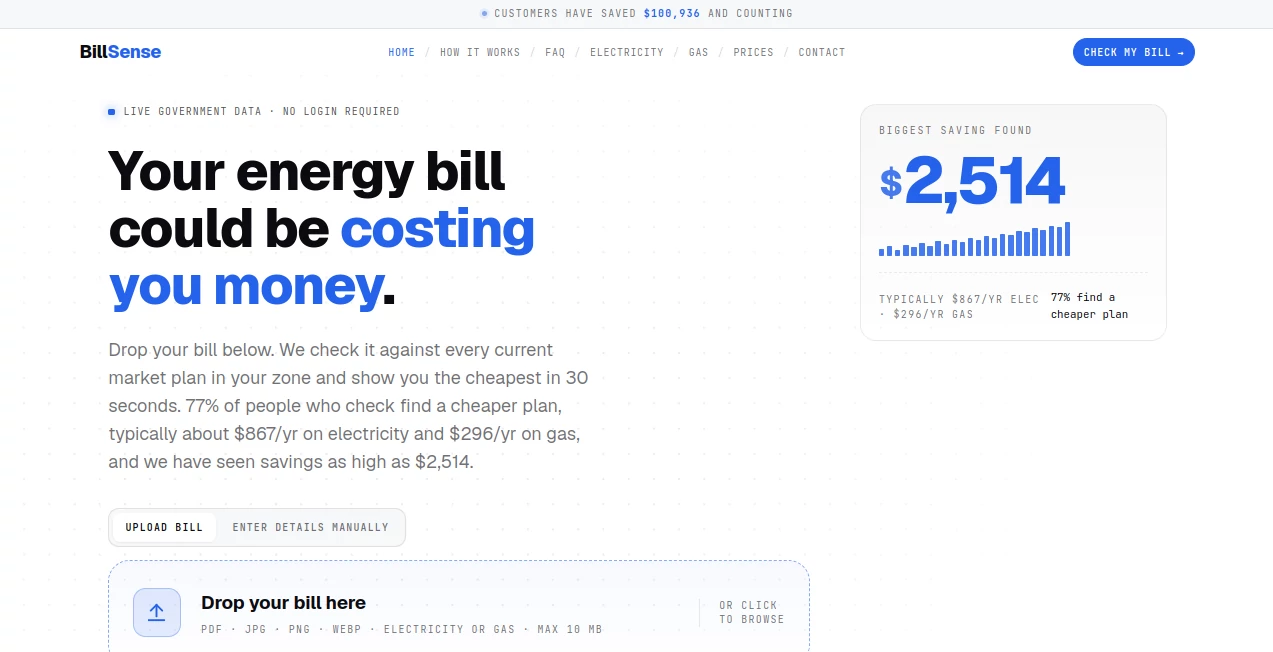
The interface is built around a single action: provide your latest energy bill. Users can drag and drop a document or image directly into the upload area, while manual entry provides another route for people who do not want to upload a file.
This simplicity makes sense for the problem being solved. Someone checking an electricity bill usually does not want to spend twenty minutes entering tariff information into a comparison form. A short upload-first workflow gets the process moving quickly and keeps the experience focused on the result.
Accuracy & Performance
The comparison is more useful than a generic estimate because it uses information from the user's actual bill. The system extracts details such as the retailer, fuel type, usage, tariff rates, supply charge, billing period, and network zone.
It then applies the user's usage to eligible plans in the relevant zone and ranks them according to estimated annual cost. This is particularly important in Australia, where electricity pricing can vary between distribution networks and where tariff structures can make simple price-per-kWh comparisons misleading.
The service also accounts for factors such as solar exports and plan freshness. Users should still check the final Energy Price Fact Sheet before switching, since retailer offers and prices can change.
Capabilities
The service supports both electricity and gas bills. Electricity comparisons are available across major supported markets including New South Wales, Victoria, Queensland, South Australia, and the Australian Capital Territory, with more limited coverage in Western Australia and Tasmania. Northern Territory electricity plans are currently not supported.
For gas, comparisons are available across Victoria, New South Wales, South Australia, the Australian Capital Territory, and Queensland. Coverage can vary by location because the underlying government registry does not contain the same level of plan data everywhere.
For households with solar panels, the solar filter can help surface plans where feed-in credits affect the overall cost. There are also options for concession, green-energy, and business-related comparisons, making the tool useful beyond a basic residential electricity check.
Security & Privacy
Privacy is one of the strongest parts of the experience. The service is designed to extract the numbers needed for comparison without requiring users to create an account or provide unnecessary personal information.
According to its privacy information, the system focuses on details such as the energy retailer, fuel type, usage, tariff rates, supply charge, billing period, state, and distribution zone. It deliberately avoids collecting information such as the user's name, street address, and account number for the comparison process.
The uploaded bill is processed in memory and the original file is not stored. There is also no requirement to join an email marketing list simply to receive a comparison. For users who are cautious about uploading household bills, this limited-data approach is a meaningful advantage.
Use Cases
One of the most obvious use cases is checking an electricity bill after receiving a surprisingly high quarterly charge. Instead of assuming the increase is unavoidable, a household can upload the bill and see how its current rates compare with available alternatives.
It can also be useful when a contract is approaching its end. Comparing the existing annual cost with current market plans can give the customer a clearer idea of whether staying with the same retailer still makes financial sense.
Solar households can use the comparison when looking for plans where feed-in credits make a meaningful difference. Likewise, people using time-of-use tariffs can benefit from a comparison that considers the different rates shown on their bill rather than relying on a single headline electricity price.
Small businesses and households with concession eligibility can also use the relevant filters to narrow the results to plans that match their circumstances.
Pros and Cons
- Pros: Free to use, no account required, quick comparison process, supports electricity and gas, uses live government plan data, considers actual usage, matches plans to network zones, and takes a privacy-focused approach.
- Pros: Results are ranked by estimated annual cost, while solar, concession, green-energy, and business filters make the comparison more flexible.
- Cons: Coverage is not equally comprehensive across every Australian state and territory.
- Cons: Results are estimates based on available plan data and the user's usage, so final retailer pricing should always be confirmed before switching.
- Cons: People using unusual plans or arrangements may need to review the retailer's terms and conditions carefully before making a change.
Pricing Plans
The service is free for users. There is no account fee, subscription, credit card requirement, or payment needed to run a bill comparison.
The business may receive a referral fee from some energy retailers when a customer switches through a retailer connection. However, the service states that referral payments do not determine the ranking of results. Plans are intended to be ordered according to estimated annual cost rather than according to which retailer pays the highest referral fee.
How to Use It
Start by preparing a recent electricity or gas bill. A PDF is recommended, although common image formats such as JPG, PNG, and WebP are also accepted.
Upload the bill through the comparison page. The system reads the relevant rates, usage information, fuel type, and network details needed for the calculation. It deliberately avoids using unnecessary identity information.
After the bill is analysed, the available plans are compared against the usage shown on the bill. The results are then ranked according to estimated annual cost, putting the lower-cost options toward the top.
Use the available filters if you have solar, a concession card, an interest in green energy, or a business ABN. When you find a suitable plan, you can follow the retailer's switching process directly. Before committing, check the final plan details and Energy Price Fact Sheet, particularly if your existing contract includes an exit fee.
Comparison with Similar Tools
Traditional energy comparison websites often ask users to enter their postcode, household information, consumption figures, tariff details, and contact information before showing results. That approach can work, but it places much of the responsibility for entering accurate information on the customer.
This service takes a more bill-focused route. Rather than starting with a blank form, it uses an existing bill as the source of the comparison data. That makes the process particularly appealing to someone who already has a recent statement available and simply wants to know whether a better deal exists.
Another notable difference is the emphasis on ranking by estimated annual cost. The comparison methodology is designed around the customer's usage and network zone, rather than presenting a generic list of attractive-looking plans.
It is still worth comparing the final offer directly with the retailer's published terms. Energy contracts can include conditions, introductory periods, exit fees, or eligibility requirements that deserve attention before switching.
Conclusion
For Australian households trying to make sense of an electricity or gas bill, this is a useful shortcut. The strongest part of the experience is its focus on the bill itself: upload the document, extract the important numbers, compare them with current plans, and see whether switching could reduce the annual cost.
The combination of a fast workflow, government-sourced plan information, network-level matching, and a privacy-conscious approach makes it particularly attractive for people who dislike lengthy comparison forms or sales-oriented experiences.
It is not a replacement for checking the final retailer offer, but it can make the first and often most frustrating part of the process much easier: finding out whether your current energy plan is actually competitive.
Frequently Asked Questions (FAQ)
Is the energy comparison free?
Yes. The comparison is free to use and does not require an account, subscription, credit card, or mandatory email registration.
Can I compare both electricity and gas?
Yes. Electricity and gas bills can both be compared, although available plan coverage depends on the state or territory and the underlying government registry.
Does the comparison use my actual energy usage?
Yes. The service reads usage and tariff information from the bill and applies those figures when estimating annual costs across eligible plans.
Is my uploaded bill stored?
The service states that the original uploaded file is processed in memory and is not stored. It also deliberately avoids collecting information such as your name, street address, and account number for the comparison.
Can I compare solar energy plans?
Yes. A solar filter is available, and feed-in credits can be included when estimating the annual cost of eligible plans.
Does the cheapest result always mean I should switch?
Not necessarily. The comparison provides an estimate based on your usage and available plan information. Before switching, review the retailer's final offer, eligibility requirements, contract conditions, introductory rates, and any applicable exit fees.
Other .
These classifications represent its core capabilities and areas of application. For related tools, explore the linked categories above.

BillSense Alternatives Product

Hugging Face

Devil Hunter…

Judgement Ta…

EZ Grader

grow a garde…

forge calcul…

Flyback.ai

Suno top

PetShard