
BioReason-Pro
What is BioReason-Pro?
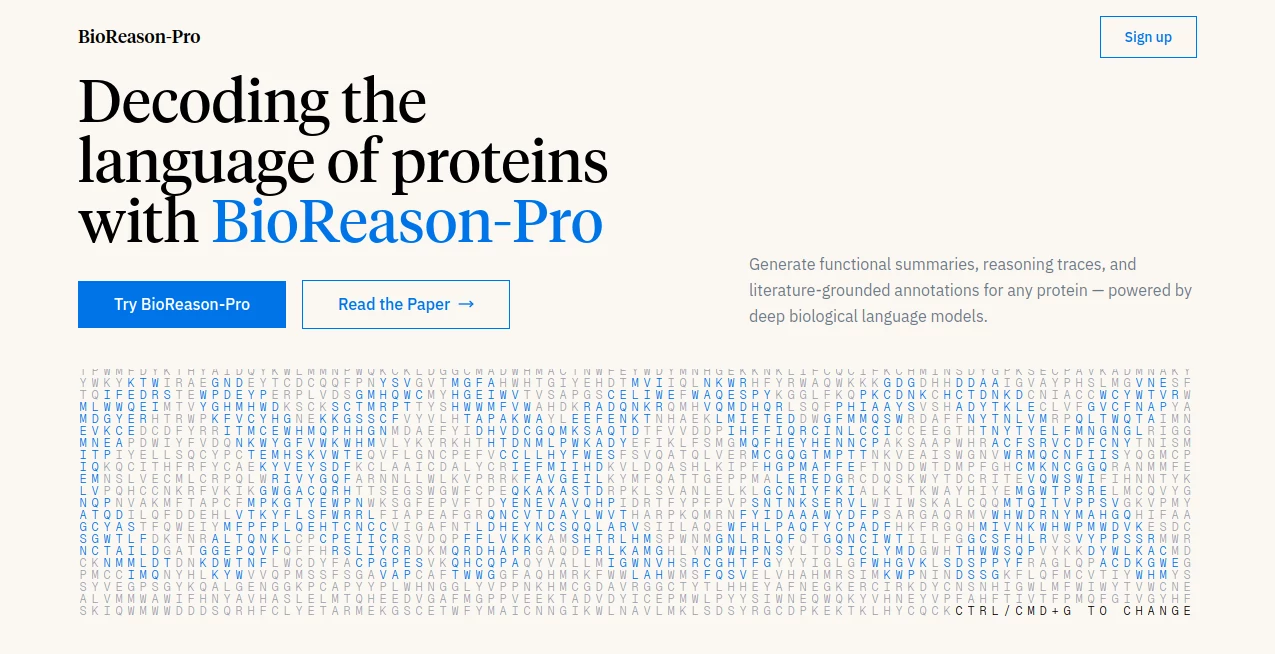
BioReason-Pro is a multimodal biological reasoning model designed to help researchers make sense of complex protein information and connect biological evidence into a clearer line of reasoning. Rather than treating a protein sequence as isolated text, the system combines biological representations with language-based reasoning to produce explanations that are easier to inspect and discuss.
The project builds on earlier work that connected DNA foundation models with large language models. Its newer protein-focused approach combines ESM3 embeddings with Qwen3 and reinforcement learning, giving the model a way to work with protein-level information while producing detailed biological interpretations.
For researchers dealing with protein function, molecular biology, or computational biology, this is an interesting direction because the goal is not simply to return a label. The model is designed to connect sequence evidence with biological context and explain how it reaches its conclusions.
Key Features
- Multimodal reasoning across protein and biological information.
- Integration of ESM3 protein representations with a reasoning-oriented language model.
- Expert-level protein function annotation capabilities.
- Step-by-step biological reasoning traces for examining model conclusions.
- Ability to reason about biological entities beyond those encountered directly during training.
- Research-oriented architecture built around supervised fine-tuning and reinforcement learning.
- Publicly available research resources, including code and model-related materials.
User Interface
The public website takes a research-demo approach rather than trying to imitate a conventional productivity application. It presents representative biological queries and generated outputs so visitors can examine how the model handles different inputs.
One particularly useful part is the reasoning-trace presentation. Instead of hiding the result behind a single prediction, the interface gives researchers a way to inspect the biological argument produced by the model. That makes the experience feel closer to exploring a research hypothesis than simply asking a chatbot a question.
Accuracy & Performance
The underlying research reports substantial improvements on biological reasoning benchmarks. Earlier evaluations showed strong gains in disease pathway prediction and variant-effect prediction compared with single-modality approaches. The research also reports an average improvement of around 15% over strong baseline systems on variant-effect prediction tasks.
The protein-focused work takes this idea further by targeting protein function prediction. Reported evaluations indicate that the system can generate protein annotations that researchers may find preferable to existing database entries in a significant majority of tested cases.
These figures should be viewed as research results rather than a guarantee for every biological question. Protein biology is highly context-dependent, and model-generated conclusions still need to be checked against experimental evidence, established databases, and domain expertise.
Capabilities
The strongest aspect of the system is its ability to combine several layers of biological evidence. Protein sequences can contain information about domains, conserved regions, structural characteristics, and potential molecular roles, but interpreting those signals together is difficult even for experienced researchers.
The model is designed to turn these signals into a more understandable biological narrative. For example, a sequence may contain patterns associated with a particular protein family. The system can use that evidence to discuss possible molecular functions, cellular roles, interacting partners, or biological processes that fit the observed characteristics.
This reasoning-oriented approach is especially useful when the researcher wants more than a classification label. It can help formulate hypotheses that can later be investigated through literature searches, computational experiments, or laboratory work.
Security & Privacy
The available public research material focuses primarily on the model architecture, biological reasoning capabilities, benchmarks, and demonstration outputs rather than presenting a detailed enterprise privacy policy. Researchers should therefore review the current deployment terms and data-handling practices before submitting proprietary sequences, unpublished research data, or other sensitive biological information.
For scientific work, it is also sensible to distinguish between exploring a public demonstration and processing confidential research material. The latter should only be done after the applicable data policies and deployment arrangements have been verified.
Use Cases
The technology is particularly relevant to researchers and teams working with computational biology and protein science.
- Protein function annotation: Generate informed hypotheses about the likely role of previously characterized or less familiar proteins.
- Biological research: Explore connections between sequence-level evidence and broader biological processes.
- Variant analysis: Support investigation of how genetic changes may influence biological function.
- Disease pathway research: Examine relationships between biological entities and disease-associated pathways.
- Hypothesis generation: Turn complex model outputs into potential research questions that can be experimentally tested.
- Scientific education: Give students and early-career researchers an example of how modern biological foundation models can be combined with language reasoning.
- Computational protein studies: Assist researchers who need to interpret large volumes of protein-related information.
Pros and Cons
- Pros: Strong focus on biological reasoning rather than simple text generation.
- Pros: Combines protein foundation-model representations with language-based reasoning.
- Pros: Provides interpretable reasoning traces that make outputs easier to inspect.
- Pros: Research results demonstrate meaningful improvements over several baseline approaches.
- Pros: Useful for generating biological hypotheses and exploring protein function.
- Cons: It is primarily a research-oriented system rather than a general-purpose AI assistant.
- Cons: Model-generated biological explanations should not be treated as experimental proof.
- Cons: Users working with confidential biological data should verify deployment and privacy conditions before uploading information.
Pricing Plans
No conventional commercial pricing plans are prominently presented in the public research materials. The project is presented as an open research effort, with its code, datasets, and model-related resources made publicly available for research use.
That makes it particularly appealing to researchers who want to investigate the underlying approach without approaching it as a conventional subscription-based SaaS product. Availability of specific hosted services, model checkpoints, or future commercial offerings may change over time, so researchers should check the current project documentation before planning a production workflow.
How to Use It
- Open the public demonstration and review the available biological examples.
- Select a representative protein or biological query relevant to the research question.
- Provide the required biological input supported by the demonstration.
- Review the generated interpretation and biological reasoning trace.
- Compare the suggested function or explanation with trusted scientific resources and existing annotations.
- Use promising findings as hypotheses for additional computational or experimental investigation.
A practical workflow is to treat the generated answer as a research starting point rather than the final answer. For example, if the model suggests a previously overlooked protein function, a researcher could compare that suggestion against sequence databases, structural information, published literature, and laboratory results before drawing a conclusion.
Comparison with Similar Tools
Traditional protein annotation systems are often excellent at matching sequences against known databases, identifying conserved domains, or assigning established functional labels. Their strength is consistency and access to curated biological knowledge. However, they may provide limited narrative reasoning about why several pieces of evidence point toward a particular conclusion.
General-purpose language models have the opposite advantage. They are comfortable explaining scientific concepts and connecting information expressed in natural language, but they do not inherently understand protein sequences in the same way that specialized biological foundation models do.
This approach sits between those two worlds. It combines specialized biological representations with language-model reasoning, aiming to preserve meaningful sequence information while making the resulting interpretation more accessible to humans. That distinction is what makes it especially interesting for researchers looking beyond conventional annotation pipelines.
Conclusion
BioReason-Pro represents an ambitious step toward AI systems that can reason about biology instead of merely predicting biological labels. Its combination of protein foundation-model embeddings, language reasoning, and reinforcement learning gives researchers a different way to investigate protein function and biological relationships.
The most compelling part is the emphasis on explanations. In scientific research, knowing that a model predicts something is useful, but understanding the evidence behind that prediction can be even more valuable. The reasoning traces make it easier to examine a proposed biological explanation, question weak assumptions, and decide which ideas deserve further investigation.
It is not a replacement for experimental biology or expert review. Used appropriately, however, it can serve as a powerful research companion for exploring complex protein questions, generating hypotheses, and making large-scale biological information easier to reason about.
Frequently Asked Questions (FAQ)
What is BioReason-Pro used for?
It is designed for multimodal biological reasoning, with a particular focus on protein function prediction and interpretation. Researchers can use it to explore protein-related questions and generate hypotheses from biological evidence.
Can it explain its biological predictions?
Yes. A central feature of the system is its reasoning trace, which presents a step-by-step biological interpretation of how the model arrives at a conclusion.
Is it suitable for protein research?
Yes. Protein function prediction is one of its primary research applications, making it particularly relevant to computational biologists, molecular researchers, and teams studying protein sequences and biological mechanisms.
Can its predictions be trusted as scientific evidence?
They should be treated as model-generated hypotheses rather than definitive scientific evidence. Important findings should be validated using established databases, scientific literature, expert review, and experimental methods where appropriate.
Is the underlying research publicly available?
Yes. The associated research project provides public access to code, datasets, and model-related resources, allowing researchers to investigate and reproduce aspects of the work.
What makes this approach different from a general AI chatbot?
The system is built around biological foundation-model representations rather than treating biology purely as natural-language text. This gives it access to specialized sequence-level information that a general conversational model does not inherently possess.
Who can benefit from it?
Computational biologists, protein researchers, bioinformatics teams, academic laboratories, and students studying modern AI-for-biology methods can all find value in exploring its capabilities.
Can it replace laboratory experiments?
No. Its role is better understood as computational support for research and hypothesis generation. Experimental validation remains essential when a prediction has meaningful scientific or clinical implications.
Github Repos , AI Research Tool , Large Language Models (LLMs) .
These classifications represent its core capabilities and areas of application. For related tools, explore the linked categories above.
BioReason-Pro details
Website unavailable — View Alternatives
Pricing
- Freemium
Apps
- Web App
Categories

BioReason-Pro Alternatives Product

Chrome Sidek…

Flyback.ai

Lensgo

UseWok

freellm

CoolVerdict

AI Podcast I…

Website Traf…

GPTZero