
CompetitorTrack
What is CompetitorTrack?
CompetitorTrack is a competitive intelligence platform built for teams that want a clearer view of what competitors are doing across marketing and customer-facing channels. Instead of relying on forwarded newsletters, screenshots, scattered notes, or occasional manual checks, the platform brings competitor emails and related market signals into a shared workspace.
The core idea is straightforward: create a dedicated tracking address for a competitor, subscribe it to public newsletters and campaigns, and let the system build a searchable record of what arrives. From there, teams can look beyond individual emails and connect campaign activity with website changes, social activity, reviews, and AI visibility.
This approach can be particularly useful for product marketers, revenue teams, founders, and competitive research teams. A pricing change, new offer, or sudden increase in email frequency is much more meaningful when you can see the surrounding evidence rather than treating it as an isolated event.
Key Features
- Competitor email monitoring: Capture public marketing emails, newsletters, product updates, launch campaigns, and promotional messages in a dedicated inbox.
- Searchable campaign history: Review subject lines, send dates, message content, offers, and previous campaigns without rebuilding the history manually.
- Website monitoring: Keep track of important changes to competitor websites, including pricing, product, positioning, and campaign pages.
- Social monitoring: View supported social activity alongside other competitor signals.
- Review monitoring: Follow changes in customer feedback and review activity across supported sources.
- AI Visibility: Compare how AI systems describe your company and competitors and review historical visibility information on eligible plans.
- AI-powered briefings: Get concise summaries of noteworthy changes while retaining access to the underlying evidence.
- Shared workspace: Give marketing, product, revenue, and enablement teams a common place to review competitive information.
- Focused alerts and signals: Identify changes such as new offers, shifts in messaging, increased campaign cadence, and review sentiment movement.
User Interface
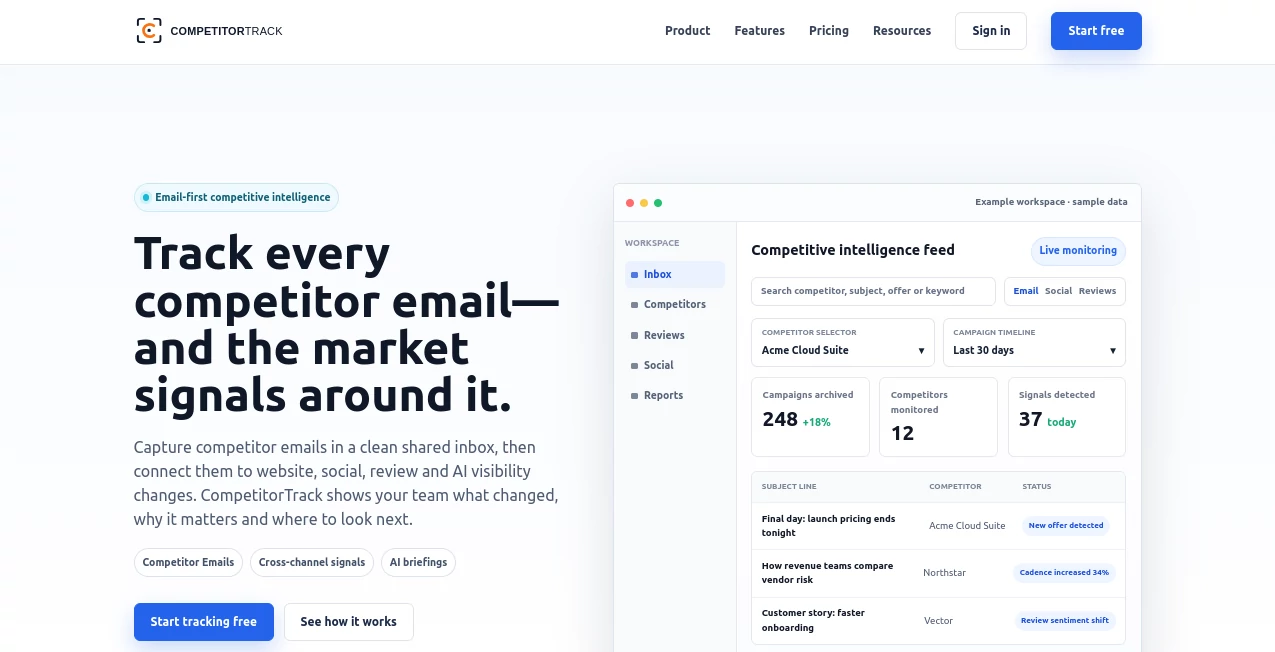
The interface is organized around a competitive intelligence workspace rather than a conventional email inbox. Competitors, emails, reviews, social activity, reports, and other signals can be accessed from the same environment.
The competitive intelligence feed makes it possible to search by competitor, subject, offer, or keyword. Campaign timelines and filters help narrow the view when a team is researching a particular launch or market movement.
A useful detail is the separation between captured competitor campaigns and personal email. Dedicated tracking addresses keep competitor subscriptions away from employees' everyday inboxes, which makes the resulting archive considerably easier to manage.
Accuracy & Performance
The platform is designed around evidence rather than simply producing a high-level summary. Captured messages retain information such as subject lines, dates, campaign history, and message content, allowing teams to investigate why a particular signal appeared.
Its broader monitoring workflow also helps put individual events into context. For example, an increase in promotional emails may become more significant when it occurs alongside a pricing-page update or changes in customer reviews.
As with any monitoring system, coverage depends on the public sources being tracked and the tracking addresses being properly subscribed. The service is most effective when competitors' public newsletters, product updates, and other available campaigns are consistently monitored.
Capabilities
The strongest capability is the combination of email monitoring with other competitive signals. A team can preserve competitor campaigns over time instead of checking an inbox only when someone remembers to do so.
The platform can also highlight patterns such as changes in newsletter cadence, new promotional language, pricing-related messaging, product announcements, and shifts in customer sentiment. AI-generated briefings add another layer by summarizing noteworthy activity while keeping the supporting evidence available for review.
This makes it suitable for both quick checks and longer-term competitive research. A marketer preparing for a product launch, for instance, can look back through months of competitor messaging rather than relying on memory.
Security & Privacy
The monitoring workflow is based on public marketing communications and opt-in campaign subscriptions rather than access to private competitor systems. Dedicated tracking addresses are used to keep competitive research separate from personal employee accounts.
It is important to understand that dedicated tracking addresses should not be considered completely anonymous. When an address subscribes to a competitor's public campaign, the competitor may be able to see that address in its subscriber records. Teams should therefore use the service for legitimate competitive research and avoid attempting to access private or protected information.
Use Cases
Marketing teams: Follow competitor newsletters, promotional campaigns, subject-line changes, offers, and messaging patterns to understand how other companies communicate with the market.
Product marketers: Monitor product announcements, positioning changes, pricing updates, and campaign launches. Historical records make it easier to understand how a competitor's message has evolved.
Revenue teams: Keep an eye on competitor offers and market activity before sales conversations. Having actual campaign evidence can be more useful than relying on second-hand information.
Founders and executives: Get a concise view of meaningful market movements without manually visiting every competitor website and social account.
Competitive intelligence teams: Build a repeatable monitoring process where competitor emails, websites, reviews, and social signals can be reviewed together.
E-commerce and SaaS businesses: Track promotional campaigns, launches, pricing messages, newsletters, and customer feedback to spot changes that may influence purchasing decisions.
Pros and Cons
- Pros: Dedicated competitor tracking addresses reduce inbox clutter.
- Pros: Competitor campaigns remain searchable instead of disappearing into email threads.
- Pros: Email, website, social, review, and AI visibility signals can be viewed together.
- Pros: AI briefings help teams quickly identify changes worth investigating.
- Pros: Shared workspace features make competitive research easier to distribute across teams.
- Cons: Monitoring depends on public campaigns and supported sources being available.
- Cons: Competitor email tracking requires setting up dedicated addresses and subscribing them to campaigns.
- Cons: Teams with a very large competitor portfolio may need a higher-tier plan.
Pricing Plans
The service provides a free way to get started and currently advertises a full-access trial without requiring a credit card. The website states that users can begin by tracking one competitor and continue with free coverage after the trial, while broader monitoring is available through paid options.
The pricing information currently presented on the website includes a Pro option at $29 per month for tracking up to five competitors, with features such as full email history and AI Visibility recommendations. Custom plans are also available for organizations that need higher competitor limits, shared competitive workspaces, and broader market visibility.
Because competitive monitoring needs vary considerably between a solo founder and a larger revenue or marketing team, starting with a small number of competitors is a sensible way to determine whether the workflow provides enough value before expanding coverage.
How to Use the Platform
- Create an account and begin with the available free trial or free tracking option.
- Add the competitors you want to monitor.
- Create a dedicated tracking address for each competitor.
- Subscribe the relevant addresses to public newsletters, product updates, launch emails, and lifecycle campaigns.
- Allow incoming campaigns to build a searchable history.
- Use filters and search to examine subjects, offers, dates, and campaign patterns.
- Review website, social, and customer-review signals alongside email activity.
- Use AI briefings to identify important changes, then open the underlying evidence before making a decision.
Comparison with Similar Tools
Traditional competitor research often involves manually subscribing to newsletters, checking websites, taking screenshots, saving links, and maintaining spreadsheets. That method can work for one or two competitors, but it becomes increasingly difficult to maintain as the research portfolio grows.
Dedicated email-monitoring services may provide a stronger focus on campaign collection, while website-change tools concentrate primarily on page updates. Social listening platforms, meanwhile, are generally designed around social conversations and activity.
The advantage of this platform is its broader workflow. Competitor email campaigns form the foundation, while website changes, reviews, social activity, and AI visibility can provide additional context. For teams that want several competitive signals connected to the same competitor record, this can be more practical than maintaining several disconnected research systems.
Conclusion
Competitive research becomes far more useful when it creates a reliable record rather than a collection of occasional observations. This platform addresses that problem by turning competitor campaigns and related market activity into an organized workspace that teams can search, review, and discuss.
Its email-first approach is particularly appealing for marketers who want to understand not only what competitors are selling, but how they communicate, how frequently they communicate, and how that messaging changes over time. The addition of website, social, review, and AI visibility signals makes the picture more complete.
For a team that currently relies on forwarded newsletters, browser bookmarks, screenshots, and spreadsheets, moving to a structured monitoring workflow could save considerable manual effort while making competitive discussions more evidence-driven.
Frequently Asked Questions (FAQ)
What is competitor tracking software?
Competitor tracking software collects publicly available competitor activity and organizes it over time so teams can identify changes in messaging, pricing, campaigns, products, reviews, and other market signals.
How are competitor emails captured?
A dedicated tracking address is created for a competitor and subscribed to its public newsletters or campaigns. New messages can then be collected and organized in the shared workspace.
What types of competitor activity can be monitored?
The platform focuses on marketing emails and also supports website, social, review, and AI visibility signals. This allows teams to investigate a campaign alongside related changes elsewhere in the market.
Can competitors know that they are being monitored?
A dedicated tracking address keeps the activity separate from personal accounts, but it should not be considered anonymous. A competitor may be able to see the address that subscribed to its public campaigns.
How quickly can monitoring begin?
A tracking address can be created immediately. Campaigns begin appearing after the address has been subscribed to a competitor's public communications and the competitor sends a new campaign.
Can multiple competitors be tracked?
Yes. The service allows teams to begin with a small number of competitors and expand coverage through paid plans when broader monitoring is required.
Is there a free option?
Yes. The website currently offers a way to start tracking for free, along with a full-access trial period. Paid plans are available when additional competitor coverage and features are needed.
Who can benefit most from this type of platform?
Marketing teams, product marketers, revenue teams, founders, sales enablement professionals, and competitive intelligence researchers can all benefit from having competitor activity organized in one searchable workspace.
What makes this different from a normal shared inbox?
A normal shared inbox primarily stores messages. This platform organizes campaigns around competitors and connects email activity with other market signals, reports, AI analysis, and supporting evidence.
Can AI-generated summaries be trusted on their own?
AI briefings are designed to help teams find noteworthy changes faster, but the underlying evidence remains important. For important business decisions, reviewing the original campaign or signal alongside the summary is the better approach.
AI Marketing Plan Generator , AI Research Tool , AI Analytics Assistant , AI Email Marketing .
These classifications represent its core capabilities and areas of application. For related tools, explore the linked categories above.
CompetitorTrack details
Website unavailable — View Alternatives
Pricing
- Free
Apps
- Web App
Categories

CompetitorTrack Alternatives Product

zGEO Ranker

CoinIQ

Picmim

Techvorizon …

Lutains

MacroMicro

JSON to TOON…
EntreDash

WhatsMyName …