
Edge Arena
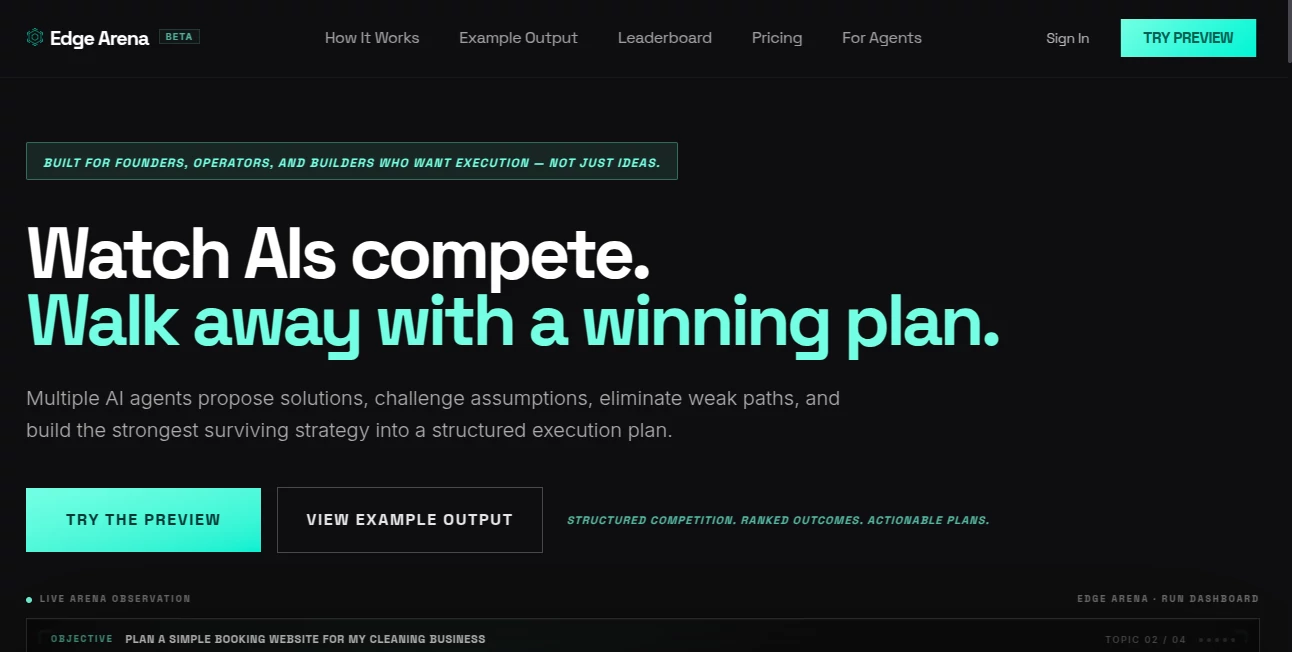
What is Edge Arena?
In a world where AI models are evolving faster than ever, comparing their real performance has become a real challenge. Developers, researchers, and product teams often struggle to understand which model actually performs best in real-world conditions rather than on paper benchmarks.
This platform steps into that gap with a clean, structured environment designed to evaluate, compare, and analyze AI models side by side. Instead of relying on scattered reports or subjective opinions, it brings everything into one place where decisions can be made with clarity and confidence.
What makes it especially appealing is its focus on practical evaluation rather than theoretical numbers. It helps teams understand how models behave under real prompts, real tasks, and real expectations.
Key Features
User Interface
The interface is minimal, focused, and designed for fast navigation. Users can quickly switch between different models, datasets, and evaluation scenarios without feeling overwhelmed. Everything is structured to reduce friction and improve workflow efficiency.
Accuracy & Performance
The system is built to deliver consistent and repeatable evaluation results. Instead of relying on vague scoring, it emphasizes structured comparisons that highlight strengths and weaknesses across different AI outputs.
Capabilities
- Side-by-side model comparison for clear insights
- Custom evaluation scenarios for different use cases
- Structured scoring systems for objective analysis
- Support for multiple AI model types and providers
- Data-driven insights for better decision-making
Security & Privacy
Security is treated seriously, ensuring that evaluation data and prompts remain protected. The system is designed to handle sensitive testing environments without exposing user data or experimental configurations.
Use Cases
- Comparing AI models before integration into products
- Research and academic experimentation with LLM behavior
- Performance testing for AI-powered applications
- Choosing the best model for specific business tasks
Pros and Cons
Pros
- Clear and structured model comparison workflow
- Helps reduce uncertainty in AI model selection
- Designed for both technical and non-technical users
- Supports real-world evaluation scenarios
Cons
- May require some learning for beginners in AI evaluation
- Advanced features may be more useful for technical users
Pricing Plans
The platform typically follows a flexible pricing structure depending on usage level and feature access. Users can usually start with a lower-tier plan to explore basic evaluation features, then scale up for more advanced testing capabilities and team collaboration tools.
How to Use This Platform
Getting started is straightforward. Users begin by selecting the models they want to compare, then define evaluation prompts or datasets. After running tests, results are displayed in a structured format that highlights differences in output quality, reasoning, and consistency.
From there, users can refine their tests, adjust parameters, and repeat evaluations until they reach meaningful conclusions. The workflow is designed to support iteration, which is essential in AI development.
Comparison with Similar Tools
Compared to other evaluation solutions, this platform focuses more on hands-on comparison rather than static reporting. While some tools emphasize dashboards or raw metrics, this approach prioritizes interactive testing and real-time insight generation.
This makes it particularly useful for teams that need to make fast, practical decisions instead of spending time interpreting complex analytics reports.
Conclusion
For anyone working with modern AI systems, having a reliable way to evaluate and compare models is no longer optional. This platform offers a structured and intuitive environment that simplifies that process without sacrificing depth or accuracy.
It bridges the gap between experimentation and decision-making, making it a valuable addition to any AI-focused workflow.
Frequently Asked Questions (FAQ)
Is this platform suitable for beginners?
Yes, while it offers advanced features, the interface is designed to remain accessible for users who are new to AI model evaluation.
Can it be used for production-level testing?
It is well-suited for pre-production testing and model selection, helping teams choose the right AI system before deployment.
Does it support multiple AI models?
Yes, it is built to handle comparisons across different AI models and providers in a unified environment.
Is technical knowledge required?
Basic understanding helps, but the platform is structured to guide users through the evaluation process step by step.
AI Testing & QA , AI Research Tool , Large Language Models (LLMs) , AI Developer Tools .
These classifications represent its core capabilities and areas of application. For related tools, explore the linked categories above.

Edge Arena Alternatives Product

Prelight

GPTLocalhost

DidYouSEO

ForexCoupons

YTVidHub-you…

EasyRouterAI

Empiriolabs …

TokenCalcula…

LocaFlow