














Featherless AI
What is Featherless AI?
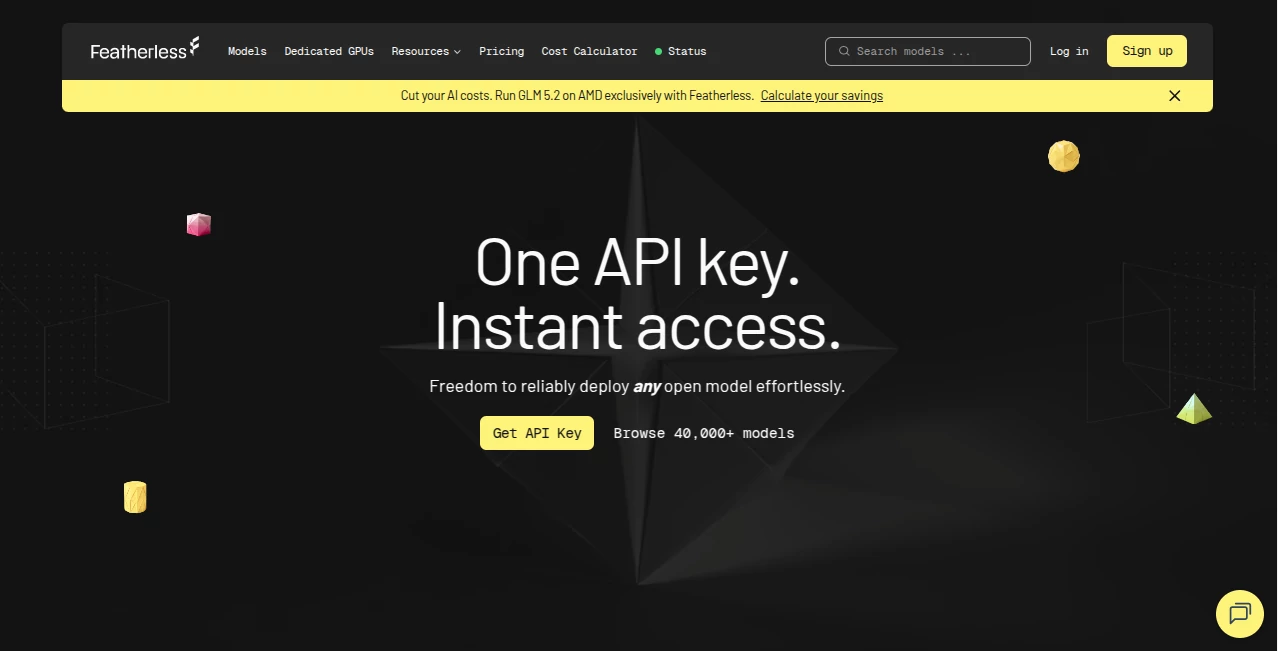
Featherless AI is an advanced platform that helps developers and businesses access powerful open-source language models through a simple and efficient AI infrastructure. It removes many of the challenges involved in deploying and managing large AI models, allowing teams to focus on building useful applications instead of maintaining complex systems.
With a focus on speed, scalability, and accessibility, this platform provides an easier way to experiment with modern AI capabilities. Whether you are creating an AI assistant, integrating intelligent features into a product, or testing different open-source models, it offers a practical environment designed for real-world development needs.
The platform is especially valuable for teams that want the flexibility of open-source models without the operational burden of running their own infrastructure. It provides a streamlined experience for accessing AI capabilities while keeping development workflows simple and efficient.
Key Features
User Interface
The platform is designed with simplicity in mind, making it easier for developers to explore and use AI models without unnecessary complexity. The user experience focuses on clear access to available models, straightforward integration options, and tools that help users quickly move from testing to production.
Developers can spend less time managing technical setup and more time improving their applications. The clean workflow makes it suitable for both experienced AI engineers and teams that are beginning to explore generative AI solutions.
Accuracy & Performance
Performance is one of the main advantages of using a dedicated AI inference platform. By optimizing the process of running open-source models, it helps applications deliver faster responses and reliable AI-generated results.
For businesses building AI-powered products, response speed and consistency are essential. The platform is designed to support demanding workloads while maintaining efficient model execution.
Capabilities
The service provides access to a wide range of open-source AI models that can be used for different tasks, including text generation, conversational applications, content creation, coding assistance, and other natural language processing workflows.
This flexibility allows developers to choose models that match their specific requirements instead of being limited to a single AI ecosystem. It can support experimentation, prototyping, and large-scale application development.
Security & Privacy
Security and responsible AI usage are important considerations for companies adopting AI technology. The platform focuses on providing a reliable infrastructure where developers can build applications while maintaining control over their AI workflows.
Organizations can benefit from using open-source models while having more flexibility compared with traditional closed AI systems.
Use Cases
This platform can be useful across many industries and development scenarios. Some common applications include:
- Building AI chatbots and virtual assistants
- Creating AI-powered writing and content tools
- Adding intelligent features to SaaS products
- Developing coding assistants and developer tools
- Testing different language models for specific business needs
- Creating research and automation solutions
For example, a startup building a customer support assistant can quickly test different AI models and choose the option that provides the best balance between quality, speed, and cost.
Pros and Cons
Pros
- Access to open-source AI models
- Simplifies AI model deployment
- Suitable for developers and businesses
- Supports scalable AI applications
- Reduces infrastructure management requirements
Cons
- May require technical knowledge for advanced integrations
- Model availability and performance can vary depending on selected models
- Some advanced business features may require additional planning
Pricing Plans
Pricing is designed around AI usage and infrastructure requirements. Users can typically explore available options based on their development needs, from experimenting with AI models to running production-level applications.
The flexible approach makes it suitable for individual developers, startups, and companies that need scalable AI capabilities without investing heavily in their own model infrastructure.
How to Use
Getting started usually involves selecting a suitable AI model, connecting it through available development tools or APIs, and integrating the model into an application workflow.
A typical process includes choosing the right model for your project, testing responses, adjusting your implementation, and deploying the final AI-powered experience for users.
Comparison with Similar Tools
Compared with traditional AI providers that mainly offer closed models, this platform provides more flexibility by focusing on open-source model access. This approach gives developers more choices when selecting AI technology for their projects.
It can be a strong option for teams that want more control over their AI stack while avoiding the complexity of managing large-scale computing infrastructure themselves.
Conclusion
For developers and businesses looking to integrate open-source artificial intelligence into their products, this platform offers a practical and efficient solution. Its focus on accessibility, performance, and flexible model usage makes it a valuable choice for creating modern AI applications.
As more companies adopt AI-driven workflows, tools that simplify access to powerful models will continue to play an important role in helping teams innovate faster.
Frequently Asked Questions (FAQ)
What type of AI models can be used with this platform?
It provides access to various open-source language models that can support tasks such as text generation, conversations, coding assistance, and AI-powered applications.
Is this platform suitable for developers?
Yes. It is designed mainly for developers and teams that want to integrate AI capabilities into applications without managing complex model infrastructure.
Can businesses use it for production applications?
Yes. The platform is designed to support scalable AI projects, making it useful for startups and organizations building AI-powered products.
Why use open-source AI models?
Open-source models provide more flexibility, customization options, and greater control over AI development compared with many closed alternatives.
AI Chatbot , AI API Design , Large Language Models (LLMs) , AI Developer Tools .
These classifications represent its core capabilities and areas of application. For related tools, explore the linked categories above.

Featherless AI Alternatives Product

FortuneTelle…

Overchat AI
Timestamp Ro…

PromptBuilder

Luma AI

git-lrc

Ai Angels

ModelsLab

Cupid