
Findrix
What is Findrix?
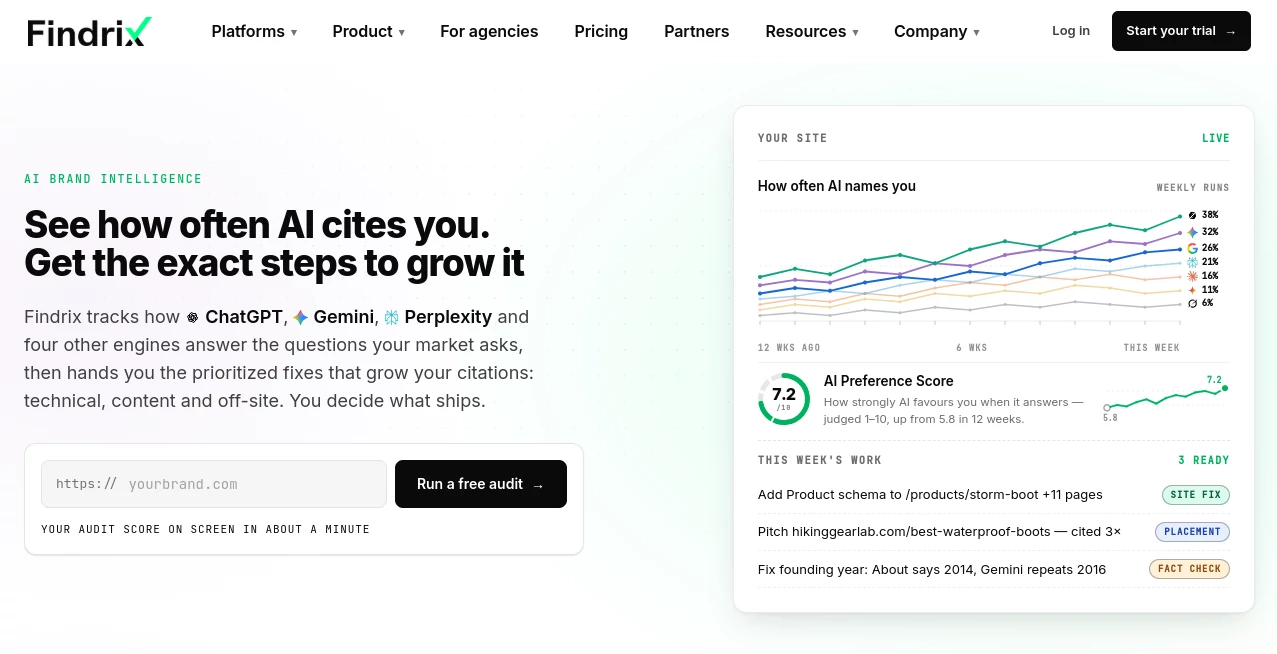
Findrix is an AI brand intelligence and visibility platform designed for businesses that want to understand how artificial intelligence systems present their brand. Instead of focusing only on traditional search rankings, it examines how major AI engines answer questions related to a company's market, competitors, products, and reputation.
The platform monitors AI-generated answers, measures how frequently a brand is mentioned or cited, identifies gaps, and turns those findings into practical recommendations. It is particularly useful for marketing teams that are beginning to treat AI search and generative search visibility as an important part of their overall strategy.
Key Features
- AI visibility tracking across major AI engines
- Citation share and competitor benchmarking
- Brand fact checking and mismatch detection
- Source mapping to identify websites influencing AI answers
- Technical and content recommendations
- Prioritized fix lists based on potential impact
- Weekly monitoring and repeated measurements
- Confidence ranges for reported metrics
- Branded PDF reporting
- Before-and-after views for proposed fixes
User Interface
The interface is built around a straightforward Detect, Fix, and Measure workflow. Instead of simply presenting a large collection of charts, the platform focuses attention on what needs to be improved. Users can see their AI visibility, competitor comparisons, source information, brand facts, and recommended actions from a central workspace.
The practical approach is one of its strongest qualities. A marketing manager can move from discovering that an AI engine is using outdated information to seeing the proposed correction without having to interpret a complicated technical report first.
Accuracy & Performance
The platform takes a measurement-focused approach to AI visibility. Its methodology uses market-specific prompt sets and repeated weekly runs rather than relying on a single AI response. It checks factors such as source coverage, ranking stability, sample size, and competitor presence before metrics are presented.
Another useful detail is the inclusion of uncertainty ranges. Rather than treating every percentage as an absolute truth, the reporting shows confidence ranges around measurements, which can make trends easier to interpret responsibly.
Capabilities
The system goes beyond counting brand mentions. It can identify how often a company appears in AI answers, compare visibility against competitors, inspect the sources being used by AI systems, and flag brand facts that appear to be outdated or incorrect.
It also produces recommendations covering technical, content, and off-site opportunities. Examples shown on the platform include improving structured data, updating page metadata, adding missing AI-readable files, correcting outdated company information, and identifying external websites that may influence AI-generated answers.
One particularly useful capability is its source mapping. AI answers can draw information from many different websites, including niche publications, affiliate pages, editorial content, and community discussions. Understanding those sources can give marketers a more realistic picture of where AI systems obtain information about their industry.
Security & Privacy
The platform takes a controlled approach to website changes. It does not automatically modify a customer's website. Instead, recommendations are delivered with the proposed change, instructions, and before-and-after information so the site owner or their developer can review and apply the update manually.
This workflow is reassuring for businesses that do not want an automated optimization system making unsupervised changes to production websites.
Use Cases
The platform can be useful for several types of users. SEO and marketing teams can use it to monitor visibility in generative search, while brand managers can check whether AI systems are presenting accurate company information.
Agencies can also use the system to monitor multiple client websites. The agency offering supports managing client sites from one account and uses per-site billing, making the model easier to understand for teams with a growing portfolio.
Another practical use is competitor research. By comparing prompts, AI models, citations, rankings, and source patterns, marketers can identify areas where competing brands receive attention that their own company is missing.
Pros and Cons
Pros:
- Focuses specifically on AI search and brand visibility
- Tracks several major AI engines
- Combines measurement with actionable recommendations
- Provides competitor benchmarking
- Includes brand fact checking
- Identifies external sources influencing AI answers
- Provides confidence information alongside metrics
- Recommended fixes are written rather than merely flagged
- Website changes remain under the customer's control
- Offers a free audit without requiring a credit card
Cons:
- The service is primarily aimed at businesses rather than casual users
- Pricing is based on each monitored website
- Advanced monitoring and higher prompt volumes require more expensive plans
- Additional AI engines can increase the monthly cost
- Businesses looking only for traditional SEO tools may find some of its functionality unnecessary
Pricing Plans
The service offers three main paid plans, with every paid tier including a 14-day free trial. The Presence plan costs $49 per month per site and includes tracking for ChatGPT, Google AI Overviews, and Perplexity, along with 60 weekly prompts, visibility metrics, competitor benchmarking, audits, and a prioritized fix list.
The Growth plan costs $99 per month per site and expands monitoring to five core engines, including Gemini and Google AI Mode. It provides 100 weekly prompts, source fact checking for the top 50 cited pages, and written fixes that can be reviewed before implementation.
The Authority plan costs $199 per month per site and is designed for agencies and larger brands. It increases the allowance to 180 weekly prompts, checks the top 100 cited pages, and provides a larger optimization budget.
Claude and Grok tracking are also available as paid add-ons, depending on the selected plan. A free audit is available for businesses that want to evaluate their current AI visibility before subscribing.
How to Use the Platform
Start by entering the website or brand you want to evaluate and run the available audit. The system analyzes the site's AI visibility and presents an overview of how frequently the brand appears in relevant AI answers.
Next, review the citation share, competitor comparisons, source information, brand facts, and technical findings. The prioritized fix list is particularly useful here because it helps separate high-impact issues from smaller improvements.
After reviewing the recommendations, apply the appropriate changes to your website or give the written instructions to the person responsible for your site. The platform does not publish the changes automatically, so the final decision remains with you.
Finally, continue with the weekly measurements. AI answers can change over time, so repeated monitoring provides a better indication of whether improvements are actually affecting brand visibility.
Comparison with Similar Tools
The biggest distinction is the platform's emphasis on moving from measurement to implementation. Many AI visibility products are primarily concerned with monitoring mentions, citations, rankings, or share of voice. Here, those measurements are connected directly to a prioritized list of technical, content, brand-fact, and off-site actions.
It also takes a different approach to measurement by showing confidence information and using repeated prompt runs. This can be valuable for teams that need reporting they can explain to clients or internal stakeholders rather than relying on a single snapshot of an AI response.
For agencies, the per-site model and multi-client approach can also make the service attractive when the goal is to monitor a portfolio of websites rather than a single brand.
Conclusion
For companies trying to understand their visibility beyond conventional search engines, this platform offers a focused way to see what AI systems are saying, which sources influence those answers, and where a brand has room to improve.
Its strongest point is the connection between diagnosis and action. Instead of leaving marketers with another analytics dashboard to interpret, it turns many of its findings into specific fixes that can be reviewed and implemented. The combination of AI visibility tracking, citation analysis, competitor benchmarking, source mapping, and written recommendations makes it a compelling option for businesses taking generative search seriously.
The free audit is a sensible starting point, particularly for teams that want to see how their brand currently appears across AI-generated answers before committing to a paid monitoring plan.
Frequently Asked Questions (FAQ)
What does the platform measure?
It measures AI visibility indicators such as citation share, rankings, recommendations, source mix, competitor presence, and how AI systems perceive and describe a brand.
Which AI engines are monitored?
Monitoring includes major platforms such as ChatGPT, Gemini, Perplexity, Google AI Overviews, Google AI Mode, Grok, and Claude, with availability depending on the selected plan and add-ons.
Does it automatically change my website?
No. Recommendations are provided for review and manual implementation. Nothing is published to the website without the customer's approval.
Is a developer required?
Not necessarily. The platform provides written fixes and copy-paste instructions that can be handed to whoever manages the website.
Does it track competitors?
Yes. AI visibility can be compared against named competitors across prompts and AI models, helping businesses understand where competing brands are receiving more attention.
Is there a free trial?
Yes. The paid plans include a 14-day free trial, and a free audit is also available without requiring a credit card.
Can agencies use it for multiple clients?
Yes. The agency offering is designed for teams managing multiple client websites from one account, with per-site billing and additional agency-focused capabilities.
AI SEO Assistant , AI Marketing Plan Generator , AI Research Tool , AI Analytics Assistant .
These classifications represent its core capabilities and areas of application. For related tools, explore the linked categories above.

Findrix Alternatives Product

Best of AI

Sorank

Quso AI

Elicit

Chrome Sidek…

LocalRAG!

AI Podcast I…

cznull

Greek Numero…