
FinTract
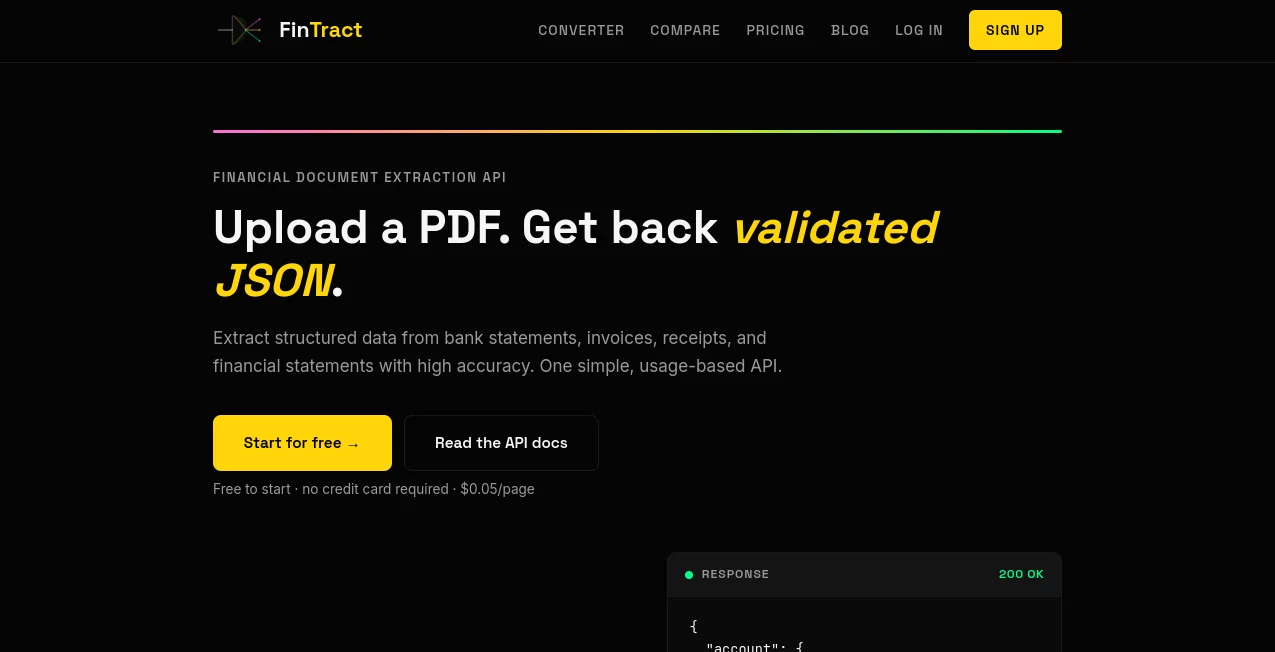
What is FinTract?
Fintract is a powerful financial document extraction solution designed to transform complex financial PDFs into structured, validated data. Built for developers, fintech companies, accounting platforms, and businesses that need reliable financial information, it helps eliminate the tedious process of manually reading statements, invoices, receipts, and accounting documents.
Instead of returning simple OCR text, this platform focuses on delivering organized JSON data with validation checks and source references. This makes it easier for applications to process financial documents while reducing errors caused by incomplete extraction or incorrect calculations.
For teams building finance-related products, automation workflows, lending platforms, or accounting systems, this approach provides a practical way to connect financial documents with modern software without spending months creating custom extraction pipelines.
Key Features
User Interface
The platform follows a developer-friendly approach with a straightforward workflow. Users can upload financial documents and receive structured output through an API-based experience. The documentation and integration process are designed to be simple, allowing teams to start testing quickly without complicated onboarding procedures.
The clean workflow makes it suitable for both experienced developers and businesses that want to add financial automation features without building a complete document-processing system from scratch.
Accuracy & Performance
Financial documents require more than text recognition. The system focuses on understanding financial structures and validating extracted information. It can check important relationships such as transaction balances, document totals, and accounting consistency before returning results.
Each important extracted value can include source information, helping users trace data back to the original document. This creates a more transparent workflow compared with traditional OCR solutions that often provide raw text without financial context.
Capabilities
The platform supports multiple financial document types and converts them into machine-readable formats. It can process bank statements, invoices, receipts, and accounting statements while returning structured information suitable for software applications.
- Extract financial data from PDF documents
- Convert documents into structured JSON output
- Process bank statements with transaction details and balances
- Extract invoice information including line items and totals
- Handle receipts and accounting documents
- Provide source references for important extracted fields
- Support automated document classification
- Work with scanned and digital documents
Security & Privacy
Security is an important consideration when handling financial information. The platform is designed with privacy-focused practices, including controlled document retention policies and an infrastructure approach that avoids unnecessary dependency on closed systems.
Businesses can integrate financial extraction into their own applications while maintaining control over their workflows and data management processes.
Use Cases
This technology can support a wide range of financial automation scenarios. Companies that manage large volumes of documents can reduce manual data entry and create faster processing workflows.
- Fintech Applications: Add automated financial document processing to lending, banking, and payment solutions.
- Accounting Software: Import invoices, statements, and receipts into accounting platforms automatically.
- Lending Platforms: Analyze borrower financial documents faster with structured transaction data.
- Business Automation: Replace repetitive document review tasks with automated extraction.
- Data Analytics: Convert unstructured financial files into usable datasets.
Pros and Cons
Pros
- Designed specifically for financial documents
- Provides structured data instead of only OCR output
- Includes validation features for financial accuracy
- Supports API-based integration
- Useful for fintech and accounting workflows
- Transparent usage-based pricing model
Cons
- Primarily focused on financial document processing rather than general document management
- Best suited for businesses and developers that need API integration
- Advanced workflows may require technical implementation
Pricing Plans
The pricing model is based on usage rather than traditional subscriptions. Users can start with free credit and pay according to the number of pages processed.
- Free starter credit available for new users
- Pay-as-you-go pricing model
- No monthly subscription requirement
- Suitable for both testing and production workloads
This flexible structure makes it easier for startups and growing businesses to experiment with financial automation before committing to large-scale plans.
How to Use Fintract
Getting started is designed to be simple. Users can connect their application through the API, upload financial documents, and receive structured responses that can be used directly inside their software workflows.
- Create an account and access the API credentials
- Upload a supported financial document
- Select the required extraction workflow
- Receive validated structured data
- Integrate the results into your application or database
Comparison with Similar Tools
Many document extraction platforms focus mainly on recognizing text from images or PDFs. However, financial workflows often require additional checks, calculations, and structured outputs.
This solution stands out by focusing specifically on financial data extraction, helping businesses move beyond simple OCR and create more reliable automation systems. For teams working with statements, invoices, and accounting records, specialized financial understanding can provide better results than general-purpose document scanners.
Conclusion
Automating financial document processing can save significant time and reduce manual errors. With its focus on validated financial extraction, structured output, and developer-friendly integration, this platform offers a practical solution for companies that need accurate financial data from complex documents.
Whether you are building a fintech product, improving accounting workflows, or creating internal automation tools, this technology provides a strong foundation for turning financial documents into actionable data.
Frequently Asked Questions (FAQ)
What types of documents can be processed?
The platform supports financial documents such as bank statements, invoices, receipts, and accounting reports.
Does it provide raw OCR text or structured data?
It focuses on structured data extraction and provides organized output that can be used directly by software applications.
Is it suitable for fintech companies?
Yes. It is designed for fintech products, lending platforms, accounting applications, and businesses that work with financial documents.
Does it support API integration?
Yes. Developers can integrate the extraction capabilities into their own applications using an API workflow.
What pricing model does it use?
It uses a usage-based pricing approach where customers pay according to document processing volume rather than a fixed subscription.
AI Document Extraction , AI Accounting Assistant , AI API Design , AI Files Assistant .
These classifications represent its core capabilities and areas of application. For related tools, explore the linked categories above.

FinTract Alternatives Product

Workik

Document Chat

hd image con…

PDFgear

AI Agent Ski…

Watermark in…

PDF Inspector

ModelsLab

Timestamp Ro…