
Fortrip
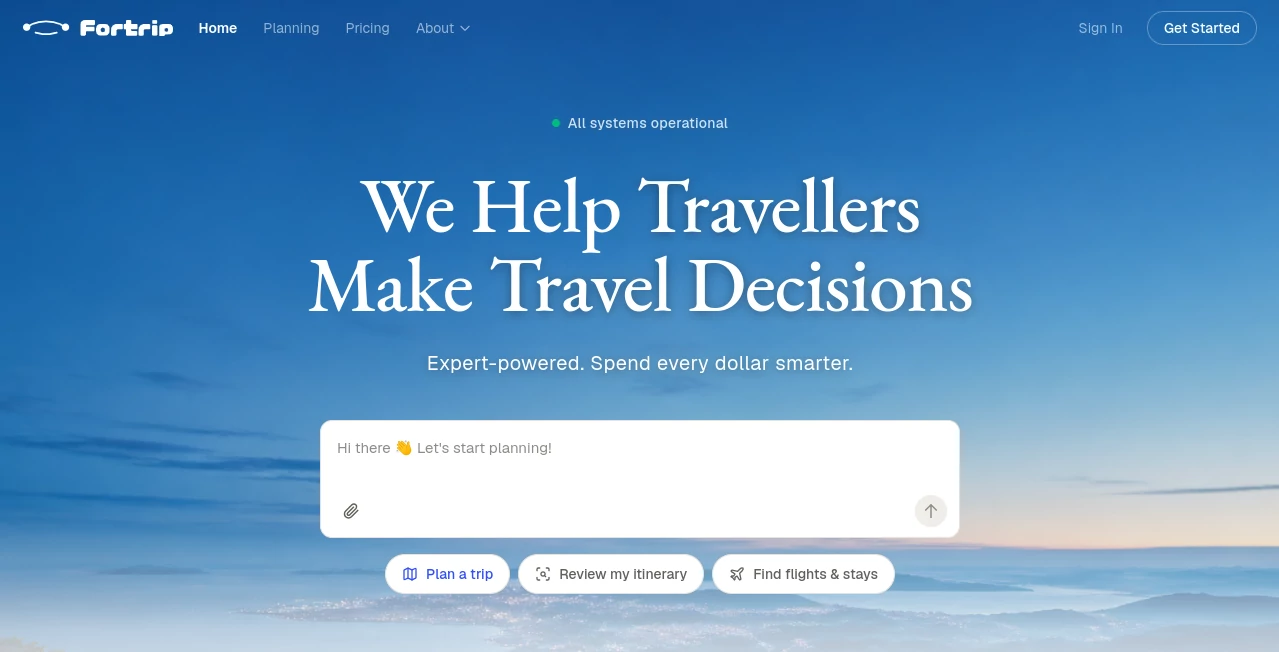
What is Fortrip?
Planning a good trip is rarely difficult because there are too few ideas. The real challenge is making all those ideas work together. A beautiful itinerary can fall apart because of an awkward train connection, an unrealistic pace, expensive hotel dates, or a route that looks sensible on a map but wastes half a day in practice.
Fortrip.ai is an AI-powered travel planning platform designed to help travelers make more practical decisions before they book. It can turn a rough travel idea into a personalized day-by-day itinerary, review an existing plan, compare transportation options, and help optimize hotel choices. The platform is built around a simple idea: a useful travel plan should be enjoyable, but it should also survive contact with reality.
Instead of simply producing another long list of attractions, the platform considers factors such as budget, dates, traveler type, pace, transportation, and personal preferences. This makes it particularly useful for travelers who are planning multi-city trips or already have a draft itinerary they want someone to challenge and improve.
Key Features
- AI-powered personalized trip planning based on dates, budget, interests, group size, and travel preferences.
- Itinerary validation across multiple practical dimensions, including feasibility, pacing, sequencing, and personal fit.
- Transportation comparison covering flights, trains, buses, ferries, and local transit options.
- Multi-city route optimization to find more practical combinations of destinations and transportation.
- Hotel comparison and stay optimization, including different property combinations and date arrangements.
- Destination insights covering timing, activities, local food, and less obvious places worth exploring.
- Reasoning behind recommendations so travelers can understand why an option fits their particular trip.
- Support for complex itineraries where several destinations, dates, transport connections, and accommodation decisions need to work together.
User Interface
The interface takes a conversational approach to trip planning. Travelers can begin with a simple idea rather than filling out a complicated travel form. The workspace brings conversation and the developing itinerary together, making it easier to see how suggestions translate into an actual trip.
A particularly useful touch is the ability to refine a plan instead of starting from scratch. If one activity feels too ambitious or a traveler wants a slower pace, the itinerary can be adjusted through follow-up requests. The experience feels closer to working with a planning partner than searching through disconnected travel pages.
Accuracy & Performance
Travel recommendations are only useful when they make sense in the real world. The platform therefore puts considerable emphasis on feasibility, timing, route logic, and practical constraints rather than simply generating attractive-sounding suggestions.
Its itinerary validation feature can review an existing plan across 16 dimensions. This is valuable when a traveler has already spent hours researching and wants a second opinion. Instead of assuming that a complete itinerary is automatically a good one, the system looks for potential weaknesses in pacing, sequencing, travel time, dates, budget, and overall fit.
Transportation planning adds another practical layer by comparing different ways of moving between destinations. A flight may be faster, while a train could be more comfortable or better aligned with the rest of the schedule. Looking at those trade-offs together can lead to a better decision than choosing the first convenient option.
Capabilities
The platform is especially capable when a trip involves several moving parts. Travelers can provide a destination, dates, budget, preferred style, and other requirements, then work toward a complete itinerary. Recommendations can cover activities, neighborhoods, accommodation, dining, and transportation while keeping the broader trip in view.
Multi-city travel is one of its strongest use cases. Route order can affect both travel time and accommodation costs, so the system can compare different combinations rather than treating the order of destinations as an afterthought. Its transportation tools can also compare flights and ground transportation and coordinate connections with realistic transfer times.
The stay optimization functionality goes beyond simply finding a hotel. Different properties and date combinations can be compared, which is useful when a traveler is staying in several cities. In some cases, changing the order of a trip can produce meaningful differences in hotel costs without changing the hotels or number of nights.
Security & Privacy
The service provides a published privacy policy explaining how personal information is collected, stored, used, and disclosed. Users should review the policy before entering information they consider sensitive, particularly when creating an account or using features that require personal travel details.
Travel planning can involve dates, destinations, preferences, and booking-related information, so maintaining sensible account security is also important. Users should use strong login credentials and avoid sharing account access with others.
Use Cases
There are several situations where this type of travel assistant can save substantial planning time. A solo traveler with only a destination and a budget can use it to turn a vague idea into a structured itinerary. A couple planning a city break can use it to balance sightseeing with downtime instead of filling every hour with activities.
It is also useful for families and travelers with specific requirements. Preferences such as accessibility, physical intensity, traveler age, budget, and preferred pace can be incorporated into the planning process.
Multi-city travelers may benefit even more. Someone planning a trip through several European cities, for example, can compare different city orders and transportation combinations before committing to reservations. Likewise, a traveler who has already created an itinerary elsewhere can use the validation feature as a practical second opinion.
Pros and Cons
Pros:
- Designed specifically around travel planning rather than general-purpose AI chat.
- Combines itinerary creation, validation, transportation, and accommodation optimization.
- Useful for both rough travel ideas and already-developed itineraries.
- Considers practical constraints such as pace, timing, route order, and budget.
- Provides reasoning behind recommendations instead of presenting unexplained choices.
- Particularly useful for complex and multi-city trips.
Cons:
- Travel prices and availability can change quickly, so results should be checked again before booking.
- Some travelers may still prefer researching individual hotels, attractions, and transport providers themselves.
- The quality of recommendations depends partly on how much useful information the traveler provides.
- AI recommendations should be treated as decision support rather than a replacement for checking official travel requirements.
Pricing Plans
The website currently presents the service around its planning and decision-support features, but a fixed public pricing structure was not clearly available in the information reviewed. Because travel searches, availability, and product access can change, users should check the current offering directly when they are ready to use the service.
It is also worth remembering that accommodation and transportation prices are dynamic. Even when a planning result identifies an attractive option, the final price and availability can change before a booking is completed.
How to Use the Platform
- Start with your destination or describe the kind of trip you have in mind.
- Provide useful details such as travel dates, budget, number of travelers, interests, and preferred pace.
- Review the generated itinerary and pay attention to the reasoning behind each recommendation.
- Ask for changes if the schedule feels too busy, too expensive, or poorly suited to your travel style.
- Use itinerary validation when you already have a plan and want to identify possible weaknesses.
- Compare transportation options when traveling between multiple destinations.
- Review accommodation combinations and dates before making final booking decisions.
- Double-check important travel requirements, prices, schedules, and availability with the relevant official providers before departure.
Comparison with Similar Tools
General AI assistants can be useful for brainstorming destinations, asking travel questions, or creating a quick itinerary. The difference here is specialization. This platform is built around the practical side of travel planning, where route order, transportation, accommodation dates, pacing, and feasibility can matter just as much as the attractions themselves.
Traditional travel websites are excellent for searching individual flights, hotels, and activities, but they generally leave the traveler responsible for putting everything together. This approach attempts to connect those decisions into one planning workflow.
That distinction becomes particularly noticeable on complicated trips. Rather than asking which hotel is good in isolation, the traveler can think about whether that hotel works with the route, dates, transportation, and overall purpose of the trip. It is a more decision-oriented approach to travel research.
Conclusion
A strong travel itinerary is more than a collection of places worth visiting. It needs to account for time, distance, money, energy, transportation, accommodation, and the simple fact that travelers have different ideas of what makes a good day.
This platform takes a thoughtful approach to that problem by combining personalized itinerary generation with validation and optimization. Its strongest appeal is not simply that it can produce a travel plan quickly, but that it tries to question whether the plan actually works.
For travelers who enjoy researching but dislike juggling dozens of tabs, spreadsheets, hotel pages, and transport schedules, it offers a much more organized way to move from an initial idea to a trip that feels realistic. For complex multi-city journeys in particular, having the route, timing, accommodation, and transportation considered together can make the planning process considerably easier.
Frequently Asked Questions (FAQ)
What is an AI trip planner?
An AI trip planner is a travel-focused assistant that can use information such as destinations, dates, budget, interests, and traveler preferences to help create and refine travel itineraries.
Can it create an itinerary from a simple travel idea?
Yes. Travelers do not need to have a complete itinerary before getting started. A destination, travel style, approximate budget, or a few preferences can be enough to begin building a more detailed plan.
Can it review an itinerary I have already created?
Yes. The itinerary validation feature is designed specifically for travelers who already have a draft plan. It can examine areas such as feasibility, pacing, sequencing, dates, budget, and personal fit and suggest changes where appropriate.
Can it help with multi-city trips?
Yes. Multi-city travel is one of the platform's useful applications. It can help evaluate city order, transportation combinations, trip duration, and hotel sequencing so the overall journey is more practical.
Does it guarantee the cheapest flights or hotels?
No. Travel prices and availability change continuously, so no planning service can guarantee that a result will always be the cheapest. The platform is intended to help travelers compare scenarios and identify potentially better options before booking.
Should I verify AI travel recommendations before booking?
Yes. Important details such as visa requirements, entry rules, flight schedules, hotel policies, opening hours, and final prices should always be confirmed with the relevant official source before making a booking or starting a trip.
AI Life Assistant , AI Trip Planner .
These classifications represent its core capabilities and areas of application. For related tools, explore the linked categories above.

Fortrip Alternatives Product

GetFIT App

StarBattle O…

GetFIT App

Greek Numero…

FeelsTheAura

What The Food

We Are Charl…

Schengen Cal…

Monkey Eatin…