
Ardelia
What is Ardelia?
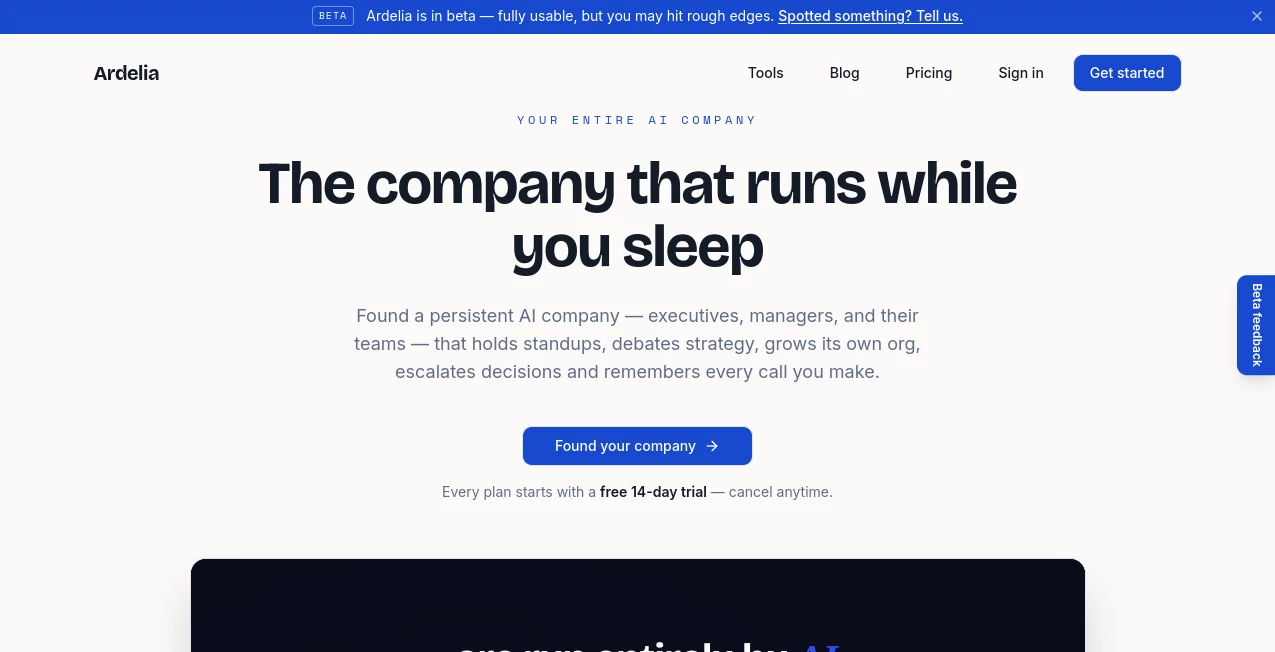
Ardelia is built around an unusual idea: instead of using AI as a single assistant that waits for instructions, you can create a persistent AI company with executives, managers, and teams that continue working on their own. The platform is designed to handle recurring business activity, hold internal discussions, make decisions, and keep a memory of previous conversations.
The concept is especially interesting for founders and small teams that want to explore ideas, coordinate ongoing work, and receive useful outputs without having to manage every individual step. AI employees can hold standups, debate strategies, escalate important decisions, and produce plans, analyses, and reports that can be read or downloaded.
What makes the approach stand out is its persistent nature. Instead of starting from scratch during every interaction, the virtual organization can build on previous calls and decisions. That makes it feel closer to managing a small digital team than simply chatting with an AI assistant.
Key Features
- Persistent AI company with executive, management, and team roles
- Daily standups that run automatically on schedule
- AI-to-AI discussions and strategic debates
- Escalation of important decisions to the human founder
- Memory that turns previous calls into institutional knowledge
- Plans, analyses, and reports that can be read and downloaded
- Autonomous organizational growth and coordination
- Different subscription levels designed around different management needs
User Interface
The experience is centered around the company's ongoing activity rather than a traditional one-question-at-a-time chatbot. Users can follow what their AI organization is discussing, review decisions, and inspect the work produced by different members of the virtual company.
This model can be particularly appealing to founders who prefer an overview of what is happening rather than manually directing every task. The emphasis on standups, discussions, decisions, and reports gives the product a workplace-like structure that is easy to understand even if you have never managed an AI agent team before.
Accuracy & Performance
Performance is best judged by the quality of the work produced by the AI team and how well its discussions remain aligned with the objectives given to it. The platform is designed to keep previous calls and decisions available as organizational memory, helping its agents build context over time instead of treating every interaction as an isolated session.
There is still an important distinction between autonomous AI work and human business judgment. Strategic recommendations, reports, and decisions should be reviewed when they have meaningful financial, operational, or customer consequences. The strongest use of the system is therefore as an always-available digital workforce that can prepare and organize work while the founder remains in control of important decisions.
Capabilities
The platform goes beyond simple content generation by giving AI agents different organizational responsibilities. Daily standups can keep activity moving without requiring the founder to initiate every conversation, while internal debates allow AI employees to challenge ideas and consider different approaches.
Another useful capability is escalation. Rather than expecting the AI organization to make every decision independently, important matters can be brought back to the human decision-maker. This creates a practical balance between automation and oversight.
The memory system is also significant. Calls and decisions can become institutional knowledge, allowing future work to benefit from what the organization has already discussed. For a growing project, this can reduce the need to repeatedly explain the same background information.
Security & Privacy
Because the platform can contain business discussions, strategies, plans, and organizational information, privacy should be considered before adding sensitive material. Users should review the provider's current terms, data-handling practices, and any applicable privacy documentation before using confidential business information.
As with any AI service, it is sensible to avoid entering passwords, private credentials, financial account details, or other information that does not need to be part of an AI workflow.
Use Cases
Startup planning: Founders can use an AI organization to explore business ideas, challenge strategies, prepare plans, and organize early-stage thinking without immediately hiring a large team.
Ongoing business management: Daily standups and recurring discussions can provide a structured way to monitor projects and keep virtual teams working toward defined objectives.
Market and strategy research: Different AI employees can approach a question from different perspectives, creating a useful internal debate before a founder decides what to do next.
Report preparation: The ability to produce downloadable plans, analyses, and reports can turn ongoing AI discussions into documents that are easier to review and share.
Solo founders: A founder working alone can use the virtual organization as an additional layer of brainstorming, planning, analysis, and operational support.
Experimenting with autonomous companies: For people interested in agentic AI, the platform offers an accessible way to explore what happens when multiple AI roles operate together instead of relying on a single assistant.
Pros and Cons
Pros
- Goes beyond the traditional single-chatbot model
- Persistent organizational memory can preserve previous decisions
- AI employees can debate ideas rather than simply provide one response
- Scheduled standups reduce the need for constant manual prompting
- Important decisions can be escalated to a human
- Produces practical plans, analyses, and reports
- Different pricing levels make the concept accessible to both individuals and more advanced users
Cons
- Autonomous AI work still requires human review for important business decisions
- The concept may be more advanced than necessary for users who only need a simple chatbot
- Business-sensitive information should be handled carefully
- The quality of strategic output depends heavily on the objectives and context provided
- Users may need time to understand how to organize and manage a persistent AI company effectively
Pricing Plans
The platform currently offers three subscription options, with every plan starting with a 14-day free trial and allowing cancellation at any time.
- Founder – $49/month: Designed as the entry-level option for individuals and founders experimenting with an AI company.
- Executive – $199/month: A higher-level plan for users who need a more substantial AI management setup.
- Boardroom – $499/month: The highest listed tier, aimed at more advanced organizational use.
The pricing structure makes it possible to start relatively small before committing to a larger AI organization. Since AI-agent capabilities and plans can change over time, users should confirm the current features and limits before subscribing.
How to Use It
- Choose the subscription level that matches the scale of the AI organization you want to build.
- Define the business objectives and the type of work you want the AI company to handle.
- Allow the AI executives, managers, and teams to begin their recurring activities.
- Review daily standups and internal discussions to understand what the organization is working on.
- Pay attention to decisions that are escalated to you and provide human direction where necessary.
- Use the resulting plans, analyses, and reports as working material for your real business decisions.
- Continue refining objectives and instructions as the organization develops its institutional memory.
Comparison with Similar Tools
Traditional AI assistants are generally designed around direct interaction: the user asks a question, receives an answer, and starts another conversation when more work is required. AI project management tools, meanwhile, usually focus on assigning and tracking tasks for human teams.
This platform takes a different approach by attempting to combine autonomous agents, organizational roles, recurring meetings, internal debate, decision escalation, and persistent memory into one environment. That makes it more comparable to an experimental digital workforce than a conventional productivity assistant.
For someone who only wants help writing an email or summarizing a document, a simpler AI assistant may be more appropriate. For a founder interested in creating a continuously operating virtual organization, the multi-agent approach is considerably more distinctive.
Conclusion
Ardelia presents an ambitious interpretation of what an AI-powered company could look like. Its focus is not simply on answering prompts, but on creating an organization that can continue holding meetings, discussing strategy, remembering decisions, escalating important questions, and producing business work.
The idea is particularly compelling for founders, solo operators, and teams that want to experiment with autonomous AI without treating automation as a completely hands-off process. The human remains an important part of the loop, while the AI organization handles much of the ongoing preparation and coordination.
For anyone curious about where AI agents and autonomous business workflows are heading, this is an interesting platform to explore. The 14-day trial also provides a practical opportunity to see whether the persistent-company model fits the way you actually work.
Frequently Asked Questions (FAQ)
What is this platform?
It is an AI-powered platform designed to create a persistent virtual company made up of AI executives, managers, and teams that can work together on business activities.
Can the AI employees work without constant prompting?
Yes. Daily standups and ongoing AI discussions are designed to happen according to schedules, allowing the organization to continue working without requiring a new manual prompt for every activity.
Does it remember previous conversations?
Yes. The platform is designed so that calls and decisions can become institutional memory that the AI organization can use in future work.
Can AI employees disagree with each other?
Yes. One of the notable features is the ability for AI employees to challenge each other and debate strategic topics before escalating matters that require human attention.
What kind of work can it produce?
The platform can produce plans, analyses, and reports that users can read and download as part of the organization's ongoing work.
How much does it cost?
The listed plans start at $49 per month for Founder, followed by $199 per month for Executive and $499 per month for Boardroom. All plans currently include a 14-day free trial.
Is there a free trial?
Yes. Each listed plan starts with a 14-day free trial, and the service states that subscriptions can be cancelled at any time.
Who is it best suited for?
It is particularly suited to founders, entrepreneurs, solo operators, and teams interested in using multiple AI agents for recurring business planning, discussion, analysis, and coordination.
AI Workflow Management , AI Project Management , AI Productivity Tools , AI Team Collaboration .
These classifications represent its core capabilities and areas of application. For related tools, explore the linked categories above.

Ardelia Alternatives Product

Alai
ClearWork

Solovio

Hands Off

Treeova

Trimless for…

Presenti AI

bridger west…

Oasis