GetMentions AI
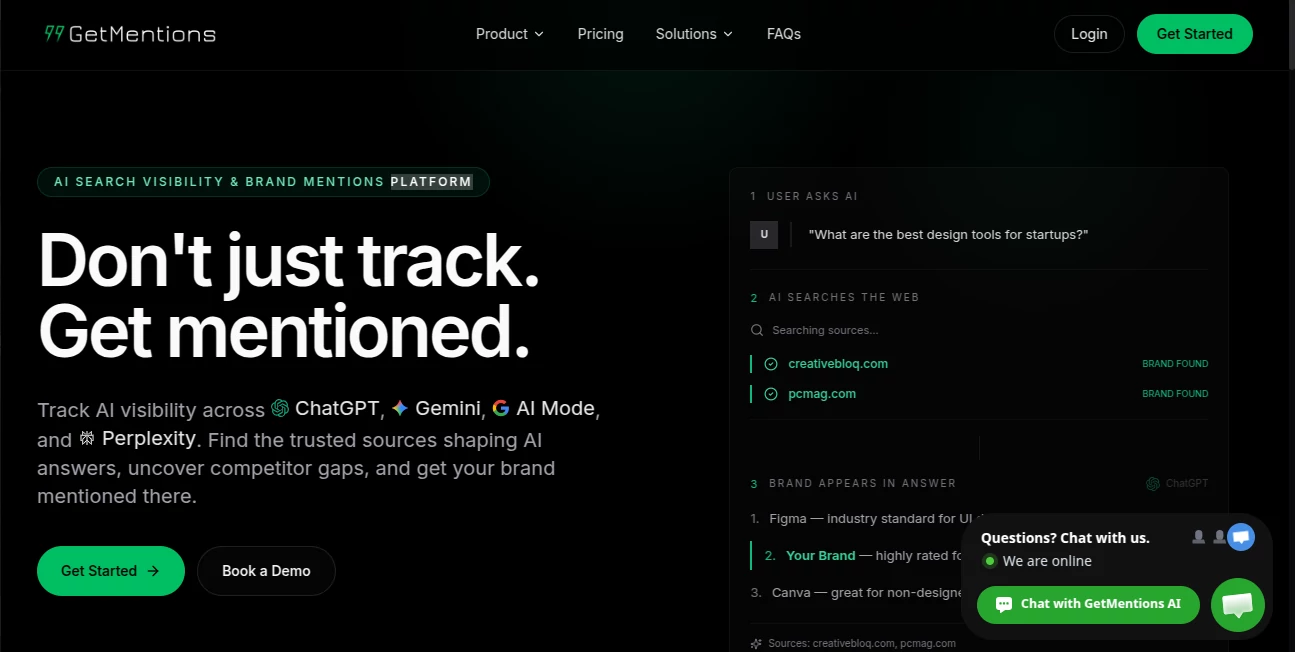
What is GetMentions AI?
There's a shift happening in how people find brands, products, and services — and it's happening faster than most marketing teams realize. When someone opens ChatGPT and types "what's the best project management tool for remote teams," they're not scrolling through a list of ten blue links. They're reading a curated answer. And if your brand isn't in that answer, you essentially don't exist for that person in that moment.
This is the problem that most AI visibility tools acknowledge but don't actually solve. They'll tell you your brand appeared in 12% of relevant AI responses this month. Interesting data. But then what? That's where this platform takes a genuinely different position: it doesn't stop at measurement. It takes you from "we're not getting mentioned" all the way to "we are now."
The platform tracks brand visibility across ChatGPT, Gemini, Google AI Mode, and Perplexity, maps the citations and sources shaping AI answers in your space, identifies exactly where competitors are present and you're not, and then connects you with over 192,000 publisher and creator relationships to actually close those gaps. That full pipeline — from analytics to action — is what makes it different.
Key Features
User Interface
The dashboard is organized around a workflow, not just a collection of metrics. You move through it logically: track your current visibility, analyze the sources behind AI answers, find the gaps where competitors are featured and you're absent, prioritize the highest-impact opportunities, and then take action. That five-step structure is visible throughout the interface, which means you always know where you are in the process and what comes next.
Switching between views — AI visibility scores, citation breakdowns, competitor comparisons, opportunity shortlists — feels natural rather than disjointed. The data is dense in places, but the design handles it without making things feel cluttered. Someone who's never used an AI visibility tool before could orient themselves reasonably quickly.
Accuracy & Performance
The platform runs prompts directly across all four major AI platforms — ChatGPT, Gemini, Google AI Mode, and Perplexity — rather than estimating visibility from crawled data. That matters because AI answers aren't static; the same question asked on different days, in different languages, or from different market contexts can produce meaningfully different results. Daily refresh plans capture that variability in a way that weekly snapshots can't.
Citation intelligence pulls the actual sources — editorial pages, Reddit threads, YouTube channels, Quora discussions — that AI platforms are drawing on when generating answers in your niche. This isn't inferred; it's surfaced from the answer data itself. The gap analysis then compares competitor presence on those sources against your own, showing you a clear picture of where you're losing ground and by how much.
Capabilities
The feature set covers eight distinct stages of an AI visibility workflow, which is considerably broader than most tools in this space:
- AI Visibility Tracking: Monitor how frequently and prominently your brand appears in AI-generated answers across all four major platforms.
- Sentiment Analysis: Understand not just whether your brand appears, but how it's being characterized — positive, neutral, or framed in a way you'd want to address.
- Competitor Benchmarking: See side-by-side comparisons of your brand's AI presence against named competitors across the same prompts and platforms.
- Citation Intelligence: Identify the specific websites, editorial pages, community threads, and YouTube channels that AI models are citing when answering questions in your category.
- Mention Gap Analysis: Pinpoint every source where a competitor is featured and your brand is missing — with a quantified gap score that helps prioritize where to focus.
- Brand Mention Intelligence & UGC Opportunities: Track Reddit and Quora mentions, since community-driven content increasingly shapes how AI models form answers.
- YouTube Mentions: AI assistants can read video transcripts and cite them. The platform identifies relevant YouTube channels where your brand could appear in content that AI platforms actually reference.
- Managed Placement Execution: Access to 192,000+ publisher and creator relationships to secure actual brand mentions on the sites and channels that influence AI answers — not just identify them.
Support for 20+ languages and country-level tracking means this isn't limited to English-language markets. For brands operating across multiple regions, that's a meaningful practical advantage.
Security & Privacy
The platform publishes a formal privacy policy and terms of service. Data collected through brand monitoring and prompt analysis is handled for the purpose of generating the visibility and citation reports shown in the dashboard. For agencies managing multiple client brands, the multi-brand support across plans means client data stays organized without the kind of account sprawl that creates its own privacy management headache.
There's no indication that brand data or competitor intelligence surfaced through the platform is shared externally or used to train models. Given that some of this data reflects competitive positioning strategies, that's worth confirming directly with the team before onboarding sensitive accounts.
Use Cases
The most direct use case is a brand that has invested heavily in traditional SEO and content marketing but is watching traffic shift toward AI-assisted search — and wants to understand and improve their position in that new landscape before competitors do.
Imagine a SaaS company that ranks well for organic keywords but notices their brand almost never appears when users ask AI assistants for tool recommendations in their category. The platform would show them exactly which sources — say, a PCMag review, three Reddit threads, and two YouTube comparison videos — are shaping those answers, which competitors are featured on all of them, and what it would take to get their brand included.
- Growth and SEO teams at established brands looking to build AI search presence systematically rather than through guesswork
- Digital PR teams who need to know which outlets and creators actually influence AI answers, not just which ones have high domain authority by traditional metrics
- Agencies managing AI visibility strategy across multiple client accounts from a single dashboard with per-brand tracking
- Marketing leaders who need to report on AI visibility as a business metric and demonstrate movement over time, not just a one-time snapshot
- Brands entering competitive categories who want to understand the citation landscape before investing in content or PR spend
The YouTube angle is underappreciated. A lot of brands investing in written content don't realize that video transcripts are increasingly being indexed and cited by AI platforms. Identifying which YouTube channels are already influencing answers in your space — and getting your brand mentioned there — is a channel most teams haven't thought about yet.
Pros and Cons
What works particularly well:
- The full pipeline from tracking to placement execution sets it apart from tools that only provide analytics — this is the difference between knowing there's a problem and actually fixing it
- Citation intelligence is genuinely useful for digital PR strategy, not just AI visibility reporting — it tells you where to invest attention
- Tracking across all four major AI platforms in a single dashboard avoids the fragmented reporting that comes with stitching together separate tools
- UGC tracking for Reddit and Quora reflects a more realistic understanding of how AI answers are actually constructed
- YouTube mentions tracking addresses a channel most AI visibility tools ignore entirely
- 20+ language support and country-level tracking make it viable for international brands and agencies with global clients
- Free trial available on every plan — you can test the data quality before committing to a subscription
Things to factor in:
- Pricing scales with prompt volume, brands, and markets — teams with large-scale needs will be on the Scale plan or enterprise pricing
- The managed placement execution is a significant differentiator but adds cost beyond the base subscription
- Daily refresh plans are priced substantially higher than weekly — teams doing one-off audits rather than ongoing monitoring may find weekly cadence sufficient for their needs
- Like any platform covering a fast-moving space, the relative influence of different AI platforms will continue to shift — staying current on which prompts and markets to monitor requires ongoing attention
Pricing Plans
Plans are structured around prompt volume, number of brands, and markets tracked, with a choice between daily and weekly refresh cadences. Annual billing saves the equivalent of one month's cost.
- Starter — $85/month (daily) or $25/month (weekly): 50 prompts, 1 brand, 1 market. Good entry point for a single brand testing AI visibility tracking for the first time.
- Growth — $155/month (daily) or $45/month (weekly): 100 prompts, 2 brands, 3 markets. The most popular plan, sized for active marketing teams running ongoing visibility programs.
- Pro — $289/month (daily) or $80/month (weekly): 200 prompts, 3 brands, 5 markets. Suitable for brands tracking multiple product lines or running deeper competitive analysis.
- Scale — $479/month (daily) or $135/month (weekly): 350 prompts, 5 brands, 10 markets. Designed for agencies and larger teams managing AI visibility across multiple clients or geographies.
- Enterprise: Custom pricing available for teams with volume or configuration needs beyond the Scale plan.
All plans include the full platform — every feature from visibility tracking through to placement opportunities is available regardless of which tier you're on. The differences are purely about scale.
How to Use GetMentions AI
Getting started is straightforward, and a free trial is available on every plan without needing to speak to sales first.
- Step 1 — Set up your brand profile: Enter your brand name, define the markets you want to track, and set your prompt library — the questions your target customers are likely to ask AI assistants when looking for products or services like yours.
- Step 2 — Run your first visibility scan: The platform queries ChatGPT, Gemini, Google AI Mode, and Perplexity using your prompts and returns your brand's visibility score alongside sentiment analysis and competitor comparisons.
- Step 3 — Explore citation intelligence: Review which sources are being cited in AI answers in your space, how frequently each source is cited, and which competitors are already featured there.
- Step 4 — Identify and prioritize gaps: Use the gap analysis view to see where competitors are present and you're not, ranked by citation frequency and relevance. This becomes your action list.
- Step 5 — Execute placements: Work with the platform's publisher and creator network to secure brand mentions on the sites, editorial pages, Reddit communities, and YouTube channels that are actually influencing AI answers in your category.
For agencies, the multi-brand setup means you can run this workflow across several clients from a single account without context-switching between separate logins or tools.
Comparison with Similar Tools
The competitive landscape for AI visibility tracking is growing quickly, but most tools in the space share a common limitation: they're analytics-only. They'll show you a dashboard of how often your brand appears in AI answers, maybe break it down by platform or sentiment, and leave you to figure out what to do with that information.
Tools like Profound, Otterly, and Brandwatch's AI monitoring features all sit in this category — useful for measurement, but they don't tell you which specific sources to target or give you the infrastructure to actually get placed on them. The managed execution layer changes the equation fundamentally. Having access to 192,000+ publisher and creator relationships means the gap between "we identified this opportunity" and "we acted on it" collapses from months of manual outreach to a much shorter timeline.
The YouTube tracking capability is also rare. Most AI visibility tools focus on text-based citations — editorial articles, forum posts, review sites. The fact that AI platforms are increasingly drawing on video transcripts is not widely accounted for in competitive tools. Getting placed in a YouTube video that gets cited by ChatGPT is a legitimate and underutilized channel, and this is currently one of very few platforms tracking it systematically.
The UGC angle — tracking Reddit and Quora alongside traditional editorial sources — also reflects a more accurate model of how AI answers are constructed. Ignoring community-driven content means ignoring a meaningful part of the citation graph.
Conclusion
The way people discover brands through AI is fundamentally different from how search worked, and the rules haven't fully been written yet. That's actually an opportunity — the brands that build AI visibility now, before the citation landscape hardens around incumbents, are the ones who will be recommended by default two years from now.
The difference this platform offers over alternatives isn't subtle. Most tools give you a score and a dashboard. This one gives you the score, the map of where you're missing, and the network to actually fix it. For any brand or agency treating AI search visibility as a real growth channel — not just a metric to report — that end-to-end capability is genuinely hard to find elsewhere.
The free trial makes it easy to validate whether the data quality matches your expectations before committing. Given the pace at which AI-assisted search is eating into traditional query volume, understanding your position now rather than later is the kind of decision that looks obvious in retrospect.
Frequently Asked Questions (FAQ)
Which AI platforms are tracked?
The platform tracks brand visibility across ChatGPT, Gemini, Google AI Mode, and Perplexity — the four platforms that currently account for the vast majority of AI-assisted search queries.
What is citation intelligence and why does it matter?
Citation intelligence identifies the specific websites, editorial pages, Reddit threads, Quora discussions, and YouTube channels that AI platforms are drawing on when generating answers in your category. Knowing which sources influence AI answers tells you exactly where to focus your digital PR and content placement efforts — rather than guessing based on traditional domain authority metrics.
How does the managed placement execution work?
Once you've identified the highest-priority gaps — sources where competitors are cited and your brand isn't — the platform connects you with its network of 192,000+ publisher and creator relationships to secure brand mentions on those specific properties. This is the step that moves the needle on your visibility scores over time.
Is there a free trial?
Yes. A free trial is available on every plan. You don't need to contact sales to start — you can sign up directly and test the platform against your own brand and competitive set.
Do all plans include the same features?
Yes. Every plan includes the full platform — all eight stages from visibility tracking through to managed placement execution. Plan differences are purely about scale: how many prompts, brands, and markets you're tracking, and whether you're refreshing daily or weekly.
Can agencies manage multiple client brands?
Yes. The Growth, Pro, and Scale plans support multiple brands, and the platform has a dedicated agency solution for teams managing AI visibility across client portfolios from a single account.
What languages and markets are supported?
The platform supports 20+ languages and offers country-level tracking, making it viable for international brands and agencies running visibility programs across multiple regions.
AI SEO Assistant , AI Marketing Plan Generator , AI Social Media Assistant , AI Analytics Assistant .
These classifications represent its core capabilities and areas of application. For related tools, explore the linked categories above.

GetMentions AI Alternatives Product
PortBackLinks
DidYouSEO

Beamtrace
TokTools
MaxAEO
Marketbetter…

Lutains
Surmado
Groniz