
Happenstance
What is Happenstance?
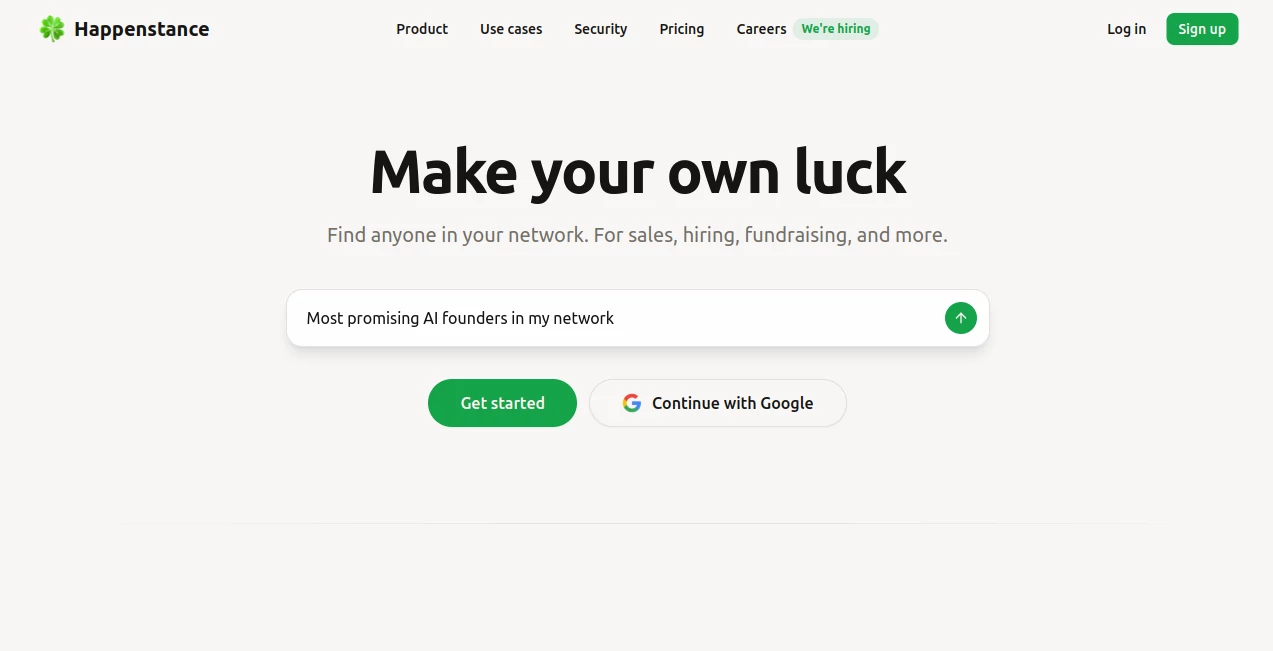
Happenstance is an AI-powered network search platform designed to help professionals find the right people through the relationships they already have. Instead of treating networking as a collection of disconnected contacts, it brings signals from different parts of your professional and social network into one searchable place.
The idea is particularly useful when the person you need is not someone you can easily find through a conventional search. You might be looking for a potential investor, a senior engineer, a customer, a recruiter, a founder, or someone who can make a warm introduction. By searching your own network and the networks of people you know, the platform can surface relevant people together with the paths that connect you.
Its current positioning focuses on sales, hiring, fundraising, and professional relationship discovery. The service says it is used by more than 500,000 professionals and teams, and it can connect information from sources including Gmail, Calendar, LinkedIn, Twitter, Instagram, Outlook, and contacts.
Key Features
- AI network search: Search for people using natural-language descriptions rather than relying only on names, titles, or companies.
- Warm introduction paths: Results can show who in your network knows a person and how strong the relationship appears to be.
- Cross-network discovery: Combine multiple connected sources to create a broader picture of your professional relationships.
- Team network search: Teams and communities can combine their connections into one searchable network.
- People research: Research individuals to understand their professional background, relevant connections, and potential routes for an introduction.
- Natural-language recruiting: Job descriptions can be used to find potential candidates already connected to members of a recruiting team.
- AI integrations: The service can be used with AI assistants such as ChatGPT and Claude, while developers can also connect through API, MCP, or CLI.
- Search result export: Pro users can export search results to CSV for further work.
User Interface
The interface is built around a straightforward search experience. Rather than forcing users to construct complicated filters, it encourages them to describe the person they want in ordinary language. For example, a recruiter could search for senior backend engineers with distributed-systems experience, while a founder might look for investors interested in a particular market.
Search results put people and their relationships at the center of the experience. Mutual connections, professional information, and potential introduction routes make the results more actionable than a simple list of names.
Accuracy & Performance
The platform is designed around relevance and relationship strength rather than simple keyword matching. Search results can be ranked according to how well a person fits the request and how closely they are connected to the searcher or their team.
This approach is especially valuable for searches where context matters. Finding a person who has the right job title is one thing; finding someone with the right experience who is also reachable through a trusted connection is much more useful.
Performance will naturally depend on the quality and breadth of the connected networks. A richer set of accounts and connections gives the system more signals to work with, while smaller networks may produce fewer useful paths.
Capabilities
The strongest part of the platform is its ability to turn existing relationships into something searchable. Gmail connections can be indexed from email headers, while LinkedIn data can be used to search professional connections. Other supported sources include calendars, contacts, Twitter, Instagram, and Outlook.
For recruiting, teams can combine their networks and search for candidates already connected to employees. The system can also identify which team members know a candidate, making backchannel references and introductions easier to pursue.
For sales and fundraising, the same concept can uncover potential customers, investors, founders, advisors, or partners who may be only one or two introductions away. Developers can also use the API, MCP, and CLI options to bring network search into their own workflows and AI-assisted applications.
Security & Privacy
Privacy is an important part of the product's positioning. The company states that users control what they share and that data is not used to train AI models. Its Gmail and Outlook integrations are designed to use email headers rather than the contents of email conversations.
The service also states that it is SOC 2 certified. Users can control aspects of their public network visibility, including whether named people they know are shown on their public profile.
Use Cases
Recruiting: Recruiting teams can combine employee connections, paste a job description, and search for relevant candidates already within their broader network. This can make referrals more systematic instead of depending entirely on individual employees remembering who they know.
Sales: Sales professionals can search for people at target companies and identify colleagues or friends who may provide a warm introduction. This can be useful when cold outreach is unlikely to be the best first step.
Fundraising: Founders can look for investors who fit a particular profile and then identify mutual connections who could potentially introduce them.
Networking: Professionals can search their existing relationships for people with particular expertise, experience, company backgrounds, or interests.
Research: When investigating a person or organization, users can explore professional profiles and connection paths to understand where useful relationships already exist.
Team collaboration: Companies, communities, and groups can pool their networks so that one person's connection can become a useful resource for the wider team.
Pros and Cons
Pros
- Natural-language search makes people discovery easy to understand.
- Focuses on relationships and warm introductions, not just contact information.
- Can combine multiple professional and social networks.
- Useful for recruiting, sales, fundraising, and research.
- Team groups can make collective networks searchable.
- API, MCP, and CLI options provide flexibility for technical users.
- Strong privacy positioning, including a stated policy against using customer data to train AI models.
- Free plan available without requiring a paid subscription.
Cons
- The quality of results depends heavily on the size and quality of the connected network.
- Some advanced capabilities are reserved for paid plans.
- Setting up several connected accounts can take time for users who want the broadest network coverage.
- Users who primarily need a conventional contact database may find the relationship-focused approach more specialized than necessary.
Pricing Plans
The platform offers a free plan that can be used indefinitely. The Free tier includes access to search, limited AI chat usage, unlimited connected accounts, unlimited friends, and unlimited groups.
The Pro plan is listed at $24 per month when billed annually, with a stated 20% annual-billing discount. It adds higher chat usage limits, unlimited web searches, unlimited results per web search, CSV export, and early access to new features. API and MCP usage use separate credits.
A Team plan is also available at $24 per seat per month when billed annually. It provides centralized billing, the ability to assign Pro access to selected members, shared API credits, per-member API usage tracking, and a single invoice for the team.
How to Use It
- Create an account and start with the free plan if you want to test the service.
- Connect the accounts and network sources you want to search, such as LinkedIn, Gmail, Outlook, contacts, or other supported services.
- Describe the type of person you are looking for using natural language.
- Review the returned people and pay attention to both relevance and mutual connections.
- Research promising individuals to understand their background and how you are connected.
- Choose the strongest introduction path and contact the person who can make the connection.
- For teams, create a group and invite colleagues so their networks can contribute to shared searches.
Comparison with Similar Tools
Traditional professional search platforms generally focus on discovering people based on public profiles, job titles, companies, locations, and other filters. CRM platforms, meanwhile, are usually centered on contacts already stored inside a company's sales system.
This product takes a different route by putting the relationship graph itself at the heart of the search. The question is not simply “Who fits this description?” but also “Who in my network can help me reach this person?” That distinction makes it particularly compelling for warm introductions, recruiting referrals, fundraising, and relationship-driven sales.
It is therefore best viewed as a complement to conventional professional databases and CRMs rather than a direct replacement for every contact-management workflow.
Conclusion
Finding the right person is often easier when you know where to look, but knowing who can introduce you can be even more valuable. This platform turns that second part of networking into a searchable experience, connecting people discovery with the relationships that can make an introduction possible.
Its combination of natural-language search, cross-network discovery, team relationship mapping, people research, and AI integrations gives it a distinctive place among modern professional networking tools. For recruiters, founders, investors, sales teams, and anyone who relies heavily on trusted introductions, it offers a practical way to uncover opportunities that may already be hiding inside their existing network.
Frequently Asked Questions (FAQ)
What is this platform used for?
It is used to search professional and social networks for people who match specific criteria. Common uses include recruiting, sales, fundraising, networking, and professional research.
Can I search using natural language?
Yes. Users can describe the person they are looking for in natural language instead of relying exclusively on traditional search filters.
Which accounts can I connect?
Supported sources include Gmail, Calendar, LinkedIn, Twitter, Instagram, Outlook, and contacts, with the available integrations evolving over time.
Can teams share their networks?
Yes. Teams and groups can combine members' connections into a shared searchable network, making it possible to discover relationships that one employee might not know about individually.
Does it support recruiting?
Yes. Recruiting teams can use job descriptions or public job URLs to find relevant candidates within their combined network and identify team members who can provide warm introductions or backchannel references.
Does it have an API?
Yes. Developers can access network search through an API, and the platform also supports MCP and CLI workflows for integrating network discovery into technical and AI-assisted environments.
Is there a free plan?
Yes. The Free plan is available at no cost and includes access to search, limited chat usage, connected accounts, friends, and groups.
Does the platform use my data to train AI models?
The company states that it does not share, sell, or use user data to train AI models. It also states that Gmail and Outlook integrations use email headers rather than email body content.
Is it useful for sales and fundraising?
Yes. Sales professionals can use it to discover warm paths to potential customers, while founders and investors can use network search to identify relevant people and possible introduction routes.
AI Lead Generation , AI Sales Assistant , AI Recruiting , AI CRM Assistant .
These classifications represent its core capabilities and areas of application. For related tools, explore the linked categories above.

Happenstance Alternatives Product

AthenaChat

Domer

UPDF AI

AILeadz.io

Reloq

Resuque

Sourcetable

Apify

Surgeflow