
Helios Flow
What is Helios Flow?
Helios Flow AI is an agentic marketing platform built to take much of the repetitive work out of running email and social media campaigns. Instead of jumping between separate tools for writing, designing, scheduling, and publishing, marketers can manage the process from one place. The platform can build a brand profile from a website, use saved brand assets and messaging preferences, generate campaign content, and keep a human involved before anything goes live.
The idea is particularly appealing for small businesses and lean marketing teams. You can describe what you want to achieve, let the AI handle the first draft, then review and adjust the result before publishing. It is a practical approach that combines automation with control rather than expecting users to hand their entire marketing operation over to AI.
Key Features
- AI-powered social media content generation and publishing
- AI-assisted email copywriting and email design
- Automatic brand profiling from a website
- Brand voice, colors, logos, and audience information stored for reuse
- Social publishing across LinkedIn, Instagram, Facebook, Threads, Bluesky, and X
- Campaign scheduling and approval workflows
- AI-generated images for social posts
- Editable email sections, captions, images, and calls to action
- Support for multiple AI providers and models
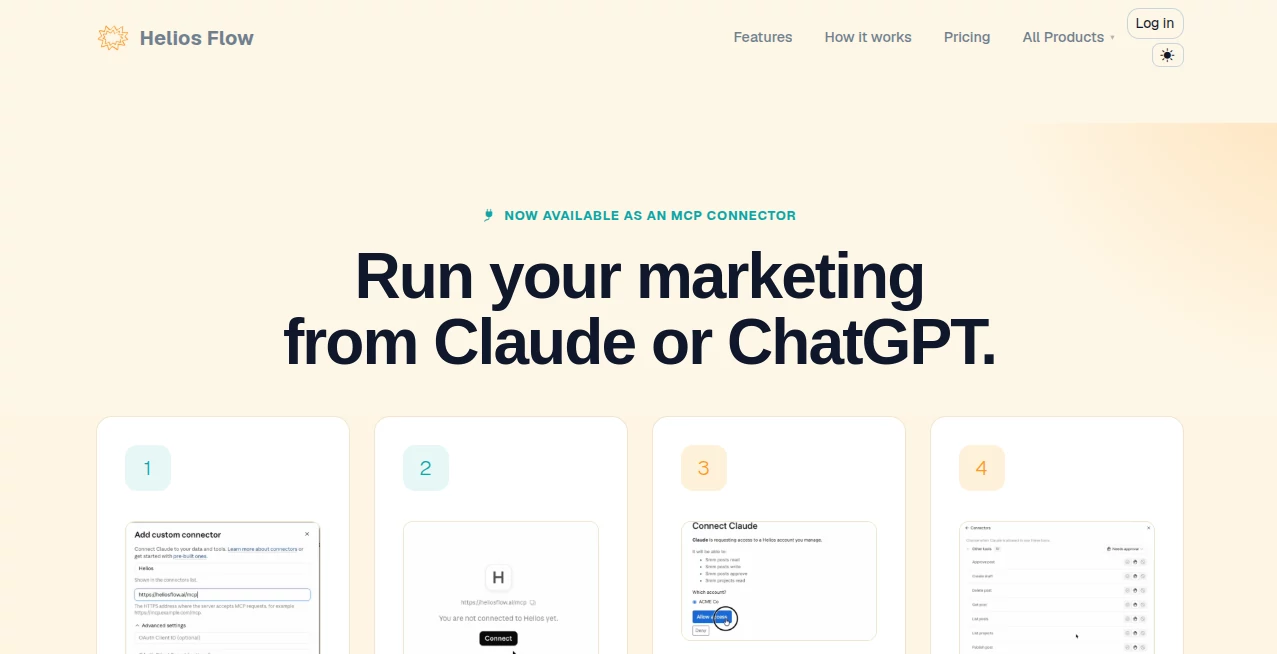
- MCP connectivity for working with AI assistants such as Claude and ChatGPT
User Interface
The interface is designed around two main marketing workflows: Social Media Manager and Email Lab. This separation makes the platform relatively easy to understand because users can focus on the type of campaign they want to create instead of navigating a large collection of unrelated marketing features.
A useful part of the setup is the website-based brand profile. After entering a website, the platform can analyze it and prepare information such as brand voice, colors, audience, and keywords. Users can then review and modify that information before saving it. Logos, taglines, and other brand assets can also be uploaded so generated material has a consistent visual identity.
Accuracy & Performance
Content quality depends partly on the instructions, brand information, angles, and quotations provided by the user. That is actually one of the stronger aspects of the workflow: marketers can give the system real messaging and quotes rather than relying entirely on generic AI copy.
The platform also allows users to choose the AI model used for individual tasks. Supported providers include Anthropic, DeepSeek, Gemini, OpenAI, Perplexity, and several specialized services. This flexibility can be useful when a campaign requires a particular balance between quality, speed, and credit usage.
Capabilities
The Social Media Manager can generate posts, create accompanying images, schedule content, and publish across multiple networks. Supported channels include Instagram, Facebook, LinkedIn, Threads, Bluesky, and X. Generated posts can be opened and edited before publication, giving marketers an opportunity to change captions, images, or other details.
The Email Lab takes a similar approach to email campaigns. Users describe a campaign, choose a template and strategy, and let the system construct the email section by section. Headlines, body content, calls to action, and imagery can be generated and then adjusted manually. The result can be reviewed before being sent or scheduled.
Another interesting capability is MCP integration. Once connected, compatible AI assistants can interact with the marketing workspace, allowing users to draft, review, approve, and publish campaigns from a conversational environment.
Security & Privacy
Marketing automation often involves access to social accounts, email infrastructure, brand assets, and campaign information, so keeping the user in control is important. The platform uses an approval-based workflow for publishing, meaning generated content does not have to go live automatically without review.
The service also states that it handles platform authentication and email deliverability, reducing some of the technical setup normally required when connecting marketing systems. Users should still review the current privacy and payment policies before connecting business accounts or uploading sensitive material.
Use Cases
Small businesses can use the platform to maintain a regular social presence without spending hours writing individual posts. A business owner could provide its website, establish a brand profile, add a few marketing angles, and then create a series of posts for several networks from the same workflow.
It can also work well for startups with a small marketing team. Instead of creating an email campaign from scratch, the team can provide the campaign objective and let the system prepare the structure, copy, visuals, and layout. The team can then concentrate on reviewing the message and making strategic changes.
Agencies and consultants may also find the multi-channel workflow useful when managing recurring campaigns. The ability to maintain brand assets and voice information can reduce repetitive setup work between campaigns.
For a practical example, imagine a software company launching a new feature. The marketer could provide the launch angle and a few genuine quotes from the team, generate a promotional email, create supporting social posts, review everything, and schedule the campaign without moving between several separate applications.
Pros and Cons
- Pros: Combines email and social marketing workflows in one platform.
- Pros: Builds a reusable brand profile from an existing website.
- Pros: Supports several major social networks.
- Pros: Allows human approval and manual editing before publication.
- Pros: Supports multiple AI providers and model choices.
- Pros: MCP integration makes conversational marketing workflows possible.
- Cons: The platform is primarily focused on marketing rather than being a complete all-purpose marketing suite.
- Cons: AI credit usage varies depending on the models and services selected.
- Cons: Businesses wanting highly specialized enterprise marketing features may need additional tools alongside it.
Pricing Plans
The Social Media Manager starts at $25 per month and includes 1,000 AI credits each month. The plan supports seven social platforms, AI-generated posts, caption overlays, and approval before publishing.
The Email Lab is also priced at $25 per month with 1,000 AI credits. It focuses on AI-designed emails, brand voice matching, section-based layouts, and editable HTML email creation.
Businesses that want both products can choose the $40 per month bundle, which provides 2,000 shared AI credits. The service also offers free ways to explore the platform, including a no-signup brand profile experience, while trial options may vary over time.
AI credits can be used across supported providers and services, with additional usage charged according to the platform's current credit pricing. Plans are presented without long-term commitments, and the paid products can be canceled at any time.
How to Use Helios Flow AI
- Start by entering your business website to create a brand profile.
- Review the generated brand voice, audience, colors, and keywords.
- Upload logos, taglines, and other useful brand assets.
- Add marketing angles, ideas, or genuine quotations from your team.
- Choose whether you want to work on social media content or an email campaign.
- Describe the campaign or content you want to create.
- Let the AI generate the copy, structure, and supporting visuals where appropriate.
- Review the generated material and make any necessary edits.
- Approve the content and publish or schedule it through the connected channels.
Comparison with Similar Tools
Many marketing applications concentrate on one part of the workflow, such as social scheduling, email automation, copywriting, or graphic creation. This platform takes a broader approach by bringing several of those activities together and adding AI agents to coordinate the process.
Its strongest distinction is the combination of brand-aware generation, multi-channel publishing, human approval, and model flexibility. A traditional social scheduler may be excellent at organizing posts, while an AI writing tool may produce strong copy, but users often still have to connect several products to complete an entire campaign.
The MCP capability adds another interesting difference. Instead of requiring every marketing action to happen inside the dashboard, compatible AI assistants can be used as an additional interface for drafting and managing campaigns. For teams already comfortable with conversational AI, this can make routine marketing work feel considerably more direct.
Conclusion
For businesses that spend too much time turning marketing ideas into finished campaigns, this platform offers a compelling alternative. It combines AI content generation, brand management, email creation, social publishing, scheduling, and human review in a workflow that is easier to manage than a collection of disconnected tools.
The strongest point is not simply that it can generate marketing copy. It is the way the different pieces fit together. A website can become the starting point for a reusable brand profile, genuine team input can shape the generated content, and marketers can still edit and approve the final result before anything is published.
For a small team that wants more marketing output without adding several new applications to its workflow, it is worth exploring. The free entry options and straightforward pricing also make it relatively easy to test whether the automation fits an existing marketing process.
Frequently Asked Questions (FAQ)
What does this platform do?
It helps businesses create, manage, schedule, and publish AI-assisted email campaigns and social media content. It combines content generation with brand management and publishing workflows.
Which social media platforms are supported?
The Social Media Manager supports Instagram, Facebook, LinkedIn, Threads, Bluesky, and X, allowing content to be prepared and scheduled across multiple channels.
Can I edit AI-generated content?
Yes. Generated posts and emails can be reviewed and edited before publication. Users can rewrite copy, change images, adjust individual sections, or start over when the first result is not quite right.
Can it keep my brand style consistent?
Yes. A brand profile can be created from a website, while logos, colors, taglines, brand voice, keywords, angles, and quotations can be used to guide future content.
Does it support different AI models?
Yes. The platform supports multiple AI providers, including Anthropic, DeepSeek, Gemini, OpenAI, and Perplexity, along with other specialized services. Users can select models according to their needs and credit budget.
Does it publish content automatically?
It supports scheduling and auto-publishing, but the workflow includes human approval so users can review generated material before it goes live.
Can I use it with Claude or ChatGPT?
Yes. Its MCP connector allows compatible AI tools to connect with the marketing workspace, making it possible to draft, review, approve, and publish certain marketing content from a conversational interface.
Is there a free option?
There is a free no-signup brand profile experience, and the service also provides trial options. The exact trial terms can change, so users should check the current offer before signing up.
How much does it cost?
The Social Media Manager starts at $25 per month, and the Email Lab also starts at $25 per month. A bundle containing both is available for $40 per month, with shared AI credits.
Who is it best suited for?
It is particularly useful for startups, small businesses, founders, marketers, and lean teams that want to automate repetitive marketing tasks while retaining control over the final content.
AI Content Generator , AI Social Media Assistant , AI Email Marketing .
These classifications represent its core capabilities and areas of application. For related tools, explore the linked categories above.

Helios Flow Alternatives Product

Instaposts.ai

PromptZerk

Z-Image

labgen

Fleck

KarmaGuy

AIOutreach

LinkedIn Spe…

Gemini Omni