
Hummingbird
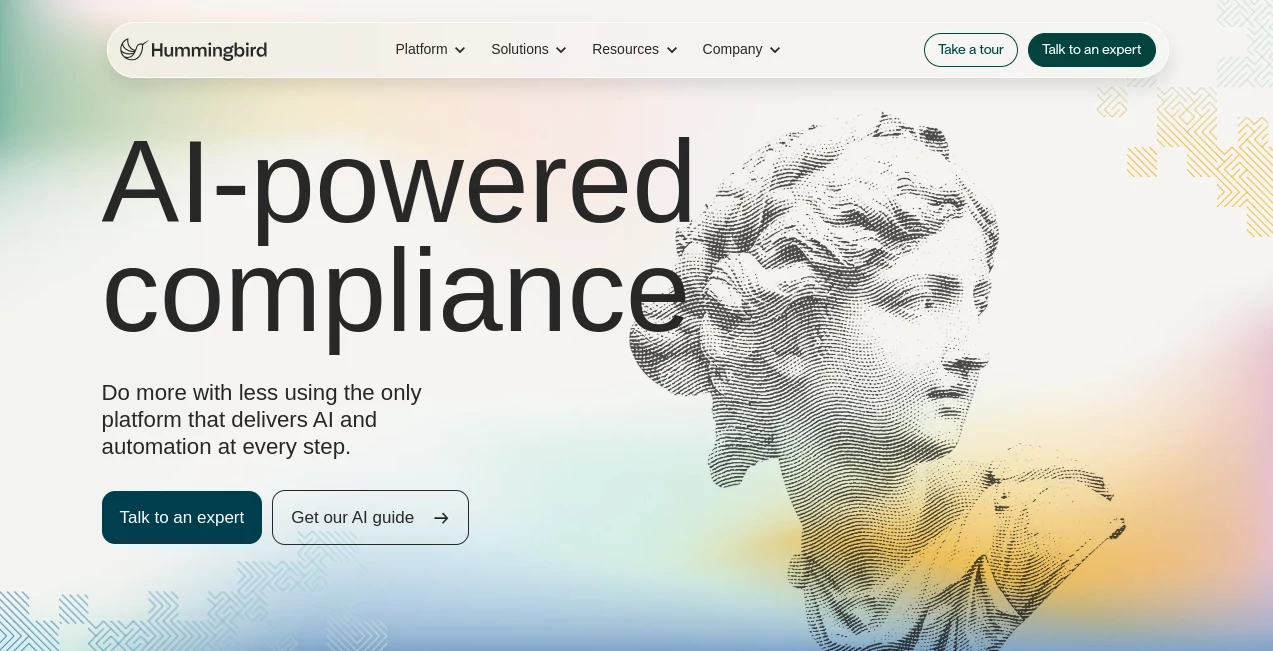
What is Hummingbird?
Financial crime compliance can quickly become a maze of alerts, customer information, investigations, regulatory filings, and repetitive administrative work. Hummingbird brings AI and automation into this environment to help compliance teams move through that workload with greater speed and consistency.
The platform is designed specifically for risk and compliance operations rather than general-purpose business automation. It brings together customer screening, transaction monitoring, investigations, regulatory reporting, AI assistance, and workflow automation in one environment. This makes it particularly useful for banks, fintech companies, crypto businesses, and other organizations that need structured processes for managing financial crime risk.
One of its most interesting strengths is the combination of AI with human oversight. Routine work can be handled by AI agents, while investigators remain responsible for reviewing important findings and making risk-based decisions. That balance can make a real difference in compliance teams where speed matters, but accountability matters just as much.
Key Features
- AI agents for routine financial crime compliance casework
- AI-assisted investigation and case insights
- Customer screening for sanctions, PEPs, and adverse media
- Transaction monitoring capabilities
- Automated SAR, STR, and CTR reporting workflows
- No-code workflow automation
- Customer profiles combining identity data, alerts, cases, and communications
- Integrations with banking systems and third-party data providers
- API access for organizations that want to connect AI capabilities with existing systems
- Configurable approvals, escalation paths, and quality-control checkpoints
User Interface
The platform is built around the way compliance teams actually work. Instead of forcing investigators to jump between disconnected sources, it brings relevant customer information, alerts, previous cases, and communications into a unified workspace.
This approach is especially useful during investigations. An analyst can work with a broader picture of a customer instead of treating every alert as an isolated event. The result is a workspace that feels more like an operational command center than a collection of separate compliance tools.
Its no-code automation capabilities also make the experience practical for teams that need to customize processes without building every workflow from scratch. Triggers, conditions, actions, assignments, SLA management, and quality checks can be configured around internal procedures.
Accuracy & Performance
Performance is one of the platform's strongest selling points. The system is designed to reduce the amount of manual work involved in investigations and reporting while helping teams process cases more quickly.
AI can assist with tasks such as researching entities, finding relevant information across case data, generating insights, and preparing investigation narratives. Instead of replacing the investigator, the technology handles much of the repetitive groundwork so analysts can spend more time evaluating the risk that actually matters.
The platform also emphasizes configurable workflows and audit-ready processes. For compliance teams, that is an important distinction: speed is useful only when the resulting work can still be reviewed, explained, and documented.
Capabilities
The platform covers several stages of the financial crime compliance lifecycle. Customer screening can help teams assess sanctions, politically exposed persons, and adverse media. Transaction monitoring provides another layer for identifying potentially suspicious activity.
For investigations, AI agents can assist with entity research and routine casework, while an AI assistant can answer questions, follow investigative threads, uncover patterns, and help analysts work through established procedures.
Regulatory reporting is another major capability. The system can help prepare SAR and STR narratives and supports filing workflows across multiple financial intelligence units. The company states that its technology supports reporting across more than 60 FIUs.
Organizations can also connect existing systems through APIs and integrations. This is particularly valuable for larger compliance operations that already have banking cores, CRM systems, data warehouses, screening providers, or other specialist tools in place.
Security & Privacy
Security and auditability are central to the product's positioning. The platform gives organizations control over how AI is deployed, including approval requirements, escalation paths, and quality-assurance checkpoints.
The company also states that customer data is not used to train its AI and that data is not retained by third-party model providers. AI activity is tracked through an audit trail, giving compliance teams a record of how the technology was used.
For regulated organizations, these controls are more than nice extras. They provide a practical framework for introducing AI into sensitive investigative workflows while keeping human oversight in place.
Use Cases
- Anti-Money Laundering: Support AML teams with screening, monitoring, investigation, and reporting workflows.
- Customer Due Diligence: Bring together customer information and screening data to support risk assessment.
- Financial Crime Investigations: Use AI-assisted research and case insights to reduce repetitive investigative work.
- Regulatory Reporting: Prepare and manage suspicious activity reports and other regulatory filings more efficiently.
- Fintech Compliance: Give growing financial technology companies a centralized environment for managing compliance operations.
- Crypto Compliance: Help teams working with digital assets manage investigations and on-chain compliance workflows.
- Banking Operations: Connect compliance processes with core banking systems and other data sources.
- Workflow Automation: Automate repetitive assignments, notifications, SLA processes, reviews, and quality checks.
Pros and Cons
Pros
- Purpose-built for financial crime and compliance teams
- Combines AI, automation, investigations, monitoring, and reporting
- AI agents can take on routine casework
- Strong emphasis on human oversight and auditability
- No-code automation makes workflows easier to customize
- Supports integrations and API-based deployment
- Useful across banking, fintech, crypto, and other regulated financial environments
Cons
- Designed for professional compliance teams rather than casual users
- May be more infrastructure than a small organization needs
- Pricing is not publicly listed
- Organizations may need implementation and integration work before using the platform at full scale
Pricing Plans
No public self-service pricing plans are listed. The platform is positioned as an enterprise compliance solution, and prospective customers are encouraged to contact the company and schedule a demo to discuss their requirements.
This approach makes sense for a platform that can involve integrations, customized workflows, AI deployment controls, and regulatory reporting requirements. Pricing is therefore likely to depend on the organization's needs, configuration, and scale rather than a simple individual subscription.
How to Use Hummingbird
- Start by discussing your organization's compliance requirements and current technology stack with the provider.
- Connect relevant data sources, compliance systems, and third-party applications.
- Configure workflows around your existing policies, approvals, escalation paths, and quality checks.
- Use AI assistance and AI agents for appropriate investigative and research tasks.
- Review AI-generated findings and recommendations as part of the human compliance process.
- Automate repetitive reporting, assignments, notifications, and other operational tasks.
- Monitor workflows and use the available audit trail to maintain oversight of AI-assisted activity.
Comparison with Similar Tools
Many compliance products concentrate on one specific part of the financial crime process, such as transaction monitoring, sanctions screening, or case management. This platform takes a broader approach by bringing several of these functions together and adding AI-powered assistance and automation.
That difference is important for organizations trying to reduce the number of disconnected systems used by investigators. Instead of treating screening, investigations, reporting, and workflow management as completely separate activities, the platform is designed to connect them within a unified compliance operation.
It is also more specialized than a general AI assistant. The technology is built around compliance procedures, investigative workflows, regulatory reporting, and auditability. For a financial crime team, that specialization can be considerably more useful than adapting a generic AI tool to sensitive compliance work.
Conclusion
For organizations dealing with financial crime compliance, the biggest challenge is rarely a lack of data. It is turning that data into useful investigative work without overwhelming analysts with repetitive tasks. Hummingbird takes a thoughtful approach to this problem by combining AI agents, investigation tools, automation, screening, monitoring, reporting, and integrations in one compliance-focused platform.
The strongest part of the solution is its focus on collaboration between people and AI. Routine work can be delegated to technology, while investigators retain control over important decisions. Add configurable workflows, audit trails, and integration capabilities, and the result is a platform built for teams that need both efficiency and accountability.
For banks, fintechs, crypto companies, and other organizations with serious compliance requirements, it is worth considering when the goal is to modernize financial crime operations without sacrificing human oversight.
Frequently Asked Questions (FAQ)
What is Hummingbird used for?
It is used by financial institutions and compliance teams to manage financial crime operations, including customer screening, transaction monitoring, investigations, regulatory reporting, and workflow automation.
Does Hummingbird use AI for financial crime investigations?
Yes. Its AI capabilities can assist with entity research, casework, investigation insights, investigative questions, and narrative writing. AI agents can also automate selected routine compliance tasks.
Can Hummingbird automate compliance workflows?
Yes. Its no-code automation tools allow teams to configure triggers, conditions, and actions for repetitive processes such as assignments, SLA management, notifications, reviews, and quality checks.
Does Hummingbird integrate with other software?
Yes. The platform provides integrations with banking systems, third-party data providers, business applications, and other tools. API access is also available for organizations that want to connect its AI capabilities with an existing case management environment.
Is Hummingbird suitable for small businesses?
It is primarily designed for professional financial crime and compliance operations. Smaller organizations may benefit from it when they have significant regulatory requirements, but teams should evaluate the platform's implementation needs and commercial model before adopting it.
Does Hummingbird offer a free plan?
No public free or self-service plan is listed. Organizations interested in the platform can contact the provider and request a demonstration to discuss their requirements.
AI Workflow Management , AI Research Tool , AI Legal Assistant .
These classifications represent its core capabilities and areas of application. For related tools, explore the linked categories above.

Hummingbird Alternatives Product

MindSnapz

Sound Level …

Yorph AI

AllInOneTools

Zapier

SEO Tools Hu…

SciSpace

Grok

TutuoAI