


















iPulse AI
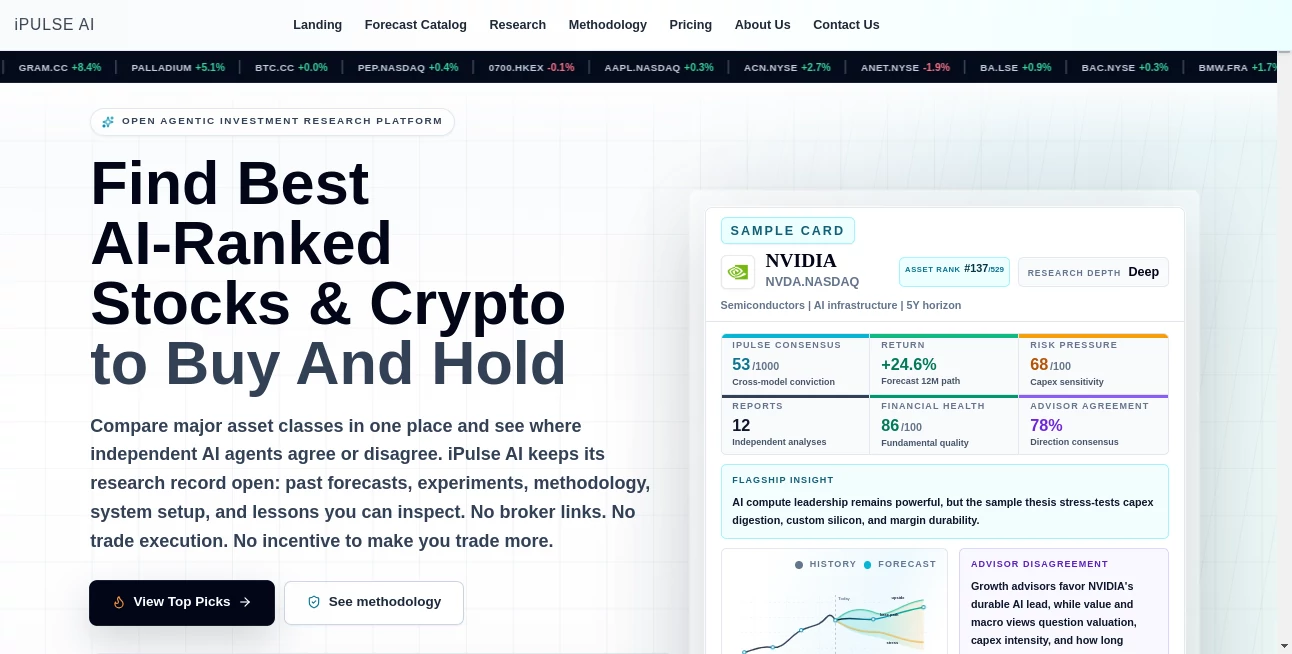
What is iPulse AI?
Finding an interesting stock or cryptocurrency is easy. Understanding why it may be interesting, what could go wrong, and how different analytical approaches view the same asset is much harder. iPulse AI takes a research-first approach by bringing multiple AI analysis frameworks together and turning their findings into structured market research.
The platform is designed for investors, analysts, researchers, and curious market watchers who want more than a stream of prices and headlines. It covers stocks, cryptocurrencies, commodities, indices, and forex, allowing users to explore opportunities across several asset classes from one place.
One of its most interesting ideas is the use of multiple independent AI advisors rather than relying on a single generated answer. The system runs large numbers of prompts and analysis workflows, compares the resulting views, and produces a consensus score that helps users see where the different perspectives agree and where they diverge.
This makes the experience particularly useful for research. Instead of asking an AI model about a company and receiving one polished opinion, users can inspect different forecasts, assumptions, risks, opportunities, and reasoning behind the overall signal.
Key Features
- AI-powered investment research across multiple asset classes
- 100+ investment analysis frameworks
- Thousands of prompts processed in parallel during deep analysis
- Multi-agent advisor research with different analytical perspectives
- Consensus scoring based on forecast direction, magnitude, consistency, volatility, and other factors
- Ranked BUY and SELL signals
- Historical forecasts for transparency and comparison
- Detailed asset research reports
- Fundamental company and financial data
- Forecast scenarios covering different time horizons
- Risk, opportunity, tailwind, and headwind analysis
- Market coverage spanning stocks, crypto, commodities, indices, and forex
- Searchable asset research catalog
- Mispricing and Alpha Value Gap signals on paid plans
User Interface
The interface is built around discovery and comparison rather than complicated trading screens. Users can start with ranked market opportunities and then open an individual asset for a deeper look.
Research pages bring several pieces of information together, including company context, industry information, forecasts, financial performance, valuation data, risks, and the reasoning behind individual AI advisor predictions. Charts and forecast views make it easier to compare scenarios without jumping between several unrelated research tools.
The Top Picks area is particularly practical for users who do not want to begin their research with a specific ticker. It presents ranked opportunities and warning signals, giving investors a starting point for further investigation.
Accuracy & Performance
The platform approaches forecasting as a research problem rather than presenting AI predictions as guaranteed outcomes. Its consensus system combines multiple advisor outputs and considers factors such as forecast direction, expected return, consistency, volatility, dividends, and event-related risk.
Another useful feature is forecast history. Previous predictions can remain available for inspection, making it possible to compare earlier expectations with what happened later. This creates a more useful feedback loop than a system that only displays today's prediction and forgets yesterday's.
There is still an important limitation: financial markets are unpredictable, and AI-generated forecasts can contain errors, bias, or incorrect assumptions. The platform itself describes its outputs as research and decision-support information rather than personalized financial advice. For that reason, the strongest use of the service is as a research companion rather than an automatic trading system.
Capabilities
The breadth of analysis is where the platform becomes especially interesting. A single asset can be examined through several analytical perspectives, with individual advisor reports available alongside the aggregated result.
Users can investigate stocks such as technology and financial companies, major cryptocurrencies, commodities including gold and oil, market indices, and selected forex pairs. Depending on the asset and workflow, forecasts can extend from shorter-term views to scenarios reaching five years.
The research workflow also connects AI analysis with conventional financial information. Company pages can include revenue, net income, free cash flow, valuation, leverage, liquidity, assets, debt, equity, dividends, and historical performance. This combination helps prevent the research experience from becoming nothing more than an AI-generated opinion.
The consensus score is another distinctive element. Rather than hiding disagreement, the system keeps different advisor perspectives visible and uses them as part of the research process. For an investor, that can be valuable: strong agreement may tell one story, while a wide disagreement between models can signal that an opportunity deserves a closer look.
Security & Privacy
The service takes a relatively simple approach to account-related financial information. At its current stage, users do not need to connect a brokerage account or provide bank details, personal financial statements, portfolio holdings, or a personal risk-profile questionnaire to access the research platform.
It also does not execute trades, hold assets, or provide custody. Users remain responsible for deciding what to do with the research they see.
For anyone considering an AI investment research service, this separation is useful. The platform can be used to investigate markets without giving it direct control over a brokerage account or investment portfolio.
Use Cases
One straightforward use case is building a watchlist. Instead of manually scanning hundreds of companies, users can start with ranked opportunities and then investigate the assets that catch their attention.
It can also help investors pressure-test an existing idea. Suppose someone is interested in a technology stock because of its growth prospects. Looking at several AI advisor perspectives can reveal concerns around valuation, competition, capital expenditure, margins, or changes in the broader market.
Crypto researchers can use the same workflow to compare major digital assets and examine forecasts alongside risk factors. Commodity and forex traders may also find value in having different market views collected in one research environment.
For analysts and consultants, historical reports can provide a useful research archive. Instead of starting from scratch every morning, previous forecasts and reasoning can be reviewed before updating a thesis.
It is also useful for investors who simply do not have hours available for daily market research. A structured shortlist can provide a much quicker starting point than opening dozens of financial websites and attempting to combine the information manually.
Pros and Cons
Pros
- Uses multiple AI advisors instead of a single model response
- Provides a transparent research workflow
- Keeps historical forecasts available for inspection
- Covers several major asset classes
- Combines AI forecasts with fundamental financial information
- Offers ranked market opportunities and warning signals
- Provides detailed reasoning behind individual forecasts
- Includes a free plan for exploring the platform
Cons
- AI forecasts cannot guarantee investment results
- The free plan is limited to 10 assets
- Some planned portfolio features are not yet available
- Users still need to perform their own due diligence
- The platform is intended for research rather than direct trade execution
Pricing Plans
A free plan is available at no cost. It provides access to a limited selection of 10 assets, more than 75 years of historical market data, forecasts extending up to five years, detailed investment reports, asset tailwinds and headwinds, risk and opportunity information, and daily BUY and SELL leaderboards.
The Base Plan is listed at $19 per month when billed monthly, with an annual option that lowers the effective monthly price. The paid plan expands access to stocks, crypto, commodities, indices, and forex tickers, adds fundamental data and past forecasts, and includes mispricing and Alpha Value Gap signals. A seven-day trial is also offered.
A Professional Plan is available with tailored pricing. It is aimed at broader portfolio and reporting requirements and includes features such as portfolio-level research capabilities, Excel and PDF reporting, forecast accuracy metrics, multi-client workspaces, and the possibility of requesting additional assets.
How to Use the Platform
- Create an account and start with the available free research.
- Open the Top Picks section to explore ranked BUY and SELL opportunities.
- Select an asset that interests you.
- Review its summary, forecast scenarios, financial information, risks, and opportunities.
- Compare individual AI advisor reports to understand different perspectives.
- Pay attention to both agreement and disagreement between advisors.
- Review historical forecasts when available.
- Use the research as one input in your own investment decision-making process.
Comparison with Similar Tools
Traditional financial research platforms are often excellent at presenting market data, company fundamentals, analyst opinions, charts, and screening tools. General-purpose AI assistants can also conduct deep research when given a specific company or market question. The difference here is the attempt to run that research repeatedly across a broad asset universe and preserve the resulting analysis for later inspection.
Another distinction is the emphasis on advisor disagreement. A conventional single-answer AI workflow can make an investment thesis sound more certain than it really is. By presenting several analytical perspectives, this platform gives users an opportunity to see where assumptions conflict.
It is not a replacement for a brokerage platform, because it does not execute trades or hold investments. It is also not intended to replace professional financial advice. Its strongest position is somewhere between market research software and an AI-powered research assistant: a place to discover ideas, investigate them, compare perspectives, and decide what deserves deeper human attention.
Conclusion
For investors overwhelmed by market information, the biggest challenge is often not finding data but deciding what deserves attention. This platform addresses that problem by combining market information, fundamental analysis, multiple AI perspectives, forecasts, and historical research into a single workflow.
The multi-agent approach is its most compelling feature. Instead of treating one AI response as the final word, the system makes room for different interpretations and turns their outputs into a structured consensus signal. That does not remove uncertainty, but it can make uncertainty easier to see.
The free plan makes it possible to explore the concept without committing to a subscription, while the paid plans provide broader asset coverage and deeper research access. For investors who want an organized way to discover market ideas and challenge their own assumptions, it is a compelling addition to a research toolkit.
The important point is to use the forecasts in the right context. Markets can move for reasons no model anticipates, and an attractive AI score is not a promise of future performance. Used as research and decision support, however, the combination of multiple perspectives, historical outputs, and transparent methodology can make the investment research process considerably more structured.
Frequently Asked Questions (FAQ)
What does the platform analyze?
It provides AI-assisted research across stocks, cryptocurrencies, commodities, indices, and forex. Coverage and forecast horizons can vary depending on the asset and available workflow.
How are the investment forecasts generated?
The system combines market information, structured prompts, different AI advisor configurations, and analytical frameworks. Individual forecasts are then processed into structured outputs containing predictions, drivers, risks, opportunities, and thesis summaries.
What is the consensus score?
The consensus score is a bounded signal designed to summarize the direction and strength of multiple AI advisor forecasts. It considers factors including forecast magnitude, consistency, volatility, and other risk-related inputs. It should not be interpreted as a guarantee of future performance.
Can users trade directly through the platform?
No. The service does not function as a broker and does not execute trades, hold assets, or provide custody. Users must make investment decisions and execute trades through their chosen financial provider.
Is the platform financial advice?
No. Its forecasts and reports are intended as educational market intelligence and research support. They are not personalized financial, tax, legal, or investment advice, and users should apply independent judgment before making financial decisions.
Is there a free version?
Yes. The free plan provides access to a limited set of assets, historical market data, long-term forecasts, detailed reports, risk and opportunity information, and daily BUY and SELL classifications.
AI Investing Assistant , AI Research Tool , AI Analytics Assistant , AI Trading Bot Assistant .
These classifications represent its core capabilities and areas of application. For related tools, explore the linked categories above.

iPulse AI Alternatives Product

AISEOMate

Schedpilot

CheckAEO

Serplux

Schema Synth

cznull

Harvey

Sourcetable

Sound Level …
