
krucbl
What is krucbl?
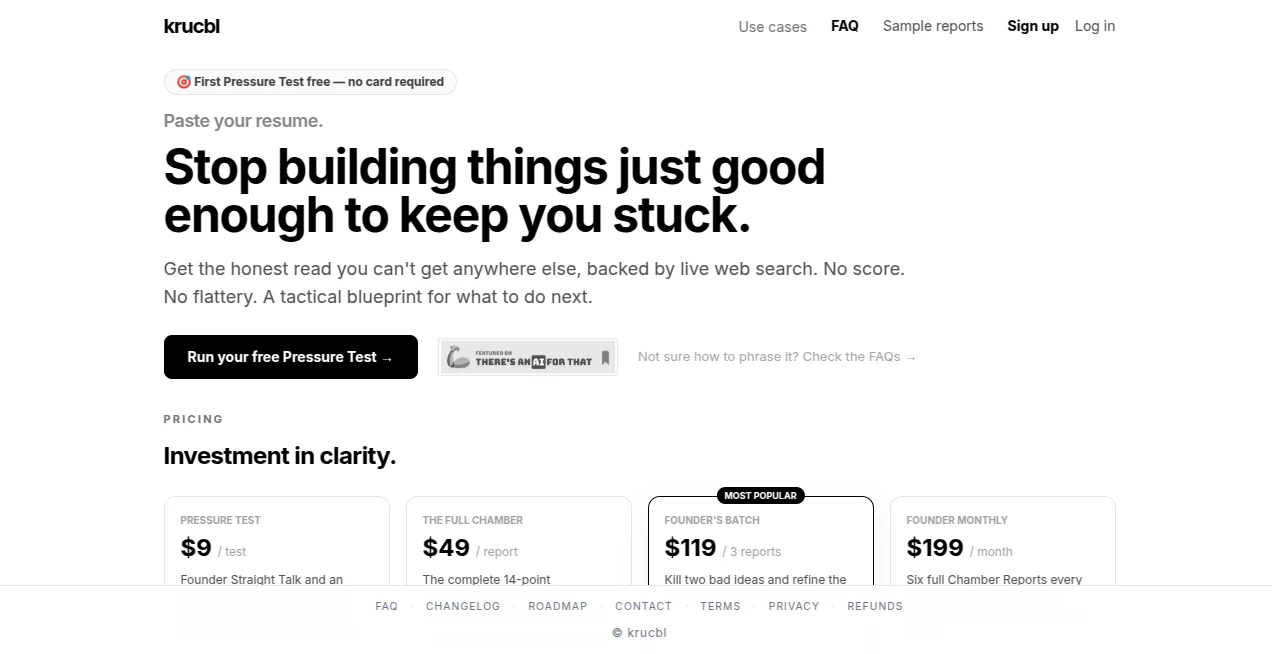
Building a product is exciting, but deciding whether an idea deserves months of work is a much harder question. Many founders rely on friendly opinions, generic market research, or AI conversations that tend to focus on the positive side of an idea. krucbl takes a different approach. It is an AI-powered idea diagnostic service designed to pressure-test product concepts before significant time and money are committed.
The service combines large language models with live web research and a structured 14-point analytical framework. Instead of simply giving an idea a score, it looks for contradictions, competitive threats, weak business assumptions, timing problems, customer friction, and other factors that could quietly cause a product to fail.
This makes it particularly interesting for founders who would rather discover a serious problem before building than after launching. A short analysis can sometimes save weeks of development work and prevent a promising-looking concept from turning into an expensive distraction.
Key Features
- Live web search for current competitor and market information
- A structured 14-point diagnostic framework
- Founder-focused analysis without artificial optimism
- Competitive research based on current web information
- Tactical recommendations rather than generic encouragement
- Analysis of customer behavior, market timing, unit economics, and product risks
- Identification of potential pivots and alternative directions
- Reports designed to be delivered within minutes rather than requiring a long research process
User Interface
The experience is deliberately simple. The process starts with a straightforward request to paste an idea, which removes much of the setup normally associated with research platforms. This is useful for founders who want to test several concepts without learning a complicated dashboard first.
The simplicity also fits the product's purpose. The important part is not navigating dozens of settings; it is getting a useful assessment of whether an idea deserves further investment.
Accuracy & Performance
A major strength is the use of live web search during analysis. Instead of relying entirely on information contained in an AI model's older training data, the system checks current web information to identify real competitors and market signals.
The analysis is also structured around fourteen specific pressures. These include internal contradictions, user reactions, competitive positioning, timing, economics, technical feasibility, psychological barriers, and potential failure points. That structure makes the output more practical than an open-ended AI conversation.
There is still an important caveat: live research does not make an automated report infallible. The website itself acknowledges that the web changes and that models can occasionally get things wrong. For major investment decisions, the report should therefore be treated as a strong research input rather than the only source of truth.
Capabilities
The diagnostic process goes considerably beyond asking whether an idea sounds good. It examines what the product is actually doing, where its internal logic may break, and what a real customer might experience.
It can investigate who already controls a market, identify gaps competitors may have missed, explore possible pivots, assess whether market timing makes sense, and consider who the first likely customers could be. It also looks at unit economics, structural advantages, competitive threats, purchasing psychology, operational complexity, and whether the proposed product can realistically be built and shipped.
For a founder sitting between two or three possible directions, this type of structured criticism can be especially useful. Instead of asking an AI to choose a favorite idea, the founder can use the analysis to understand where each concept is strong and where it could break.
Security & Privacy
Privacy is addressed directly in the service's FAQ. User inputs are not used to train the models, and generated reports remain inside the user's account. Reports are only visible to other people when the user chooses to share a link.
That approach is important for founders who may be testing an early concept that has not yet been publicly announced. Even so, users should always avoid submitting highly sensitive information that is unnecessary for evaluating an idea.
Use Cases
The service can be useful at several stages of product development. A founder with a new SaaS concept can use it to investigate competitors before writing the first line of code. Someone considering a marketplace can examine customer behavior, existing alternatives, and possible economic weaknesses.
It can also help when an existing product has reached a plateau. Rather than immediately adding another feature, a founder can use a diagnostic report to investigate whether the real problem lies in positioning, customer psychology, pricing, competition, or the underlying business model.
Another practical use is comparing multiple ideas. The Founder's Batch is specifically designed for this situation, providing three full reports and cross-idea comparison. That can make the research process more disciplined when several possible directions are competing for the same limited development time.
Pros and Cons
- Pros: Uses live web research instead of relying solely on older model knowledge.
- Pros: The 14-point framework provides a much more structured analysis than a normal AI chat.
- Pros: The deliberately blunt approach can expose problems that overly positive feedback may hide.
- Pros: Reports include tactical directions and potential pivots instead of stopping at criticism.
- Pros: Several pricing options make it possible to test one idea or analyze multiple concepts.
- Cons: Automated market research can still contain errors or miss information that changes quickly.
- Cons: It is a diagnostic tool, not a replacement for talking to real customers.
- Cons: Founders looking only for encouragement may find the deliberately critical approach uncomfortable.
Pricing Plans
The service currently offers several ways to purchase an analysis. The Pressure Test costs $9 per test and includes Founder Straight Talk plus an initial brief based on a short live search.
The Full Chamber costs $49 per report and provides the complete 14-point diagnostic, live competitive search integration, and a tactical action grid.
For founders comparing several concepts, the Founder's Batch costs $119 for three full reports and includes priority processing and cross-idea comparison. There is also a Founder Monthly plan at $199 per month, which includes six full Chamber reports each month and renews automatically until canceled.
How to Use It
Start by clearly describing the product or business idea you want to investigate. A useful description should explain what the product does, who it is intended for, and the problem it aims to solve.
Submit the idea for analysis and select the report level that matches your needs. The initial option is suitable when you want a quick reality check, while the full diagnostic is better when you are seriously considering building the product.
Once the report is ready, read the criticism as carefully as the recommendations. Pay particular attention to competitive gaps, customer friction, economic assumptions, and the reasons a potential buyer might walk away. If the analysis identifies a serious weakness, use the suggested tactical pivots to rethink the concept before investing heavily in development.
Comparison with Similar Tools
Traditional AI chatbots are useful for brainstorming, market research prompts, and exploring possible business directions, but they often depend heavily on the quality of the questions being asked. They may also produce overly agreeable answers when a founder is looking for validation.
This service is positioned differently. Its workflow is built around diagnosis rather than conversation. Live web search is incorporated into the research process, and the fixed 14-point framework forces the analysis to examine areas that a casual brainstorming session might overlook.
The distinction is particularly valuable when the goal is not to generate more ideas but to challenge an existing one. A founder does not necessarily need another list of reasons why a product could work; sometimes the more valuable information is the uncomfortable reason it might not.
Conclusion
Good product development is not only about building quickly. It is also about knowing when an idea deserves to be built in the first place. This diagnostic approach gives founders a practical way to challenge their assumptions before committing substantial resources.
The combination of live competitive research, structured analysis, and a deliberately honest tone makes it a useful option for early-stage product validation. It will not replace customer interviews, financial modeling, or hands-on market testing, but it can provide a valuable layer of research before those investments become larger.
For founders who prefer uncomfortable answers over comfortable validation, a focused idea diagnostic can be a surprisingly useful step between having an idea and deciding to build it.
Frequently Asked Questions (FAQ)
Is this just an AI chatbot?
No. Although large language models are used as part of the technology, the service combines them with live web search, competitor research, and a custom 14-point diagnostic framework. The purpose is structured product analysis rather than open-ended conversation.
Does it search the web in real time?
Yes. Live web search is used during the analysis to identify current competitors and market information rather than relying exclusively on older training data.
Does the system use submitted ideas to train models?
According to the site's privacy information, user inputs are not used to train the models.
How quickly are reports delivered?
The full diagnostic is advertised as being ready in under 15 minutes, while the initial Pressure Test is designed to arrive within a few minutes.
Can I analyze several business ideas?
Yes. The Founder's Batch includes three full reports and cross-idea comparison, making it suitable for founders deciding which concept deserves more attention.
Can I share my report?
Yes. Reports remain in the user's account and are only visible to others when the user chooses to share the report link.
Does the analysis guarantee that an idea will succeed?
No. The purpose is to uncover risks, contradictions, competitive pressures, and opportunities before a founder commits significant resources. Market conditions can change, so the report should be combined with real customer research and ongoing validation.
AI Research Tool , AI Business Ideas Generator , AI Consulting Assistant .
These classifications represent its core capabilities and areas of application. For related tools, explore the linked categories above.

krucbl Alternatives Product

obbylist

Schema Synth

Sleepless Tr…

Preuve AI

GEO Checker

Hirescope.te…

Aiso
JSON to TOON…

Syncity AI