
Listing Good
What is Listing Good?
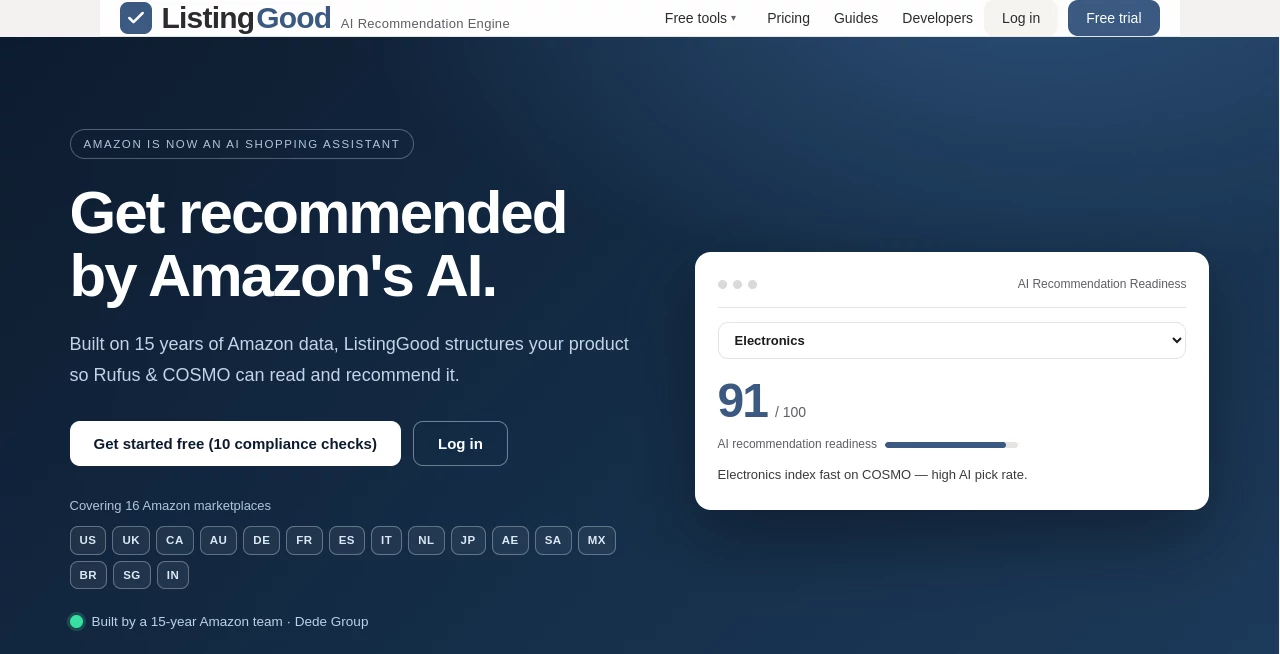
ListingGood is an AI-powered recommendation and listing optimization platform built for Amazon sellers who want their products to be easier for Amazon's AI shopping systems to understand, evaluate, and recommend. Instead of treating a product listing as a collection of keywords, the platform focuses on structure, product attributes, compliance, localization, and competitive positioning.
The service combines listing generation with compliance analysis and marketplace-specific research. Sellers can provide product information, keywords, selling points, notes, and product images, then generate listing content for multiple Amazon marketplaces. It currently supports markets including the US, UK, Canada, Australia, Germany, France, Spain, Italy, the Netherlands, Japan, UAE, Saudi Arabia, Mexico, Brazil, and Singapore.
What makes the approach particularly useful is its focus on the changing way shoppers discover products. Amazon is increasingly using AI-driven systems to interpret product information, so clear attributes, useful descriptions, relevant search terms, and consistent product information can matter far beyond traditional keyword placement.
Key Features
- AI-assisted Amazon title, bullet point, search term, and A+ content generation.
- AI-readable product structure designed around product attributes and use cases.
- Compliance scanning for potential listing risks before publishing.
- Marketplace-specific localization for international Amazon sellers.
- AI-ready scoring covering readability, compliance, and competitiveness.
- Competitor research to help sellers understand how their listings compare with others.
- Product image analysis for certain compliance concerns.
- Appeal generation for Amazon warnings and violation notices.
- Negative review analysis with suggested response and improvement plans.
- Workspace history with the ability to revisit products and rerun previous work.
User Interface
The interface is organized around a straightforward product workflow. Sellers enter information such as the product name, SKU, category, brand, gender, estimated price, materials, size, color, season, occasion, selling points, keywords, and differentiators. Images can also be uploaded so the system has additional product context.
This setup is practical because it keeps the important information in one place instead of requiring sellers to repeatedly explain the same product to different tools. The marketplace selector also makes international listing work easier to manage from a single workspace.
Accuracy & Performance
The platform goes beyond simply asking a general language model to write marketing copy. Its website describes a proprietary knowledge base built around years of Amazon experience, marketplace policies, compliance information, and real-world cases. That additional context is valuable when the goal is not just attractive writing but content that can survive the practical requirements of an Amazon listing.
Generation can take several minutes because the workflow includes research, localization, and compliance scanning. For sellers managing serious product catalogs, that trade-off can be worthwhile when the alternative is manually researching every marketplace and checking every listing for potential problems.
Capabilities
The core listing workflow can generate titles, five bullet points, search terms, A+ content, category attributes, and brand-story elements. The system also supports multimodal input, allowing product images to contribute to the generated listing and compliance analysis.
Another useful capability is the compliance checker. Sellers can paste existing Amazon listing content, enter an Amazon product URL or ASIN, and provide images for additional analysis. The system checks areas such as superlatives, price promises, medical claims, off-Amazon redirects, cosmetic claims, food claims, and electronics safety considerations.
For sellers dealing with account warnings, the appeal feature can turn an Amazon violation notice into a marketplace-specific Plan of Action. Negative reviews can also be analyzed to produce a more structured response and improvement plan.
Security & Privacy
The platform provides account-based access and uses Stripe for payment processing. Its website also provides dedicated terms and privacy pages for users who want to review its policies before creating an account. As with any service used to process commercial product information, sellers should review the current privacy and terms documentation and avoid submitting information they are not comfortable sharing with a third-party service.
Use Cases
Amazon listing optimization: Sellers can use the platform to create better-organized titles, bullets, search terms, and supporting content from structured product information.
International expansion: Businesses selling in several Amazon marketplaces can generate localized content instead of relying on literal translations that may sound unnatural to local shoppers.
Compliance review: Before publishing a listing, sellers can scan copy for potentially problematic claims and receive suggested fixes.
Product research: Competitor research features can help sellers examine how their products compare with other listings in the same category.
Account recovery: Sellers who receive warnings or violations can use the appeal workflow to organize a more marketplace-specific response.
Review management: Negative buyer feedback can be analyzed to help sellers prepare an appropriate response while identifying possible product or listing improvements.
Pros and Cons
- Pros: Combines listing creation, compliance, research, localization, and appeal assistance in one workspace.
- Pros: Supports multiple Amazon marketplaces, making it useful for international sellers.
- Pros: Uses structured product information rather than relying only on a simple writing prompt.
- Pros: Includes useful compliance checks before listings are published.
- Pros: New users receive free stars to test the service before committing to paid usage.
- Cons: The generation process can take several minutes because research and compliance checks are performed together.
- Cons: The platform is specifically focused on Amazon sellers, so it may have limited value for businesses that do not sell through Amazon.
- Cons: Users managing large catalogs should consider the ongoing usage cost when planning their workflow.
Pricing Plans
The platform uses a star-based usage model rather than a traditional fixed price for every generation. New users receive 10 free stars when signing up. The site states that one star costs $0.10 per marketplace for its monthly subscription model, while additional stars can be topped up and do not expire.
Because costs can depend on the number of marketplaces checked and the specific features used, sellers with larger catalogs should evaluate their expected monthly workload before choosing a subscription or purchasing additional stars.
How to Use It
- Start by creating an account and using the available free stars to test the workflow.
- Enter the product name, SKU, category, brand, and other relevant product details.
- Add selling points, keywords, notes, and differentiators to give the system more useful context.
- Upload product images when visual information can improve the listing or compliance analysis.
- Select the Amazon marketplaces where the product will be sold.
- Generate the listing and allow the system to perform its research, localization, and compliance checks.
- Review the generated title, bullets, search terms, A+ content, and product attributes before publishing.
- Use the compliance checker for an existing listing when you want to identify potential risks.
- If an Amazon warning or negative review is received, use the appeal or review-analysis features to prepare a response and improvement plan.
Comparison with Similar Tools
Many AI writing platforms can produce product descriptions or rewrite marketing copy, but this service takes a more specialized approach. Its focus is Amazon rather than general content creation. The combination of listing generation, marketplace localization, compliance analysis, competitor research, review analysis, and appeal assistance makes it more closely aligned with the daily workflow of an Amazon seller.
A general-purpose writing assistant may be preferable when a business needs blog posts, social media content, or broad marketing copy. For an Amazon-focused operation, however, a specialized workflow can reduce the amount of manual research and context that needs to be supplied for every listing.
Conclusion
For Amazon sellers, good listing copy is only part of the challenge. Product information needs to be structured clearly, localized appropriately, aligned with marketplace requirements, and presented in a way that modern AI shopping systems can understand.
This platform brings those tasks into one focused workspace. Its combination of AI listing generation, compliance checking, marketplace localization, competitor research, and seller-support features gives it a practical role in the modern Amazon workflow. It is especially interesting for brands expanding internationally or managing multiple products where manually reviewing every listing can quickly become time-consuming.
Frequently Asked Questions (FAQ)
What is this platform designed for?
It is designed primarily for Amazon sellers who want to create, optimize, localize, and check product listings while improving their readiness for AI-powered product recommendations.
How many Amazon marketplaces are supported?
The platform currently lists support for multiple marketplaces across North America, Europe, Asia, the Middle East, and other regions, including the US, UK, Canada, Australia, Germany, France, Spain, Italy, the Netherlands, Japan, UAE, Saudi Arabia, Mexico, Brazil, and Singapore.
Can it generate Amazon product listings?
Yes. Sellers can provide structured product information and generate titles, bullet points, search terms, A+ content, category attributes, and other listing elements.
Can it check an existing listing?
Yes. Existing listing copy can be submitted for compliance analysis. Product URLs or ASINs and product images can also be provided as optional context.
Does it help with Amazon compliance?
Yes. Its compliance workflow checks multiple risk areas and provides suggested fixes. The checks are designed to identify potential problems before content is uploaded to Amazon.
Can it help with Amazon violations?
Yes. Sellers can paste an Amazon warning or violation notice and generate a marketplace-specific Plan of Action. The platform also provides a separate workflow for analyzing negative customer reviews.
Is there a free option?
New users receive 10 free stars after signing up, allowing them to test the service before purchasing additional usage.
Who would benefit most from using it?
Amazon brands, agencies, international sellers, private-label businesses, and teams managing multiple product listings are likely to get the most value from the platform, particularly when listing quality and compliance need to be handled together.
AI SEO Assistant , AI E-commerce Assistant , AI Copywriting , AI Product Description Generator .
These classifications represent its core capabilities and areas of application. For related tools, explore the linked categories above.

Listing Good Alternatives Product

TrueSource AI

Sourcetable

Vmake AI

Cataseo AI

AI Product P…

Maestra

Inkfox AI

Krisp

etsyseotools