


















Maxima
What is Maxima?
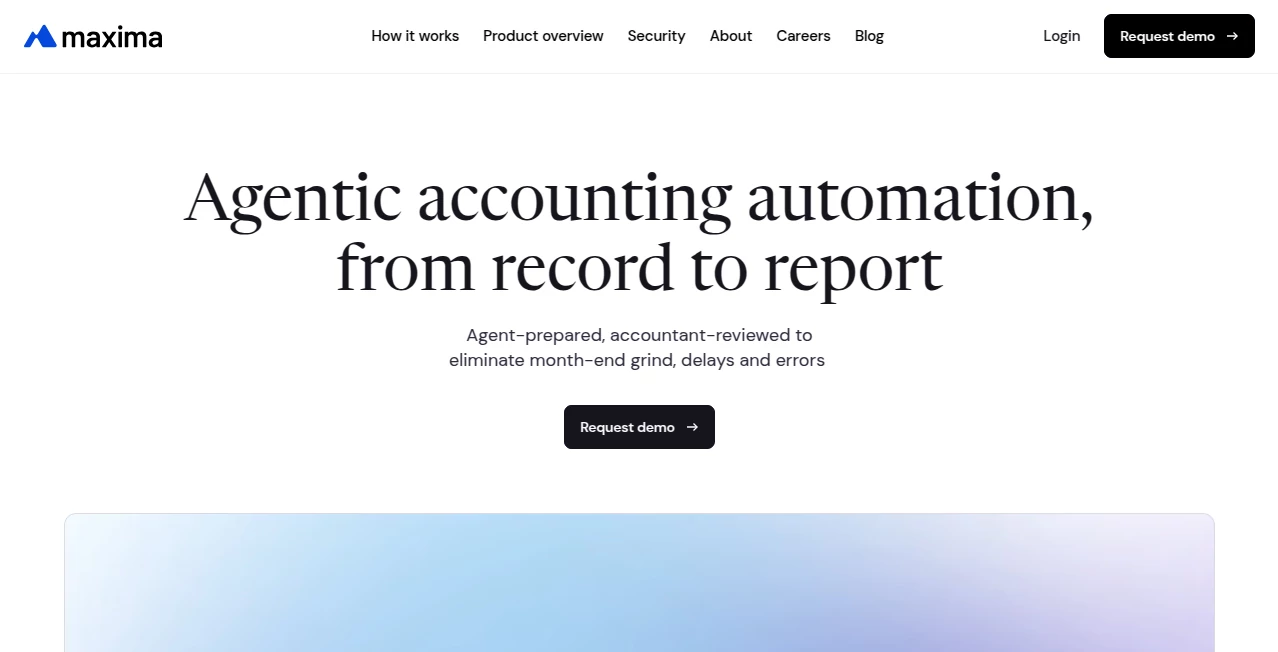
Month-end close has always been painful — late nights, endless spreadsheets, frantic reconciliations, and that constant fear of something slipping through the cracks. Maxima changes the game. Instead of just helping accountants work faster, it puts intelligent agents in the driver’s seat: pulling data, preparing journal entries, running reconciliations, and even explaining variances — all while leaving a clear, auditable trail for humans to review. Finance leaders at fast-growing companies like Scale AI are closing days faster with over 98% automation. It feels less like software and more like finally having a highly competent team member who never sleeps and actually understands accounting.
Introduction
Traditional accounting tools digitize processes but still leave humans doing the heavy lifting. Maxima is different — it’s built as an agentic platform purpose-made for the entire financial close. It connects to your ERP, banks, payroll, and other systems, builds a unified financial graph, and lets specialized AI agents handle the repetitive, error-prone work that usually drags teams down. The result is faster closes, fewer errors, and accountants who can finally focus on analysis and strategy instead of chasing down transactions. It’s the kind of shift that makes you wonder how you ever managed without it.
Key Features
User Interface
The dashboard is clean and purposeful, designed for busy finance teams rather than engineers. You see a clear overview of the close status, what agents are working on, and what’s ready for review. Everything is traceable — you can drill into any journal entry or reconciliation and see exactly where the data came from and why the agent made a particular decision. It feels familiar to accountants while adding a powerful layer of automation that doesn’t get in the way.
Accuracy & Performance
Accuracy is non-negotiable in accounting, and this is where Maxima shines. Every output includes full lineage and evidence, making it SOX-compliant and audit-ready by design. Teams report closing 2–3 days faster with over 98% automation in some areas. The agents don’t just guess — they follow your policies, validate against source data, and flag anomalies for human attention. It’s the rare AI system that actually increases confidence rather than creating new risks.
Capabilities
It automates the full close cycle: extracting and transforming data, preparing workbook schedules, generating and posting journal entries, reconciling accounts, matching balances, analyzing flux variances, and more. It handles complex areas like cash coding, payroll entries, prepaids, leases, commissions, stock-based compensation, and fixed assets. The unified finance graph gives agents complete context across all your systems, enabling truly intelligent automation instead of simple rule-based tasks.
Security & Privacy
Built for enterprise environments with serious compliance needs. Every action is logged with full traceability, data stays within your controls, and the system is designed around auditability from day one. Finance teams dealing with sensitive financial data can trust that the platform respects both security and regulatory requirements.
Use Cases
A high-growth SaaS company uses it to close faster every month, freeing their team to focus on strategic analysis instead of manual grind. A finance leader at a scaling startup replaces multiple point solutions with one intelligent platform that grows with them. An accounting team tired of late nights and error-prone spreadsheets finally gets predictable, reliable closes. It’s especially powerful for companies with complex operations across entities, currencies, and systems where traditional automation falls short.
Pros and Cons
Pros:
- Truly agentic automation that handles end-to-end close processes with minimal human intervention.
- Full audit trail and evidence for every action — built for trust and compliance.
- Connects deeply with your existing finance stack instead of forcing rip-and-replace.
- Significant time savings — teams are closing days faster.
- Handles real enterprise complexity without breaking.
Cons:
- Best suited for mid-to-large finance teams with existing systems to integrate.
- As a powerful enterprise platform, it requires proper setup and some change management.
Pricing Plans
Maxima is an enterprise-focused platform with custom pricing based on transaction volume, number of entities, and specific needs. They work closely with teams to demonstrate ROI through pilots and case studies. The value usually becomes clear quickly through faster closes, reduced errors, and freed-up accountant time for higher-value work.
How to Use Maxima
Connect your financial systems (ERP, banks, payroll, etc.) so the platform can see the full picture. Define or import your accounting policies. Let the agents begin preparing the close — they’ll pull data, create entries, run reconciliations, and flag items for review. Review the prepared work with full context and evidence, make any final adjustments, and approve. Over time, the system learns your specific processes and becomes even more effective. It’s designed so accountants stay in control while the repetitive work gets handled intelligently.
Comparison with Similar Tools
Traditional RPA and basic automation tools follow rigid rules and break easily with exceptions. Generic AI accounting assistants often lack the depth and auditability enterprises need. Maxima stands apart by combining deep financial understanding, agentic workflows, and full traceability in one unified platform. It’s not just faster — it’s more reliable and transparent than previous generations of accounting tech.
Conclusion
The financial close doesn’t have to be a monthly nightmare anymore. Maxima shows what’s possible when powerful AI agents are built specifically for accounting with auditability and control at the core. It lets talented finance teams move from grinding through transactions to focusing on insight, strategy, and growth. For any organization serious about modernizing its accounting operations, this represents a genuine leap forward — one that actually delivers on the promise of AI in the enterprise.
Frequently Asked Questions (FAQ)
How much time can we actually save on close?
Many teams report closing 2–3 days faster, with some processes seeing over 98% automation.
Is it secure and audit-ready?
Yes — built with SOX compliance, full lineage, and evidence for every action.
Do we need to replace our existing ERP?
No — it connects on top of your current systems without rip-and-replace.
Who reviews the AI’s work?
Accountants review and approve — the agents prepare, humans provide final oversight.
AI Accounting Assistant , AI Research Tool , AI Business Ideas Generator , Other .
These classifications represent its core capabilities and areas of application. For related tools, explore the linked categories above.

Maxima Alternatives Product

Sand Loop Gu…

AIDeckly

ChatFlowchart

FLINT AI

PromptZerk

Construction…

SaasThink

Treeova

LocaFlow