
NumLookup
What is NumLookup?
Getting a call from an unfamiliar number can leave you wondering whether it is a genuine person, a business, a delivery service, or simply another unwanted call. NumLookup provides a straightforward way to investigate a phone number and get useful context before deciding whether to call back.
The service is built around reverse phone lookup. Instead of starting with a person's name and trying to find their number, you begin with the number itself. Depending on the available records, a report can provide information such as an associated owner, carrier, line type, CNAM data, location-related records, and other connected details.
One of the more practical parts of the experience is the preview-first approach. Users can see which sections are available before deciding whether they need to unlock additional information. That makes the service useful for quick checks rather than forcing users to purchase a complete report every time.
For example, imagine receiving a missed call from a number you do not recognize shortly after listing an item on an online marketplace. A quick lookup can provide additional context about the number before you return the call or arrange a meeting. It does not guarantee that every unknown caller will be identified, but it can give you another useful piece of information when making a decision.
Key Features
- Reverse phone number lookup for identifying unknown callers.
- Owner and caller information when matching records are available.
- Carrier information for supported phone numbers.
- Line-type information that can help distinguish mobile, landline, and VoIP numbers.
- CNAM information for additional caller identification context.
- Free report previews before unlocking additional information.
- Structured reports that make phone-related information easier to review.
- Area-code and regional information for U.S. numbers.
- Anonymous lookup, so the person associated with a searched number is not notified about the search.
- Scam-awareness information that can help users investigate suspicious calls and messages.
User Interface
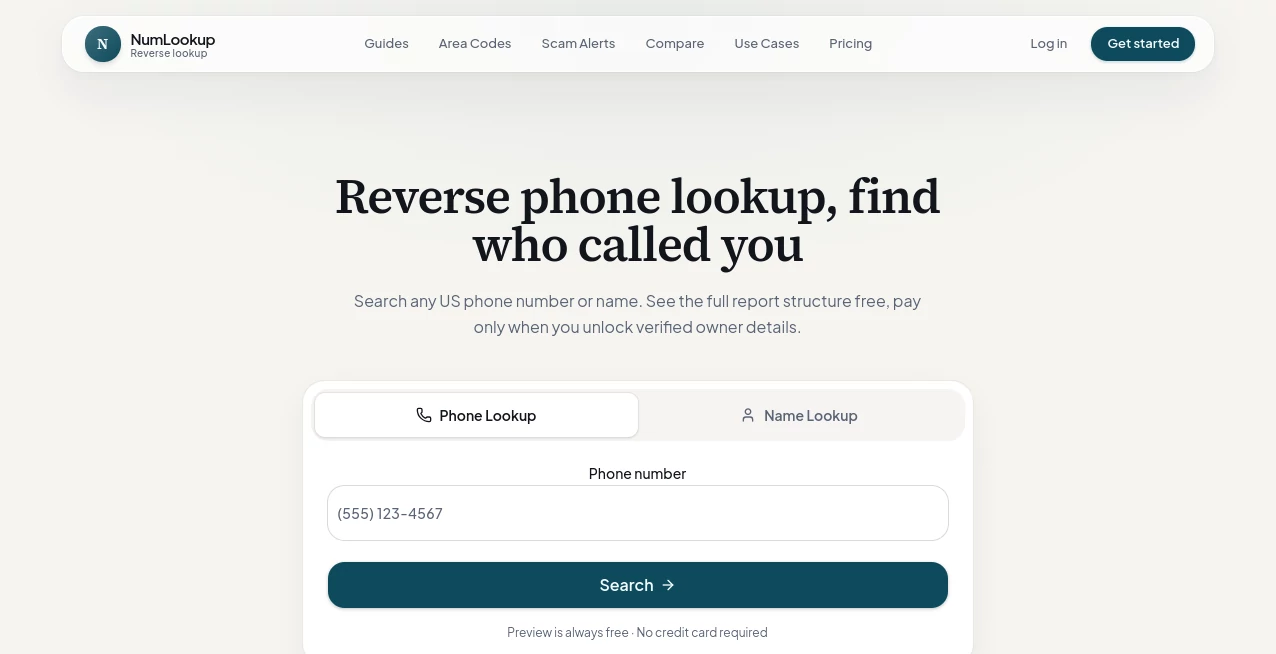
The interface keeps the central task simple: enter a phone number and start the search. There is little need to learn a complicated dashboard or configure a long list of search parameters.
This simplicity is particularly useful when someone is checking a number immediately after receiving an unexpected call. The workflow is designed around getting from a phone number to a readable report with as little friction as possible.
The preview-based report presentation is another useful touch. Rather than hiding the entire structure of a report until payment, the available sections can be reviewed first. This gives users a better idea of whether the search has produced meaningful information before spending money on an unlock.
Accuracy & Performance
Reverse phone lookup accuracy depends heavily on the number being searched and the quality and freshness of available records. A long-established business number may have a stronger public footprint than a newly created mobile or VoIP number, so results can naturally vary from one search to another.
The service combines phone-specific information such as carrier and line type with owner-related records. This distinction is valuable because a caller's displayed number does not necessarily tell you where the person is physically located. Number portability and caller-ID spoofing can make area-code assumptions misleading.
Carrier and line-type information can therefore provide useful context. A number presented as belonging to a local business, for example, may deserve closer inspection if the available records indicate a VoIP line with no corresponding business information.
Capabilities
The platform goes beyond simply displaying a name beside a number. Its lookup workflow can expose several layers of information, including owner-related values, carrier details, line classification, CNAM information, addresses, and associated records when those details are available.
Another useful capability is its area-code directory. Users can explore U.S. area codes and learn about their regional context, overlays, time zones, portability considerations, and common scam patterns. This is especially helpful for understanding why an area code alone should never be treated as proof of someone's current location.
The service also publishes practical scam-awareness material covering situations such as package-delivery phishing and suspicious calls. That educational side adds value because identifying a number is only one part of deciding what to do with an unexpected call.
Security & Privacy
Privacy is an important consideration whenever phone-related information is being searched. The service states that it does not sell users' search history and provides an anonymous lookup experience in which the person associated with a searched number is not notified.
Users should still treat reverse lookup information responsibly. Publicly available or aggregated records can be incomplete, outdated, or associated with the wrong person, so results should be considered supporting information rather than absolute proof of identity.
The service also makes an important legal distinction: its reports are not intended for FCRA-regulated decisions such as employment, tenant screening, credit, or insurance eligibility. Reverse lookup information should be used for legitimate informational and personal-safety purposes rather than harassment, stalking, or attempts to expose private individuals.
Use Cases
- Unknown calls: Check an unfamiliar number before deciding whether to return the call.
- Suspicious messages: Investigate a number connected to an unexpected SMS or possible phishing attempt.
- Marketplace transactions: Get additional context about a buyer or seller before arranging an interaction.
- Dating safety: Perform a basic phone-number check when communicating with someone new.
- Business calls: Research an unfamiliar number that claims to represent a company or service.
- Scam investigation: Look at carrier and line-type information when a call appears suspicious.
- Missed calls: Determine whether an unknown number has publicly associated information before calling back.
- Personal research: Use a phone number as the starting point when trying to reconnect with a legitimate contact.
Pros and Cons
Pros
- Simple phone-number-first search experience.
- Free previews make it possible to evaluate a report before paying for an unlock.
- Carrier and line-type information adds useful context beyond a basic name search.
- CNAM data can provide another signal when evaluating caller identity.
- Useful educational content about common phone and messaging scams.
- Anonymous searches can be useful for privacy-conscious users.
- Area-code resources provide helpful regional context.
Cons
- Results depend on the availability and freshness of underlying records.
- Not every phone number will have enough public information for a complete identification.
- Some detailed report information requires a paid unlock.
- Area codes cannot reliably establish a caller's current physical location.
- Reverse lookup results should not be treated as definitive proof of identity.
Pricing Plans
The service uses a preview-first pricing model. Report previews are available for free, allowing users to inspect the available sections before deciding whether additional information is worth unlocking.
The current Pro offering includes a one-day trial priced at $1, followed by a $10 monthly subscription that provides 10 report unlocks. This structure can work well for people who only need detailed information occasionally because the free preview can be used to decide which searches actually deserve a full reveal.
Pricing and plan terms can change, so users should check the current pricing information before subscribing or starting a trial.
How to Use the Reverse Phone Lookup
- Enter the complete phone number you want to investigate.
- Start the lookup and wait for the report preview to load.
- Review the available report sections and check whether useful information has been found.
- Pay particular attention to carrier, line type, CNAM, and owner-related information.
- Compare the available details with what the caller or sender claimed.
- If the available information is useful and you need additional details, choose the appropriate unlock option.
- Use the results carefully and avoid making high-stakes decisions solely from a reverse phone lookup.
Comparison with Similar Tools
Reverse phone lookup services can look similar at first glance, but their approach to data and reporting can be quite different. Some free people-search platforms focus heavily on advertising and broad public-record searches, while others concentrate more specifically on caller information.
This service takes a phone-focused approach and places particular attention on carrier, line type, and CNAM information. That can be valuable when investigating suspicious calls because a person's apparent name is only one part of the picture.
The preview-first model is also worth noting. Instead of requiring users to commit to a full report without knowing what information exists, the report structure can be reviewed first. For occasional users, this makes it easier to decide whether a particular lookup is worth paying for.
That does not mean it will outperform every competing service on every number. Databases differ, phone numbers change hands, records become outdated, and scammers frequently use VoIP or spoofed numbers. For important situations, it is sensible to compare information from more than one reliable source.
Conclusion
NumLookup is a practical option for anyone who wants more context around an unfamiliar phone number without navigating a complicated people-search system. Its combination of reverse lookup, carrier information, line-type classification, CNAM data, report previews, and scam-awareness resources gives users several useful signals to consider before responding to an unknown caller.
The strongest part of the experience is its straightforward workflow. Enter a number, inspect what is available, and decide whether the additional information is worth unlocking. That approach feels particularly useful for everyday situations such as missed calls, suspicious texts, marketplace conversations, and unfamiliar business contacts.
Like any reverse lookup service, it should be treated as an information tool rather than an infallible identity verification system. When used thoughtfully, however, it can turn an unknown phone number into a much clearer starting point for deciding what to do next.
Frequently Asked Questions (FAQ)
What is a reverse phone lookup?
A reverse phone lookup starts with a phone number rather than a person's name. It can search available records to find associated information such as an owner name, carrier, line type, CNAM details, or location-related records.
Can I preview a phone report for free?
Yes. The service provides free previews of report sections, allowing users to see what information may be available before deciding whether to unlock additional details.
Can a phone lookup identify every caller?
No. Results depend on available records. Newly issued, unlisted, disposable, or certain VoIP numbers may have little or no useful owner information.
Does an area code show where someone currently lives?
No. People can keep their phone numbers after moving, and scammers can spoof local-looking numbers. An area code should be treated as regional context rather than proof of a caller's current location.
Can the results be used for employment or tenant screening?
No. The service states that it is not a consumer reporting agency under the Fair Credit Reporting Act. Its reports should not be used for employment, tenant screening, credit, or insurance eligibility decisions.
Why is carrier and line-type information useful?
Carrier and line-type details can provide context that a simple caller name does not. Knowing whether a number is associated with a mobile, landline, or VoIP connection can help users evaluate suspicious claims and possible scam scenarios.
Is the lookup completely free?
Report previews are free, while additional report information may require an unlock. The current Pro offering uses a $1 one-day trial followed by $10 per month for 10 unlocks.
Other .
These classifications represent its core capabilities and areas of application. For related tools, explore the linked categories above.

NumLookup Alternatives Product

Meet in the …

Teahose

Flyback.ai

DiRe-RAPIDS

AI For Devel…

MBTI Compati…

EZ Grader

Greek Numero…

gpt-plus.ai