
OpenFate
What is OpenFate?
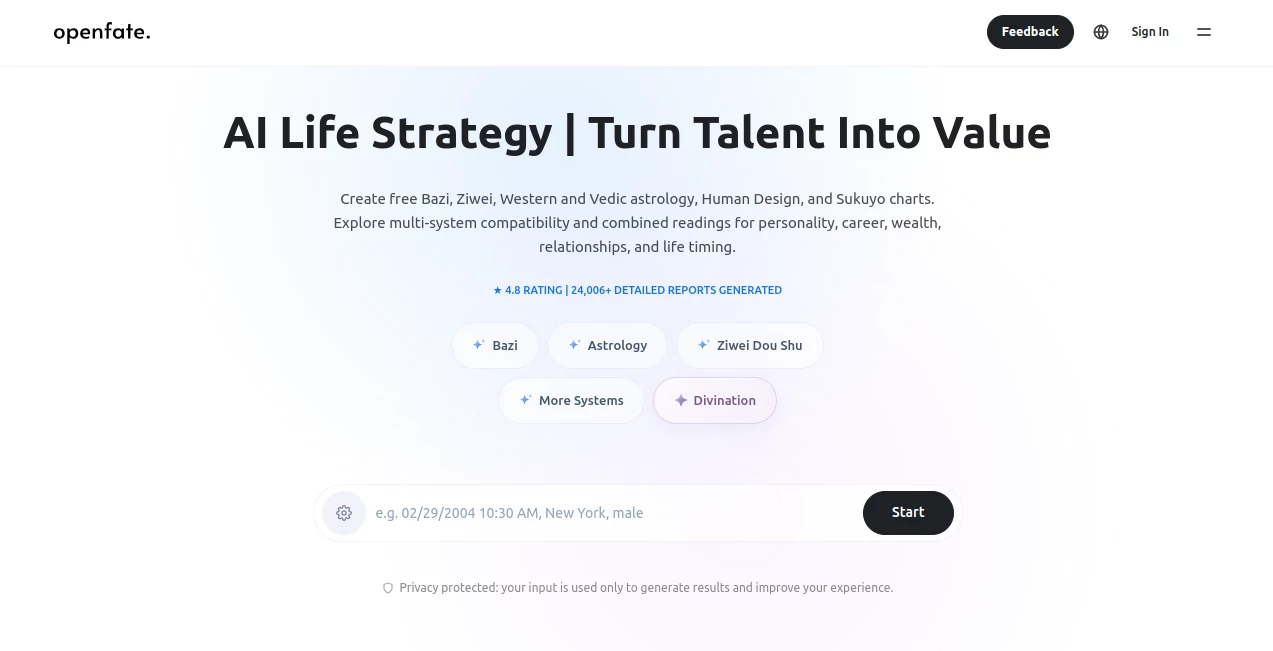
OpenFate brings traditional systems of life interpretation into a modern, interactive experience. Instead of asking users to navigate complicated charts or unfamiliar terminology on their own, the platform combines structured chart calculations with AI-assisted explanations to turn personal birth information into readable insights about personality, relationships, career, wealth, and life timing.
The service currently supports several systems, including Bazi, Ziwei Dou Shu, Western astrology, and other chart-based approaches. Users can enter their birth date, time, location, and related information, then explore an interpretation built around the selected system. The idea is particularly appealing for people who enjoy astrology, Chinese metaphysics, self-reflection, or simply want a more organized way to explore these traditions.
What makes the experience interesting is the emphasis on explanation rather than simply presenting a chart. The platform describes its approach as deterministic logic first and AI explanation next, meaning the underlying chart structure is calculated before AI is used to explain the resulting information. This gives the experience a more structured feel than a simple conversational horoscope.
The service also has a sizeable user base, with the website currently reporting more than 32,000 active users, over 20,000 detailed reports, more than 160,000 AI chat sessions, and more than 6 billion AI tokens generated. It also displays an average rating of 4.8 from more than 800 reviews.
Key Features
- Free Bazi chart calculations
- Western astrology birth chart analysis
- Ziwei Dou Shu analysis
- Multi-system compatibility analysis
- Career and wealth-oriented readings
- Love and relationship analysis
- Life timing and yearly analysis
- AI-assisted explanations and follow-up questions
- Detailed reports of up to around 6,000 words
- Premium PDF report downloads
- Multiple language support
- Open-source Bazi infrastructure and MCP support for compatible AI agents
User Interface
The interface is straightforward and built around a simple starting point: provide birth information and select an analysis system. The main experience does not require users to understand every technical term before getting started. Instead, the platform guides visitors toward Bazi, astrology, Ziwei Dou Shu, compatibility, and related analysis options.
This simplicity is one of its strongest qualities. Someone completely unfamiliar with Bazi, for example, can enter their information and begin exploring without first learning the meaning of every pillar, star, palace, or element. More experienced users can go deeper into the underlying systems and terminology.
The overall layout also separates calculation from interpretation. That distinction makes the product feel more like an interactive analysis workspace than a traditional horoscope page.
Accuracy & Performance
Accuracy in metaphysical analysis is naturally different from accuracy in a scientific measurement. The service itself presents its readings as cultural and interpretive content rather than scientific predictions or professional advice. Within that framework, the platform places considerable emphasis on structured calculations and declared rules.
Its methodology explains that chart logic is validated against the application's calculation engine before being used in public explanations. For Bazi calculations, the system also highlights True Solar Time correction and structured elements such as the Day Master, Ten Gods, Five Elements, and Luck Pillars.
User feedback displayed on the website frequently praises the detailed explanations, ease of use, and perceived accuracy of the readings. Several reviewers specifically mention the depth of the reports and the usefulness of the follow-up experience.
Capabilities
The platform goes well beyond a basic daily horoscope. Bazi analysis can explore chart structure, favorable elements, Ten Gods, and Luck Pillars, while other systems provide their own interpretive frameworks.
Relationship analysis is another notable capability. Users can explore romantic relationships, friendships, family dynamics, and workplace compatibility. There are also dedicated experiences for wealth, career direction, and relationship patterns.
The AI conversation layer adds another useful dimension. Rather than stopping after receiving a report, users can ask follow-up questions and request deeper explanations. This makes the information easier to explore because users can focus on the part of a reading that is most relevant to their current situation.
For developers and technically minded users, the project also offers an open-source Bazi MCP server designed for compatible AI agents and development environments. This extends the underlying calculation infrastructure beyond the consumer-facing interface.
Security & Privacy
Birth information is central to generating these readings, so privacy is an important part of the experience. The website states that submitted information is used to generate results and improve the experience. It also provides dedicated privacy and terms pages explaining how the service operates.
The platform makes an important distinction about the nature of its service: its readings are intended for reflection, entertainment, and cultural or educational exploration. They are not presented as medical, legal, financial, psychological, or other professional advice. Users should therefore treat the results as an interpretive resource rather than a substitute for qualified professional guidance.
Use Cases
Self-reflection: People interested in understanding personality patterns, strengths, preferences, and recurring themes can use the different analysis systems as a structured starting point for reflection.
Career exploration: Career-focused readings examine themes such as personal strengths, timing, and potential working patterns. These insights can be interesting when considered alongside real-world experience and professional planning.
Relationship compatibility: Couples, friends, family members, and colleagues can explore compatibility through the available analysis frameworks. The results can provide conversation starters around differences, communication, and expectations.
Wealth and career timing: Dedicated analysis areas examine wealth patterns, career direction, and timing within the chosen metaphysical framework.
Learning traditional systems: Beginners can use the explanations to become familiar with concepts such as Five Elements, Ten Heavenly Stems, Earthly Branches, Ten Gods, and other traditional terminology.
Personalized AI conversations: Users who want more than a single report can continue asking questions and explore specific parts of their results through the AI interaction layer.
Pros and Cons
- Pros: Supports multiple metaphysical systems in one place.
- Pros: Offers free chart calculations for several systems.
- Pros: Combines structured calculations with AI explanations.
- Pros: Provides detailed reports and follow-up AI conversations.
- Pros: Includes relationship, career, wealth, and timing-focused experiences.
- Pros: Offers PDF downloads with paid credits.
- Pros: Provides multilingual content and an open-source developer component.
- Cons: The readings are interpretive and should not be treated as scientifically validated predictions.
- Cons: Deeper reports and personalized AI conversations consume credits.
- Cons: Users unfamiliar with traditional metaphysical terminology may need some time to understand the deeper sections.
Pricing Plans
The platform uses a credit-based pricing model for its deeper personalized experiences. Users can begin with free chart calculations and then purchase additional credits when they want full reports, deeper answers, compatibility analysis, or other personalized work.
The Light Edition costs US$6.99 and includes 250 one-time credits, which the website estimates can provide approximately three full reports. The Standard Edition costs US$9.99 for 500 credits and is positioned as a good option for exploring several charts. The Deep Edition costs US$17.99 for 1,000 credits and is intended for more extensive use, with the website estimating approximately 15 full reports.
Paid credits can be used for detailed reports, typed questions, deeper AI answers, and certain personalized strategies. The site also states that failed, timed-out, or aborted AI runs automatically refund reserved credits. One-time credit packs do not renew, while subscriptions, where available, renew automatically until canceled.
How to Use It
- Select the analysis system you want to explore, such as Bazi, Western astrology, or Ziwei Dou Shu.
- Enter your birth date, birth time, location, and any additional information requested by the selected analysis.
- Submit the information to generate your chart and initial interpretation.
- Review the resulting analysis and explore sections related to personality, career, wealth, relationships, or timing.
- Use the available AI follow-up features when you want a more specific explanation.
- Purchase credits if you want access to deeper personalized reports, additional questions, or premium PDF downloads.
Comparison with Similar Tools
Many astrology websites focus on one tradition or provide relatively short horoscope-style readings. This platform takes a broader approach by placing several systems in the same environment. Bazi, Ziwei Dou Shu, Western astrology, compatibility analysis, and additional chart experiences can be explored without switching between unrelated services.
Another distinction is the combination of calculation and AI explanation. Instead of relying entirely on a free-form chatbot to generate a reading, the system describes a workflow in which structured chart logic comes first and AI is used to explain the resulting information. For users who enjoy both traditional metaphysics and modern AI interfaces, that combination makes the experience particularly appealing.
The developer-facing MCP component is also unusual compared with typical consumer astrology services. It gives technically oriented users another way to work with the underlying Bazi calculation capabilities through compatible AI-agent environments.
Conclusion
OpenFate offers a polished way to explore Bazi, astrology, Ziwei Dou Shu, compatibility, and related metaphysical systems through a modern AI-assisted interface. Its strongest point is the way it turns traditionally complex chart information into readable reports and interactive explanations.
The combination of free chart tools, detailed paid reports, compatibility analysis, AI follow-up conversations, multilingual content, and developer-oriented infrastructure gives the platform considerable breadth. It is especially well suited to people who are curious about traditional metaphysics but prefer a cleaner, more structured digital experience.
As with any metaphysical service, the most useful approach is to treat the results as a tool for reflection and exploration rather than guaranteed predictions. Used in that way, the platform offers an engaging and surprisingly detailed environment for discovering how different traditional systems interpret personality, relationships, career themes, wealth patterns, and life timing.
Frequently Asked Questions (FAQ)
Is the service free to use?
Several chart calculation features are available for free. Deeper personalized reports, AI questions, and certain premium features require credits.
Which analysis systems are available?
The platform currently provides Bazi, Ziwei Dou Shu, Western astrology, compatibility analysis, and additional chart-based experiences. Availability can vary by feature and development stage.
Can I download my report as a PDF?
Yes. Premium users can download eligible detailed reports as PDF files for offline reading.
Can I ask follow-up questions about my reading?
Yes. The service provides an AI question-and-answer experience that allows users to explore specific parts of their personalized analysis in greater depth.
Are the readings scientifically proven predictions?
No. The service describes its content as metaphysical, cultural, educational, and reflective rather than scientific prediction or professional advice. Users should not rely on the readings as a replacement for qualified medical, legal, financial, psychological, or other professional guidance.
What information is needed to generate a reading?
Depending on the selected system, users generally provide birth information such as date, time, location, and sometimes gender. Accurate input can affect the resulting chart and interpretation.
These classifications represent its core capabilities and areas of application. For related tools, explore the linked categories above.

OpenFate Alternatives Product

ZenMako

Greek Numero…

Stinglo

Suno list

MemoTune

Free AI Dire…
Robux Tax Ca…

SomniaScope …

MixBooze