
OSPEA
What is OSPEA?
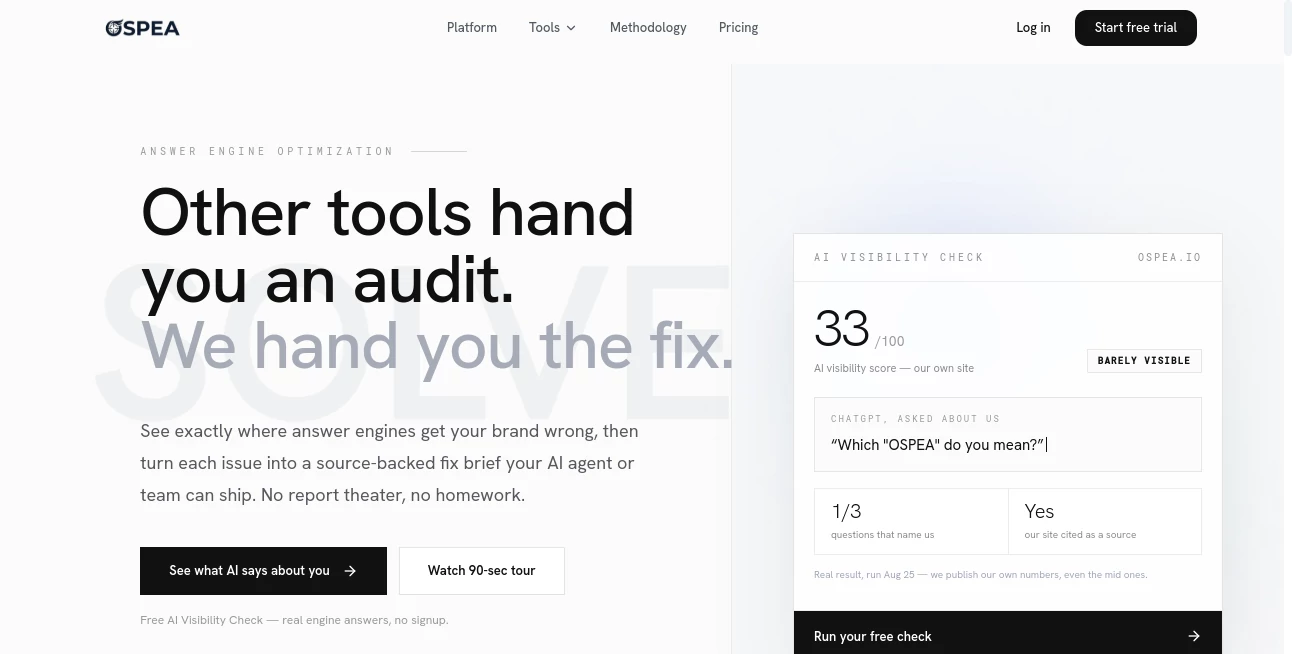
AI search is changing the way people discover brands, products, and services. A company can have a strong website and good traditional search visibility, yet still be described incorrectly—or not mentioned at all—when someone asks an AI assistant about it. OSPEA is built around solving that specific problem.
Instead of stopping at an audit or a visibility score, the platform looks at what major answer engines actually say about a brand, identifies missing or inaccurate information, and turns those findings into source-backed fixes that a marketing team, editor, developer, or AI agent can act on.
The approach is particularly useful for companies investing in answer engine optimization (AEO) and generative engine optimization (GEO). It connects monitoring with content creation, distribution, analytics, and follow-up verification, giving teams a clearer picture of whether their corrections are actually being picked up.
Key Features
- AI visibility monitoring across major answer engines
- GEO audits for identifying visibility and source gaps
- Competitor monitoring and comparison
- Source-backed fix briefs based on observed AI answers
- Content Hub for creating citation-ready pages and evidence blocks
- Semantic markup, schema, FAQ, and entity-context recommendations
- SearchOps keyword monitoring
- Distribution workflows for website and social content
- Website analytics included with every plan
- Traffic attribution on higher-tier plans
- Google Search Console integration on the Growth plan
- API access and agent-ready handoffs on Pro and Agency plans
User Interface
The platform is organized around a practical workflow rather than a collection of disconnected reports. Teams can move from an observed answer to the underlying source gap, prepare a correction, publish the relevant information, and then return to monitoring.
This structure makes the interface particularly appealing to marketing teams that do not want another dashboard filled with numbers but little direction about what to do next. The workflow gives individual findings a clear purpose, which can make ongoing AI visibility work easier to manage.
Accuracy & Performance
The strength of the platform comes from looking at actual answers and their sources instead of relying only on estimated visibility metrics. It queries major AI systems including ChatGPT, Claude, Gemini, Perplexity, and DeepSeek, then examines mentions, omissions, claims, and citations.
Its methodology also separates stale information from genuine evidence gaps. That distinction matters. Sometimes an AI answer is wrong because an old source is still being cited; in other cases, the company's website simply does not provide enough structured evidence for the answer engine to retrieve the right information.
Follow-up scans are used to see whether published corrections lead to changes in answers and citations. The result is a more practical measurement cycle than simply checking a score once and moving on.
Capabilities
The platform covers several parts of the AI visibility workflow. Its Content Hub can turn identified gaps into structured pages, FAQs, evidence blocks, and other source material designed to be easier for AI systems to retrieve and understand.
Fix briefs preserve the original issue, relevant sources, affected prompts, recommended changes, and acceptance checks. This is useful when the person who discovers a problem is not the person responsible for fixing it.
There is also a distribution layer for adapting approved content to different publishing channels. For technical teams, API access and agent-ready handoffs can connect the workflow with development or internal automation systems.
Security & Privacy
The platform highlights privacy-first website analytics as part of its product offering. Analytics are included with every plan, allowing teams to connect AI visibility activity with website traffic without needing a separate analytics product for this purpose.
For organizations evaluating the service for larger or sensitive workflows, it is still sensible to review the current privacy policy, terms, and any available security documentation before sending proprietary information through the platform. The public product information focuses more heavily on visibility, source evidence, and workflow management than on detailed security certifications.
Use Cases
One of the most obvious uses is monitoring how AI assistants describe a company. A marketing team can create a set of questions that potential customers might ask and see whether the resulting answers contain the correct positioning, pricing information, features, integrations, and competitive context.
It can also be useful when a business discovers that AI systems repeatedly cite outdated or incomplete information. Instead of simply recording the problem, the workflow helps identify the source gap and prepare material intended to establish a clearer source of truth.
SEO and content teams can use the system to find topics where stronger citations or more structured information may help. Agencies can take advantage of client workspaces and white-label reporting on the Agency plan, while larger marketing operations may benefit from API access, traffic attribution, and agent-ready workflows.
A practical example would be a SaaS company noticing that AI assistants consistently describe an old pricing structure. The team could investigate the cited sources, create a clearer pricing page with supporting evidence, publish the correction, and then monitor later answers to see whether the new information is being adopted.
Pros and Cons
Pros
- Focuses on fixing AI visibility problems rather than only reporting them
- Uses real answer-engine responses and observed citations
- Connects monitoring, content, distribution, and verification
- Supports major AI platforms including ChatGPT, Claude, Gemini, Perplexity, and DeepSeek
- Includes website analytics across plans
- Offers API and agent-ready workflows for more advanced teams
- Useful for both ongoing monitoring and targeted correction projects
Cons
- The pricing may be high for individuals or very small businesses
- The platform is primarily designed for businesses already investing in SEO, GEO, or AEO
- Some advanced functionality is reserved for higher-priced plans
- Teams looking only for a basic visibility report may find the broader workflow more than they need
- Detailed security information should be reviewed separately by organizations with strict compliance requirements
Pricing Plans
The platform offers a 14-day free trial, with website analytics included. Pricing is structured around the number of prompts, articles, keywords, competitors, AI platforms, and scan frequency.
- Starter: $79 per month when billed annually. Includes 50 prompts, 5 articles per month, 100 keywords, 3 competitors, 4 AI platforms, and scans every three days. It also includes the AIO Visibility Lab, GEO Audit, competitor monitoring, Content Hub, website analytics, and email support.
- Growth: $199 per month when billed annually. Includes 150 prompts, 20 articles per month, 300 keywords, 10 competitors, all configured AI platforms, and daily scans. It adds fix briefs, citation tracking, Distribution Hub, Intelligence Reports, competitor discovery, Google Search Console integration, and priority support.
- Pro: $449 per month when billed annually. Includes 300 prompts, 50 articles per month, 1,000 keywords, 25 competitors, daily scans, traffic attribution, API access, agent-ready handoff, and advanced reporting.
- Agency: Custom pricing for agencies, consultancies, and enterprises. It provides custom limits, unlimited competitors, all configured AI platforms, real-time scans, unlimited API calls, client workspaces, white-label reports, custom branding, and a dedicated success manager.
For smaller teams testing the concept, the Starter tier provides a straightforward entry point. The Growth plan is more suitable when the objective moves beyond monitoring into regular correction and publishing workflows.
How to Use the Platform
- Start by defining the brand, topics, competitors, and questions that matter to your audience.
- Run an initial visibility check or GEO audit to see how answer engines currently describe the business.
- Review the answers, citations, sources, omissions, and inaccurate claims identified during the scans.
- Prioritize the issues that could have the greatest effect on customer perception or discovery.
- Create a source-backed fix brief containing the evidence and recommended correction.
- Use the Content Hub or your existing publishing workflow to create and publish the required source material.
- Distribute the correction through the relevant channels when additional visibility is needed.
- Run subsequent scans and compare the new answers, citations, and traffic signals with the earlier baseline.
Comparison with Similar Tools
Many AI visibility products concentrate primarily on monitoring. They tell you whether a brand appears in an AI answer, how often it is mentioned, or which competitors are visible. That information is useful, but it can leave the team with a familiar question: what should we actually change?
This platform takes a broader position by connecting the monitoring stage with source-backed correction. Instead of treating the audit as the final deliverable, the detected problem can become a structured brief, a content task, a publishing action, and eventually a verification check.
That distinction makes it more appropriate for organizations that want AI visibility to become an ongoing operational process rather than an occasional reporting exercise. Teams that only need simple tracking may not require all of these capabilities, while companies actively working on AEO and GEO can benefit from the connected workflow.
Conclusion
AI visibility is becoming less about simply ranking a webpage and more about controlling the information available to answer engines. A company can invest heavily in conventional SEO and still discover that an AI assistant has the wrong pricing, misses an important feature, or recommends a competitor instead.
This platform offers a thoughtful response to that problem by connecting observation with action. Its ability to examine real AI answers, trace source gaps, create correction briefs, publish supporting information, and verify adoption gives marketing and content teams a practical loop to work with.
The pricing puts it firmly in the professional and business-focused category, but for teams serious about AEO, GEO, and AI-driven discovery, the combination of monitoring, content workflows, analytics, and verification makes it a compelling option.
Frequently Asked Questions (FAQ)
What does this platform do?
It monitors how major AI answer engines describe a brand, identifies incorrect or missing information, and helps teams create source-backed corrections that can be published and monitored over time.
Which AI platforms are monitored?
Coverage includes ChatGPT, Claude, Perplexity, Gemini, and DeepSeek. The exact availability and scan frequency depend on the selected plan and provider availability.
Does it replace traditional SEO tools?
Not necessarily. It is designed around the answer-engine layer, while also including SearchOps and website analytics. It works best as part of a broader SEO and content strategy rather than as a complete replacement for every traditional SEO platform.
Is there a free trial?
Yes. A 14-day free trial is available, and website analytics are included during the trial. After the trial, users can select a paid plan, with the service stating that payment is not taken without explicit confirmation.
Which plan is best for a growing marketing team?
The Growth plan is positioned for growing teams that need more than basic monitoring. It adds daily scans, fix briefs, citation tracking, distribution tools, intelligence reports, competitor discovery, Google Search Console integration, and priority support.
AI SEO Assistant , AI Content Generator , AI Research Tool , AI Analytics Assistant .
These classifications represent its core capabilities and areas of application. For related tools, explore the linked categories above.

OSPEA Alternatives Product

Ornold

Goodnotes

FinalLayer

AISEOMate

SupaTraffic

Greetings Is…
Husslix1.1

Yorph AI

Free AI Gene…