
Outmano
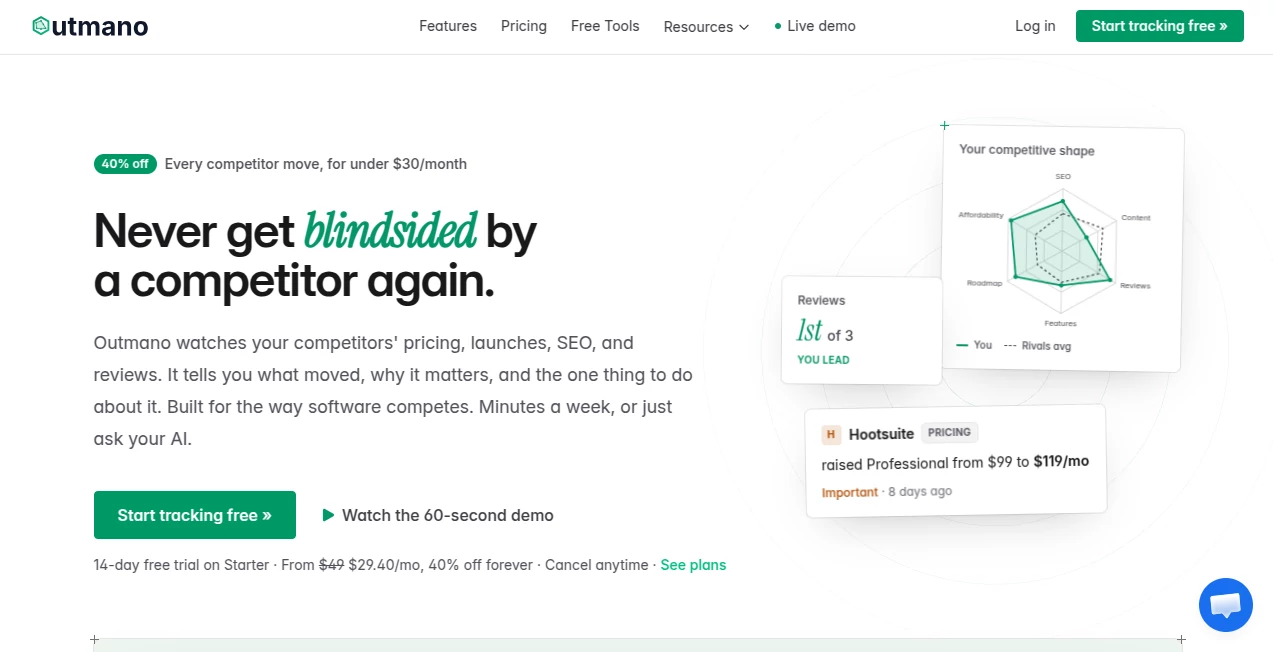
What is Outmano?
Keeping track of competitors can quickly become a full-time job. Pricing pages change, new features appear, search rankings move, reviews arrive, and marketing campaigns start or disappear. Outmano brings these signals together and turns them into practical competitive intelligence, helping SaaS teams understand not only what changed, but why it matters and what they can do next.
The platform is designed primarily for SaaS companies, founders, product marketers, and product teams that need a clearer view of their competitive landscape without building a dedicated competitive-intelligence operation. Instead of asking users to constantly check several websites and tools, it uses AI agents to monitor multiple competitive angles and summarize the meaningful changes.
One particularly useful idea is the focus on action rather than simply collecting information. A competitor changing its pricing is interesting, but knowing whether that change creates a sales risk or an opportunity is far more valuable. The platform is built around that distinction.
Key Features
- Automated competitor change detection across multiple intelligence categories.
- Pricing monitoring with comparisons between competitor plans and your own pricing.
- SEO intelligence covering organic keywords, top pages, traffic value, and search overlap.
- Google Ads monitoring, including competitor keywords and ad copy changes.
- Content monitoring for blogs, announcements, launches, and strategic shifts.
- Roadmap and changelog tracking to identify product movements before or around launch.
- Review intelligence that follows ratings, new reviews, and recurring customer complaints.
- Feature comparison with a continuously maintained competitive gap matrix.
- Hiring signals that can reveal possible strategic moves through competitor job postings.
- News and funding monitoring for events such as acquisitions, fundraising, and workforce changes.
- AI-generated strategic summaries written in plain English.
- Weekly action plans that prioritize recommended responses.
- Sales battlecards that teams can share with sales representatives.
- Slack alerts and weekly email digests for keeping teams informed.
- MCP support for asking an AI assistant questions using tracked competitive data.
User Interface
The experience is centered around a competitive intelligence workspace rather than a collection of disconnected reports. After adding a company and its competitors, users can follow changes across different intelligence angles and review the history behind those changes.
The workflow is deliberately straightforward. Add a competitor, allow the monitoring agents to collect and analyze relevant information, and then review the resulting summaries and recommendations. The weekly briefing is especially useful for busy teams because it groups important activity into a concise Monday update instead of requiring daily manual research.
Slack alerts provide a faster option when something important happens. Teams can choose the types of changes they want to receive, allowing urgent competitive movements to reach them without waiting for the weekly digest.
Accuracy & Performance
The main strength is contextual analysis. Rather than simply reporting that a page or number changed, the AI interprets the change and explains its possible competitive significance. For example, a pricing adjustment can be presented as a positioning move rather than just a before-and-after price difference.
The system monitors several sources and angles, including pricing, SEO, advertising, content, roadmaps, reviews, features, hiring, and news. This broader view helps reduce the risk of drawing conclusions from a single metric.
There is also a useful emphasis on evidence. Recommended actions include the information behind the recommendation, so teams can investigate the underlying change instead of blindly following an AI-generated suggestion.
Capabilities
The platform is particularly strong when several competitive signals need to be connected. A new feature, for instance, can be considered alongside a competitor's pricing, search visibility, customer reviews, and hiring activity.
Its weekly AI action plan turns these signals into prioritized tasks. Each suggested action includes a practical first step intended to be manageable within roughly 30 minutes. When the monitored data does not suggest that a response is necessary, the system can also indicate that there is nothing urgent to act on.
For sales teams, automatically generated battlecards add another practical layer. They can summarize competitor strengths and weaknesses, provide objection-handling material, outline pricing talking points, and help representatives prepare for competitive conversations.
Security & Privacy
The MCP integration is designed as a read-only connection. Workspace-scoped keys allow an AI assistant to access competitive intelligence for the competitors being tracked, while the exposed tools cannot modify or delete that data.
Access keys are stored in hashed form and can be revoked from the account settings. Creating an MCP key also requires password confirmation, adding an additional safeguard around access to workspace intelligence.
As with any service that connects competitive information to external AI assistants, teams should review the data-handling terms of both services they use. The platform itself describes its MCP connection as a read-only method for serving tracked competitive data to compatible AI clients.
Use Cases
Competitive pricing research: SaaS companies can monitor changes to competitor plans and compare those movements with their own positioning. This can be helpful when preparing a pricing review or responding to a rival entering a lower price segment.
SEO monitoring: Marketing teams can follow competitor keywords, important pages, and changes in search visibility. Instead of discovering a lost opportunity months later, they can identify meaningful movements sooner.
Product strategy: Product teams can watch public roadmaps, changelogs, and feature changes to understand where competitors are investing. This can help inform product planning without relying entirely on manual research.
Sales enablement: Sales representatives can use competitive battlecards before customer calls. Having current pricing, positioning, strengths, weaknesses, and objection-handling information in one place can make competitive conversations more productive.
Marketing intelligence: Teams can monitor competitor advertising, content, reviews, and announcements to spot changes in messaging and positioning. This is particularly useful when a competitor suddenly changes its market narrative.
Founder-level market monitoring: Small SaaS companies often do not have a dedicated competitive intelligence analyst. A consolidated weekly briefing can give founders a practical way to stay informed without spending hours browsing competitor websites.
Pros and Cons
Pros:
- Combines several competitive intelligence sources in one workspace.
- Focuses on interpretation and recommended actions rather than raw data alone.
- Useful coverage across pricing, SEO, ads, content, products, reviews, hiring, and news.
- Weekly AI briefings reduce the need for constant manual monitoring.
- Slack alerts make important changes easier to react to quickly.
- Sales battlecards provide a practical use for competitive research.
- MCP integration allows compatible AI assistants to query live tracked data.
- Designed with SaaS teams and SMBs in mind.
Cons:
- The platform is primarily focused on competitive intelligence rather than being a general-purpose marketing suite.
- Smaller teams tracking only one or two competitors may not need every monitoring angle.
- Some advanced value depends on having meaningful competitors and enough market activity to monitor.
- Teams looking for deep standalone SEO or advertising analytics may still need specialized tools alongside it.
Pricing Plans
The pricing structure is built around the number of competitors and team members that can be tracked. The Starter plan is listed at $49 per month and supports up to five competitors and two team members. The Growth plan costs $99 per month and supports ten competitors and five team members. The Pro plan is $199 per month, covering up to 25 competitors, ten team members, and priority support.
At the time of review, launch pricing provides a 40% lifetime discount for eligible early adopters, bringing the listed monthly prices to $29.40, $59.40, and $119.40 respectively. The Starter plan includes a 14-day free trial, while the plans also come with a 14-day money-back guarantee.
Every plan includes the core monitoring features, AI strategic summaries, weekly action plans, sales battlecards, email digests, Slack alerts, cross-competitor benchmarking, and MCP access.
How to Use It
Getting started takes only a few basic steps. First, create a workspace and add your company so the platform has a baseline for comparison. Next, add the competitors you want to monitor. A competitor finder is also available if you are unsure which companies compete for the same keywords and customers.
Once competitors are added, the monitoring agents begin examining the selected intelligence angles. Over time, the workspace builds a history of meaningful changes, while AI summaries explain the significance of those movements.
For regular monitoring, the weekly digest provides a compact overview of the most important developments. Teams that need faster reactions can connect Slack and receive alerts when selected competitive changes occur.
If your team already uses a compatible MCP client, the tracked intelligence can also be connected to an AI assistant. This makes it possible to ask questions about competitors and receive answers based on the live data being monitored rather than relying only on the model's general knowledge.
Comparison with Similar Tools
Traditional competitive intelligence platforms can be powerful, but they may be designed around larger organizations and dedicated intelligence teams. The approach here is more accessible for SaaS businesses that want useful competitive monitoring without a lengthy implementation process.
Compared with general SEO platforms, the focus extends well beyond search performance. Pricing, advertisements, content, roadmaps, reviews, product features, hiring, and news can all contribute to the competitive picture. That broader perspective is valuable when a company's next strategic move cannot be explained by SEO numbers alone.
Manual competitor research offers flexibility but demands continuous attention. The automated monitoring approach trades some of that manual control for consistency, making it easier to maintain a current view of the market week after week.
Conclusion
For SaaS teams, competitive research is rarely difficult because information is unavailable. The real challenge is knowing which changes deserve attention and turning those changes into decisions. This platform addresses that problem by bringing competitor signals together and adding an AI-driven layer of interpretation.
The combination of automated monitoring, strategic summaries, action plans, sales battlecards, alerts, and AI-assisted access makes it more than a simple website-change tracker. It is designed to help teams move from “what changed?” to “what should we do about it?”
For founders, product marketers, product leaders, and sales teams that want a practical competitive intelligence workflow without building one from scratch, it is a compelling option worth exploring.
Frequently Asked Questions (FAQ)
What does the platform monitor?
It monitors competitor pricing, SEO, advertising, content, roadmaps, reviews, features, hiring activity, and news. Additional monitoring angles may be introduced over time.
Who is it designed for?
The platform is mainly designed for SaaS companies competing with other software businesses. Founders, product marketers, product leaders, and sales teams can all benefit from the competitive information it provides.
Does it provide recommendations?
Yes. Its weekly AI action plans turn meaningful competitive changes into prioritized recommendations and include evidence and a practical first step for each suggested action.
Can sales teams use the platform?
Yes. Each tracked competitor can have a sales battlecard containing competitive strengths and weaknesses, objection-handling material, pricing talking points, and other information useful before sales conversations.
Does it offer Slack alerts?
Yes. Teams can connect a Slack channel and receive alerts when selected competitor movements occur.
Is there an MCP integration?
Yes. MCP access is included with every plan. Compatible AI assistants can query the tracked competitive intelligence through a read-only, workspace-scoped connection.
Is there a free trial?
Yes. The Starter plan currently includes a 14-day free trial, with no charge during the trial period. The service also advertises a 14-day money-back guarantee.
How many competitors can be tracked?
The current plans support five competitors on Starter, ten on Growth, and 25 on Pro.
AI SEO Assistant , AI Research Tool , AI Analytics Assistant , AI Advertising Assistant .
These classifications represent its core capabilities and areas of application. For related tools, explore the linked categories above.

Outmano Alternatives Product

EstatePass

LyricStudio

Grok

ModelsLab

Dedoctive

PortBackLinks

Ecom Tool AI

Pinpoint Ans…

Schema Synth