
PlanMoon
What is PlanMoon?
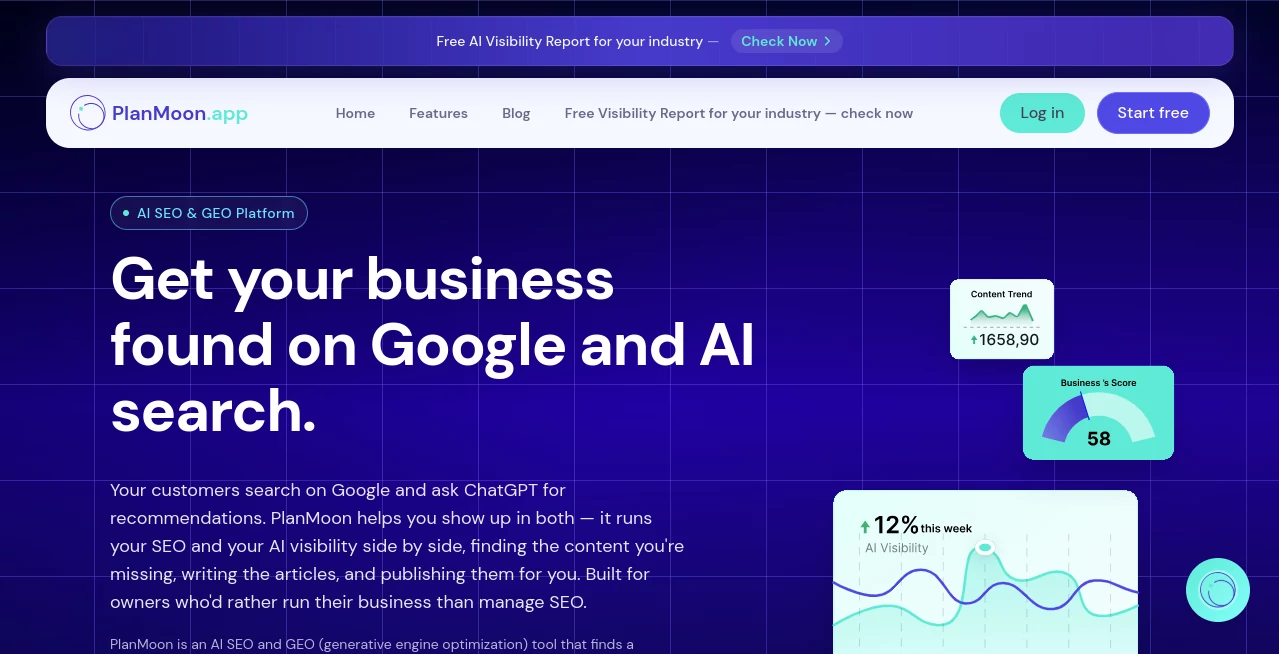
PlanMoon is an AI-powered SEO and GEO platform designed for businesses that want to improve their visibility across both traditional search engines and the growing world of AI search. Instead of forcing business owners to jump between keyword research tools, content planners, writing platforms, and analytics dashboards, it brings much of that workflow together in one place.
The platform scans a website, identifies content gaps, looks at opportunities in Google and AI search, creates a prioritized content plan, writes articles, and can publish them directly to WordPress. It also keeps track of Google rankings and mentions in AI-generated answers from platforms such as ChatGPT, Perplexity, and Gemini.
That combination makes it particularly interesting for small businesses and website owners who understand that being visible online is no longer limited to reaching the first page of Google. A business may rank well traditionally and still be absent when a potential customer asks an AI assistant for a recommendation.
Key Features
- Full website scanning for SEO and AI visibility opportunities
- Content gap analysis based on customer questions and search opportunities
- Automated, prioritized content planning
- AI-assisted article creation designed for search visibility and AI citations
- One-click publishing to WordPress
- Google ranking and search performance tracking
- AI mention and visibility tracking
- Ongoing content improvement as search conditions change
- AI SEO and GEO workflows designed for users without extensive SEO experience
User Interface
The interface is built around simplicity rather than overwhelming users with technical SEO terminology. The dashboard brings important information such as AI visibility, content gaps, articles ready for publication, Google performance, and AI mentions into a single view.
This approach should appeal to business owners who want to understand what needs attention without spending hours interpreting complicated SEO reports. Instead of simply presenting a long list of issues, the workflow moves naturally from website analysis to recommendations and then to content production.
Accuracy & Performance
The platform's strength is the way it connects several stages of the SEO process. It begins by examining the website and identifying missing topics and customer questions, then turns those findings into a content strategy. This is more practical than receiving a generic list of keywords with no clear indication of what should be published next.
It also considers AI search visibility alongside traditional rankings. This is an important distinction because appearing in Google results does not automatically mean that a business will be mentioned in an AI-generated recommendation.
Results will naturally vary depending on a website's authority, content quality, industry, competition, and existing online presence. The platform should therefore be viewed as an automation and optimization system rather than a guarantee of specific rankings or citations.
Capabilities
The workflow is designed to cover the complete journey from discovering an opportunity to putting content online. After connecting a website, the system scans the site and analyzes search opportunities, maps content gaps, creates a prioritized plan, generates articles, and supports publication.
One particularly useful capability is its focus on questions that potential customers actually ask. Rather than creating content simply because a keyword has search volume, the approach aims to answer information gaps that can help a business become more useful to both search engines and AI systems.
For WordPress websites, the publishing workflow can remove a repetitive part of content marketing. Instead of manually copying an article, formatting it, and publishing it, users can send prepared content directly to their website.
Security & Privacy
As with any service that connects to a website and may publish content, users should review the provider's current terms of service and privacy documentation before connecting a production website. Website owners should also understand what access is being granted, particularly when using publishing integrations.
No specific security certification or detailed privacy architecture is prominently presented on the public product pages reviewed for this article, so businesses with strict compliance requirements should perform their own due diligence before deployment.
Use Cases
Small business SEO: Local businesses can use the platform to identify topics and questions that potential customers are searching for, then build content around those opportunities.
AI search visibility: Businesses that want their websites to appear in recommendations from ChatGPT, Gemini, Perplexity, and other AI search experiences can use the GEO-focused workflow to identify visibility gaps.
Content marketing: Website owners who repeatedly struggle with deciding what to publish can use automated gap analysis and prioritized content planning to create a more consistent editorial process.
WordPress publishing: Businesses running WordPress sites can streamline the final stage of the content workflow by publishing prepared articles without manually moving text between systems.
SEO without a dedicated team: A small company without an in-house SEO specialist can use the automated workflow to handle research, planning, writing, and ongoing visibility monitoring from one place.
Pros and Cons
Pros
- Combines SEO and GEO in a single workflow
- Automatically identifies content gaps and opportunities
- Creates prioritized content plans instead of leaving users with raw data
- Can generate articles aimed at both Google rankings and AI citations
- Supports direct WordPress publishing
- Tracks traditional search performance and AI visibility together
- Designed for users without advanced SEO knowledge
Cons
- Automated content should still be reviewed for accuracy, originality, and brand voice
- SEO and AI visibility results can take time and cannot be guaranteed
- Businesses with advanced SEO teams may want more granular control over individual optimization tasks
- Pricing details and plan limits are not clearly presented on the public homepage reviewed
Pricing Plans
The public website currently promotes a free starting experience and states that users can connect a website and view their first content gaps without a credit card. The public product pages reviewed do not provide a detailed breakdown of paid subscription tiers or their individual limits.
For businesses considering ongoing use, it is worth checking the current account area or contacting the provider for up-to-date information about article limits, website limits, AI visibility tracking, publishing allowances, and other paid features before choosing a plan.
How to Use It
- Connect your website to the platform.
- Allow the system to scan your website and analyze its existing content.
- Review the content gaps and search opportunities it identifies.
- Use the automatically generated content plan to prioritize the most valuable topics.
- Generate articles based on the selected opportunities.
- Review the content before publication and make any brand-specific adjustments.
- Publish the finished articles, including directly to WordPress when using the supported integration.
- Monitor Google rankings and AI mentions over time and improve content as new opportunities appear.
Comparison with Similar Tools
Traditional SEO platforms are generally excellent at showing rankings, keywords, backlinks, technical issues, and search performance. AI writing platforms, meanwhile, are primarily focused on producing text. The approach here is different because the workflow attempts to connect research, content strategy, generation, publishing, and visibility monitoring.
That makes it a better fit for a business owner who wants an end-to-end process rather than another dashboard to manage. A dedicated SEO professional may still prefer specialist tools for deep backlink analysis, technical audits, competitor research, or advanced keyword analysis, but smaller teams can benefit from having the core content workflow consolidated.
The GEO component is another notable distinction. Traditional SEO tools generally measure performance in search results, while this platform also focuses on whether a business is being surfaced or mentioned in AI answers. For companies adapting to changing search behavior, having both perspectives available can make content planning more useful.
Conclusion
For businesses trying to keep up with the shift from traditional search toward AI-assisted discovery, this platform offers a practical way to approach both sides of the equation. Its biggest advantage is not any single feature, but the connection between website analysis, content gaps, planning, writing, publishing, and ongoing visibility tracking.
The workflow is especially appealing to small businesses that know they need better content but do not have the time or resources to build a full SEO operation. Instead of starting every article from a blank page, users receive a clearer path from identifying an opportunity to publishing content that addresses it.
It is not a substitute for thoughtful strategy, fact-checking, or genuine expertise. However, as an automation layer for SEO and GEO work, it provides a compelling option for businesses that want to become easier to find on Google while also preparing for the way customers increasingly discover companies through AI assistants.
Frequently Asked Questions (FAQ)
What does the platform do?
It combines AI SEO and GEO workflows to help businesses improve their visibility on Google and in AI search. It can scan a website, identify content gaps, build a content plan, generate articles, publish them, and track search and AI visibility.
What is the difference between SEO and GEO?
SEO focuses on improving a website's visibility in traditional search engine results. GEO, or generative engine optimization, focuses on increasing the likelihood that a business or its content will be referenced in AI-generated answers.
Can it write blog articles?
Yes. The platform can generate articles based on identified content opportunities, with an emphasis on producing useful content that can perform in Google search and potentially be cited by AI search systems.
Can it publish directly to WordPress?
Yes. Websites running on WordPress can use the publishing integration to send generated content directly to the site, reducing the need for manual copying and formatting.
Does it guarantee Google rankings?
No. Search rankings depend on many factors, including competition, website authority, content quality, technical SEO, links, and changes to search algorithms. The platform provides analysis and automation, but no tool can legitimately guarantee a particular ranking.
Can it help with ChatGPT visibility?
Its GEO workflow is specifically designed to help businesses improve their chances of being discovered and cited in AI search experiences, including ChatGPT, Perplexity, and Gemini. Actual visibility depends on the quality and authority of the website and many external signals.
Is it suitable for beginners?
Yes. The workflow is designed around plain-language recommendations and automation, making it accessible to business owners who may not have formal SEO training.
Is there a free option?
The public website states that users can start for free and see their initial content gaps without providing a credit card. Current paid features and limits should be checked directly before subscribing.
AI SEO Assistant , AI Content Generator , AI Analytics Assistant , AI Marketing Plan Generator .
These classifications represent its core capabilities and areas of application. For related tools, explore the linked categories above.

PlanMoon Alternatives Product

Medialyst
Schema Synth

PortBackLinks

FinalLayer
PromptFix

ScriptHook

AISEOMate

Simplified

ShipBoost