


















PrimeSpy
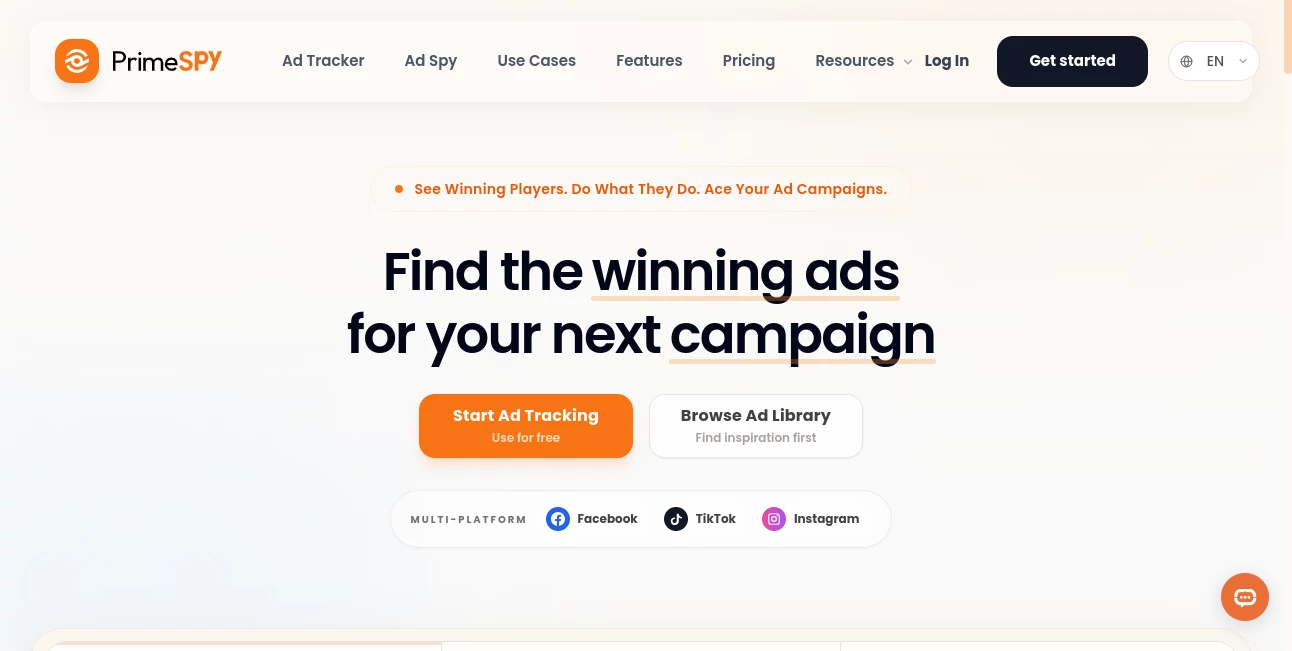
What is PrimeSpy?
PrimeSpy is an ad intelligence and competitive research platform built for marketers who want to understand what other brands are doing before launching their next campaign. Instead of spending hours moving through public ad libraries and trying to separate useful examples from noise, marketers can search ads, examine creative patterns, follow competitors, and organize useful discoveries in one place.
The platform brings together advertising research across Facebook, Instagram, and other social advertising environments, with a strong emphasis on Meta ad research. Its database currently covers more than 1.2 billion ads across 90+ countries and 200+ markets, giving users a broad pool of advertising examples to investigate.
What makes this approach particularly useful is the connection between discovery and analysis. Finding an interesting advertisement is only the first step. The real value comes from understanding its format, message, audience signals, running history, landing page, and other details that can help shape a better campaign.
Key Features
- Meta Library search for finding Facebook and Instagram advertisements.
- Smart Search for researching keywords, advertisers, products, and URLs.
- Advanced advertising filters for narrowing research results.
- Ad trackers for monitoring selected competitors over time.
- Daily Top Products for discovering products and advertising angles worth investigating.
- Saved Lists for keeping useful advertisements and research findings organized.
- Creative downloads for collecting advertising references.
- Meta ad analytics for examining advertising activity in greater detail.
- Country and market research for understanding advertising activity across different regions.
- Filters covering elements such as CTA type, ad format, duplicates, reach, and estimated spend.
User Interface
The interface is designed around the way marketers actually research advertising. Instead of presenting a complicated analytics dashboard first, it puts search and discovery at the center of the experience.
Users can search for an advertiser, keyword, product, or URL and then narrow the results with filters. The resulting workflow feels closer to building a research library than simply browsing advertisements. Saved lists also make it easier to return to promising examples instead of searching for the same ads repeatedly.
For someone researching competitors for the first time, the layout is relatively straightforward. More experienced media buyers can move quickly between search results, advertising details, filters, and saved research.
Accuracy & Performance
Advertising research is only useful when the underlying information provides enough context to make sensible decisions. The platform reports more than 1.2 billion analyzed ads, 14 billion data points, 90+ countries and regions, and 200+ markets, providing substantial coverage for competitive research.
Users can examine signals such as reach, estimated spend, duplicates, advertising status, dates, and other available attributes. These details can help separate a random advertisement from a campaign that deserves closer attention.
It is still important to treat advertising signals as research indicators rather than guaranteed proof of profitability. A long-running advertisement or high reach can provide a useful clue, but marketers should combine those signals with their own market knowledge, landing-page analysis, and campaign testing.
Capabilities
The strongest part of the platform is its ability to turn advertising discovery into a repeatable research process. A marketer can begin with a competitor, identify several active creatives, compare their messaging, inspect different formats, save promising examples, and continue monitoring the advertiser later.
This is particularly valuable for ecommerce and DTC brands. For example, a store preparing to launch a new product can research several competitors, look for recurring hooks and offers, compare different creative formats, and build a shortlist of ideas worth testing.
Agencies can use the same workflow when preparing research for clients. Rather than collecting scattered screenshots and browser bookmarks, useful advertisements can be organized into a more structured collection for creative planning.
The platform also supports research across different business models, including ecommerce, dropshipping, TikTok Shop, mobile apps, games, short-drama applications, AI SaaS products, and advertising arbitrage.
Security & Privacy
Because the service is designed around advertising intelligence, users should think of it primarily as a competitive research platform rather than a tool for accessing private advertising accounts. Its value comes from organizing and analyzing advertising information available through its research infrastructure.
Users should also review the platform's privacy policy and terms before using it for commercial research, particularly when working with sensitive business information or when sharing research with a larger team.
Use Cases
- Ecommerce Research: Discover competitor product angles, offers, creatives, and advertising patterns before planning a campaign.
- Dropshipping: Research products and advertisements that appear to be gaining traction and identify creative approaches worth testing.
- Competitor Monitoring: Follow selected advertisers and keep an eye on changes in their advertising activity.
- Creative Research: Build a collection of advertisements to study hooks, formats, calls to action, and visual approaches.
- AI SaaS Marketing: Research how competing software companies present product benefits, demos, and offers.
- App Marketing: Examine acquisition advertisements and messaging strategies used by competing applications.
- Game Marketing: Study user-acquisition creatives and promotional angles used by competing games.
- Agency Research: Create organized advertising research that can support campaign planning and client strategy.
- TikTok Shop Research: Investigate products, sellers, and advertising ideas relevant to fast-moving social commerce markets.
- Campaign Planning: Use competitor research to develop hypotheses before spending money on new creative tests.
Pros and Cons
Pros
- Large advertising database with broad geographic coverage.
- Strong focus on Meta advertising research.
- Smart search makes competitor and keyword research faster.
- Useful filters for narrowing large volumes of advertising data.
- Ad tracking supports ongoing competitor monitoring.
- Saved lists make it easier to organize research.
- Creative downloads can support swipe-file and campaign research workflows.
- Free access is available without requiring a credit card.
Cons
- The credit-based system means heavy research can consume credits quickly.
- Some advanced functionality is currently focused on Meta rather than every major advertising platform.
- Advertising signals should be treated as research indicators rather than guaranteed evidence of campaign profitability.
- Users who need large-scale enterprise reporting may require a more specialized analytics platform.
Pricing Plans
The platform currently offers a free Trial plan at $0 per month with 500 credits and two ad trackers. The trial also provides access to Meta Library search, Smart Search, core Meta filters, Daily Top Products, and a preview of Saved Lists. No credit card is required to start.
The Pro plan is listed at $9.99 per month and includes 20,000 credits, 20 ad trackers, full Meta ad analytics, advanced EU filters, ad detail insights, unlimited creative downloads, Saved List export, and priority online support.
The pricing page also states that annual billing can provide savings compared with monthly pricing. Paid access is purchased for the selected period rather than automatically renewing, according to the current service terms.
How to Use the Platform
Start by deciding what you want to learn. Instead of searching for random advertisements, choose a specific competitor, product category, market, or advertising angle.
Enter a keyword, advertiser, or URL into Smart Search and review the available advertisements. Use filters to reduce the results by factors such as country, format, CTA, date, reach, spend, or other available attributes.
When you find an advertisement worth studying, examine more than the creative itself. Look at the message, offer, call to action, running status, available performance signals, and destination page. Ask why the advertisement might be working rather than simply copying its appearance.
Save particularly useful examples into organized lists so they can be revisited later. If a competitor is important to your research, add an ad tracker and monitor changes over time.
A practical workflow is to research several competitors, identify repeated patterns, separate common industry conventions from genuinely interesting ideas, and then use those findings to create original campaign concepts.
Comparison with Similar Tools
Meta Ads Library is useful when the goal is simply to browse publicly available Meta advertisements. However, it provides a more basic research experience and requires more manual work when marketers want to compare advertisers, track campaigns, organize findings, or analyze multiple signals.
This platform adds a more research-oriented layer around advertising discovery. Advanced filters, competitor research, saved workflows, tracking, and additional advertising signals can make the process more convenient for marketers who regularly perform competitive research.
That distinction matters for frequent users. Someone who checks a competitor's advertisements once a month may be perfectly comfortable with a basic public library. A marketer researching new products and creatives every week can benefit much more from a structured workflow.
Conclusion
Good advertising research is rarely about copying another company's campaign. It is about noticing patterns before committing your own budget. Which hooks keep appearing? Which offers are competitors emphasizing? Which formats seem to receive continued attention? Which products are being promoted repeatedly?
PrimeSpy gives marketers a practical environment for answering those questions. Its large advertising database, search tools, competitor tracking, filters, analytics, and saved research workflows make it especially appealing to ecommerce operators, agencies, performance marketers, and teams that depend heavily on paid social campaigns.
The free credits make it easy to explore the workflow before making a purchase. For marketers who regularly research competitors and need more than a basic ad library, it can become a useful part of the campaign-planning process.
Frequently Asked Questions (FAQ)
Is there a free plan?
Yes. The Trial plan is free and currently includes 500 credits and two ad trackers. No credit card is required to get started.
What advertising platforms does it support?
The platform currently focuses strongly on Meta advertising research, covering Facebook and Instagram advertising. Its website also presents TikTok and Instagram as part of its broader multi-platform direction, while some additional modules are listed as coming soon.
How much does the Pro plan cost?
The current Pro plan is listed at $9.99 per month and includes 20,000 credits, 20 ad trackers, deeper Meta analytics, advanced filters, exports, and creative downloads.
Can I track competitors?
Yes. Ad trackers allow users to monitor selected advertising activity over time instead of performing one-off searches whenever they need competitive information.
Who can benefit most from this platform?
It is particularly useful for ecommerce and DTC brands, dropshippers, agencies, performance marketers, app companies, game marketers, AI SaaS businesses, and anyone who regularly researches competitor advertising.
AI Ad Creative Assistant , Marketing , AI Analytics Assistant , AI Advertising Assistant .
These classifications represent its core capabilities and areas of application. For related tools, explore the linked categories above.

PrimeSpy Alternatives Product

LyricStudio

ScriptHook
CartLens

Sellerview.ai

Pips Hint

MacroMicro

Candidate Sc…

Marketinguys

CapyQR
