
Qloo
What is Qloo?
Understanding what people actually like is much harder than simply collecting clicks, purchases, or demographic information. Preferences often cross boundaries. Someone who enjoys a particular type of music may also prefer certain restaurants, travel destinations, films, brands, or experiences. This is where Qloo takes a different approach.
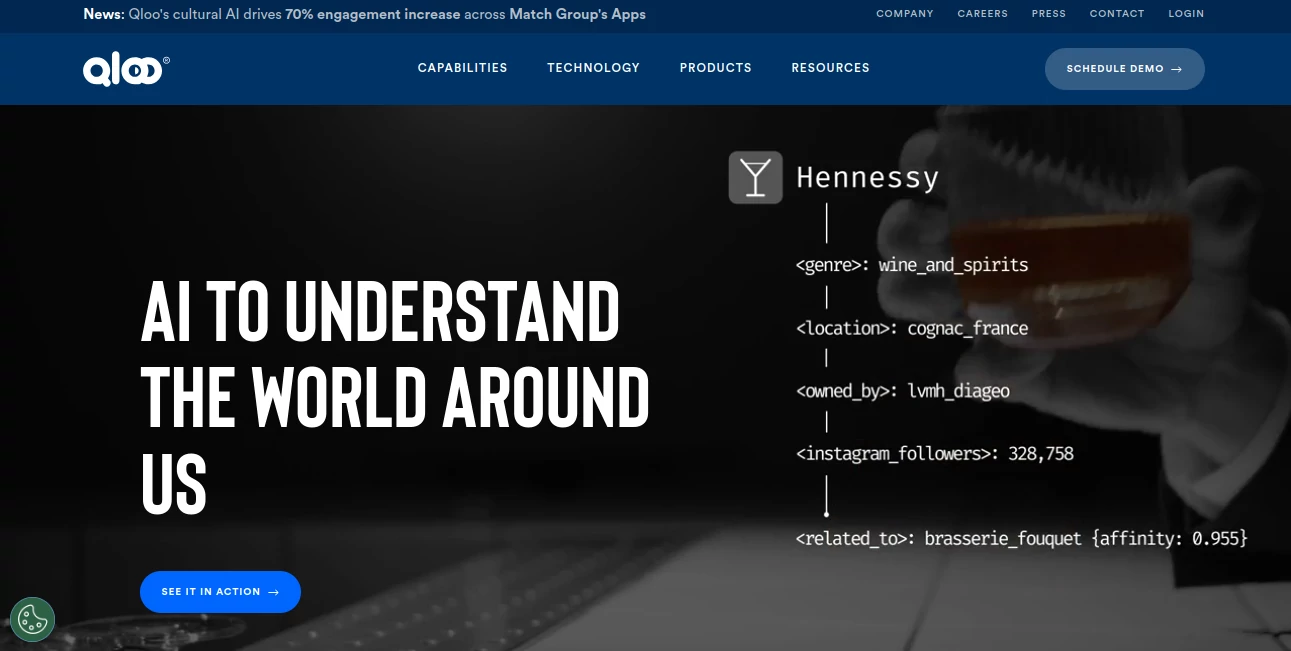
Built around a large cultural knowledge graph and years of consumer intelligence research, the platform helps businesses and AI systems understand the relationships between interests. Its technology is designed to turn complex preference signals into useful recommendations, audience insights, and personalized experiences without requiring personally identifiable information.
The platform currently maps more than 3.7 billion cultural entities and works with more than 10 trillion anonymized preference signals. Its coverage extends across areas such as entertainment, dining, travel, lifestyle, brands, music, and other cultural interests. This breadth makes it particularly interesting for companies that want their AI applications to understand context rather than treat every preference as an isolated data point.
Key Features
The core strength of the platform is its ability to connect seemingly unrelated interests. Instead of limiting recommendations to a single category, its intelligence layer can transfer preference signals between different cultural domains.
- Access to a large catalog of cultural entities, including people, places, brands, restaurants, hotels, music, films, books, podcasts, and destinations.
- Cross-domain recommendation capabilities that connect interests across different areas of culture and lifestyle.
- Audience intelligence for discovering the cultural affinities of specific audiences.
- Taste analysis designed to reveal relationships between interests and help predict what users may want next.
- API access for integrating preference intelligence into websites, applications, AI products, and internal systems.
- Support for LLM and AI agent integrations, giving generative systems structured preference information.
- On-device AI capabilities for personalization where low latency and privacy are important.
- Continuously refreshed data designed to keep recommendations aligned with changing consumer interests.
User Interface
The experience is primarily designed around business and developer use rather than a traditional consumer chatbot interface. This is an important distinction. Instead of opening a simple text box and asking questions, users typically interact with the platform through its insights products, API, integrations, and developer resources.
The overall approach is practical and focused on getting intelligence into existing products. For developers, standard API integration and documentation make it possible to connect the underlying recommendation capabilities with an existing application. For business teams, the insights experience is more focused on understanding audiences, markets, trends, and cultural relationships.
Accuracy & Performance
Performance is one of the areas where this technology becomes particularly useful for applications that need recommendations in real time. The company states that its API is built for speed and scalability and can process complex queries with near-instantaneous responses.
The underlying models combine behavioral signals, content metadata, embeddings, and deep learning techniques to identify relationships between cultural entities. Rather than relying solely on generated text, the system works with structured data and preference relationships. That can be especially valuable when an application needs recommendations grounded in actual consumer behavior.
The platform also addresses the cold-start problem. According to its documentation, recommendations can be generated with as little as one useful signal, allowing businesses to provide personalized experiences even when they have limited first-party information about a visitor.
Capabilities
The technology covers considerably more than a conventional recommendation engine. Its recommendation layer can connect preferences across domains, while audience intelligence can help businesses understand the cultural characteristics of a particular group.
Its taste analysis capabilities are particularly interesting for businesses working with complex consumer behavior. For example, an application could discover connections between a user's favorite artist and preferred travel destinations, or use interests in entertainment to improve restaurant and hotel recommendations.
The platform also supports data licensing and custom catalogs, allowing organizations to incorporate their own classifications or rating systems. Developers can access the intelligence through APIs, while companies can connect the data with existing data warehouses, customer data platforms, CRM systems, visualization tools, and other business infrastructure.
Security & Privacy
Privacy is a central part of the platform's architecture. Its models are designed to operate without personally identifiable information, using anonymized behavioral and sentiment signals instead of relying on individual identities.
The company states that its technology is designed to comply with major privacy regulations including GDPR and CCPA. This privacy-first structure can be particularly relevant for businesses that want personalized recommendations without building systems around sensitive personal profiles.
The platform also offers on-device AI capabilities, allowing certain personalization models to operate directly on devices. For applications where data residency, latency, or privacy is a major concern, this approach can provide an additional layer of control.
Use Cases
There are many practical ways businesses can apply this type of intelligence. E-commerce platforms can use cross-domain preferences to improve product discovery. Travel companies can recommend destinations, hotels, or experiences based on broader cultural interests rather than simple location filters.
Media and entertainment companies can connect audiences with movies, music, podcasts, books, or other content that fits their interests. Marketing teams can use audience intelligence to understand the media, brands, celebrities, destinations, and experiences that resonate with a particular audience.
AI developers can also use the technology to make LLM-powered applications more personalized. A travel assistant, for example, could combine a user's stated requirements with structured taste intelligence to produce recommendations that feel more relevant to that person's interests.
Another compelling use case is group decision-making. When several people need to choose a restaurant, trip, event, or activity, understanding overlapping interests can help an application find options that satisfy multiple preferences at once.
Pros and Cons
Pros
- Extensive cultural and lifestyle entity coverage.
- Strong cross-domain recommendation capabilities.
- Useful API for developers building personalized products.
- Designed around anonymized data rather than personally identifiable information.
- Suitable for LLMs, AI agents, recommendation engines, and business intelligence applications.
- Supports real-time personalization and scalable infrastructure.
- Can help address cold-start recommendation problems.
- Offers options for custom catalogs and enterprise data integration.
Cons
- The platform is primarily aimed at businesses, developers, and organizations rather than casual individual users.
- Some capabilities require technical integration or an enterprise-oriented setup.
- Pricing is not presented as a simple public self-service subscription table.
- Getting the most value from the platform may require understanding APIs, audience data, and recommendation systems.
Pricing Plans
The current offering is positioned primarily toward businesses and organizations, so pricing is not presented as a conventional collection of fixed monthly plans on the public website. Instead, prospective customers are directed toward demonstrations and conversations with the team.
API access, enterprise integrations, data licensing, insights products, and other business requirements can vary considerably depending on the implementation. For that reason, contacting the provider for a tailored plan is the most appropriate way to determine the actual cost for a specific project.
This approach makes sense for organizations that need large-scale recommendation infrastructure or specialized consumer intelligence, although users looking for a simple low-cost AI subscription may find the sales-led model less convenient.
How to Use It
Getting started depends on what you want to build. Businesses interested in audience intelligence can begin by exploring the insights capabilities and identifying the type of consumer or market questions they want to answer.
Developers building applications can use the API route. Start by reviewing the available documentation, identifying the relevant entities or preference signals, and deciding where recommendation intelligence should appear in the product.
For an AI application, the intelligence can also be incorporated into an LLM or agent workflow. For example, a recommendation request can first be enriched with structured taste information before the generative model produces the final response.
A useful implementation strategy is to start with one focused use case rather than attempting to personalize an entire product immediately. Testing recommendations in a single journey, such as content discovery, hotel selection, or product recommendations, makes it easier to measure whether the additional intelligence improves engagement and conversion.
Comparison with Similar Tools
Traditional recommendation systems often focus heavily on a company's own catalog and first-party interaction data. That approach can work well when a business has extensive historical information, but it can become less effective when a new user arrives or when interests span several unrelated categories.
This platform takes a broader cultural approach. Its knowledge graph connects entities across multiple domains, while its behavioral intelligence provides additional signals about how those entities relate to consumer preferences.
It is also different from a general-purpose LLM. A language model is excellent at understanding and generating natural language, while this technology is designed specifically to provide structured information about tastes and preferences. In practice, the two can complement one another: an LLM can handle conversation and generation, while a structured taste layer can provide more grounded personalization.
For companies building recommendation engines, audience intelligence platforms, personalized AI assistants, or culturally aware applications, this distinction can be significant.
Conclusion
For businesses trying to make AI experiences more relevant to real human preferences, this platform offers an unusually broad foundation. Its combination of cultural knowledge, anonymized behavioral signals, cross-domain relationships, APIs, and AI integrations gives developers and organizations plenty of room to build sophisticated personalization systems.
The most impressive aspect is not simply the size of the underlying database. The real value comes from connecting things that normally sit in separate datasets. Music can inform travel recommendations. Entertainment preferences can reveal useful lifestyle patterns. Brand interests can contribute to better audience understanding.
That makes the technology particularly well suited to companies where personalization is central to the product experience. It may require a more technical or enterprise-oriented setup than a typical consumer AI application, but for organizations willing to integrate it into their infrastructure, the potential applications are extensive.
Frequently Asked Questions (FAQ)
What is this platform used for?
It is used to understand consumer tastes and preferences, power personalized recommendations, analyze audiences, enrich AI applications, and connect cultural interests across different domains.
Does it provide an API?
Yes. The platform provides an API designed for integrating taste intelligence into websites, applications, AI systems, internal tools, and other digital products.
Can it work with LLMs?
Yes. Its structured preference intelligence can be integrated with large language models and AI agents to make generated responses and recommendations more relevant to user interests.
Does it use personally identifiable information?
The company states that its intelligence engine does not require or ingest personally identifiable information. Its models use anonymized behavioral and sentiment signals to understand relationships between cultural entities and preferences.
What types of information can it understand?
The system covers a broad range of cultural and lifestyle information, including people, places, brands, restaurants, hotels, music, movies, television, books, podcasts, destinations, and other interests.
Is there a free plan?
The public website does not currently present a conventional free subscription plan or fixed pricing table. Businesses are encouraged to explore the available products and contact the team for access and pricing based on their requirements.
Can businesses use their own data?
Yes. The platform supports custom catalogs and integrations, allowing organizations to combine its intelligence with existing classifications, datasets, and technology infrastructure.
Is it suitable for enterprise applications?
Yes. The API and infrastructure are designed for scalable applications, while integrations with data warehouses, customer data platforms, CRM systems, and other business technologies make it suitable for larger organizations.
Large Language Models (LLMs) , AI Research Tool , AI Analytics Assistant , Other .
These classifications represent its core capabilities and areas of application. For related tools, explore the linked categories above.

Qloo Alternatives Product

freellm

Analyse

Manus

Metal

Greek Numero…

CoolVerdict

Preuve AI

iyadel

CoinIQ