













Seodar
What is Seodar?
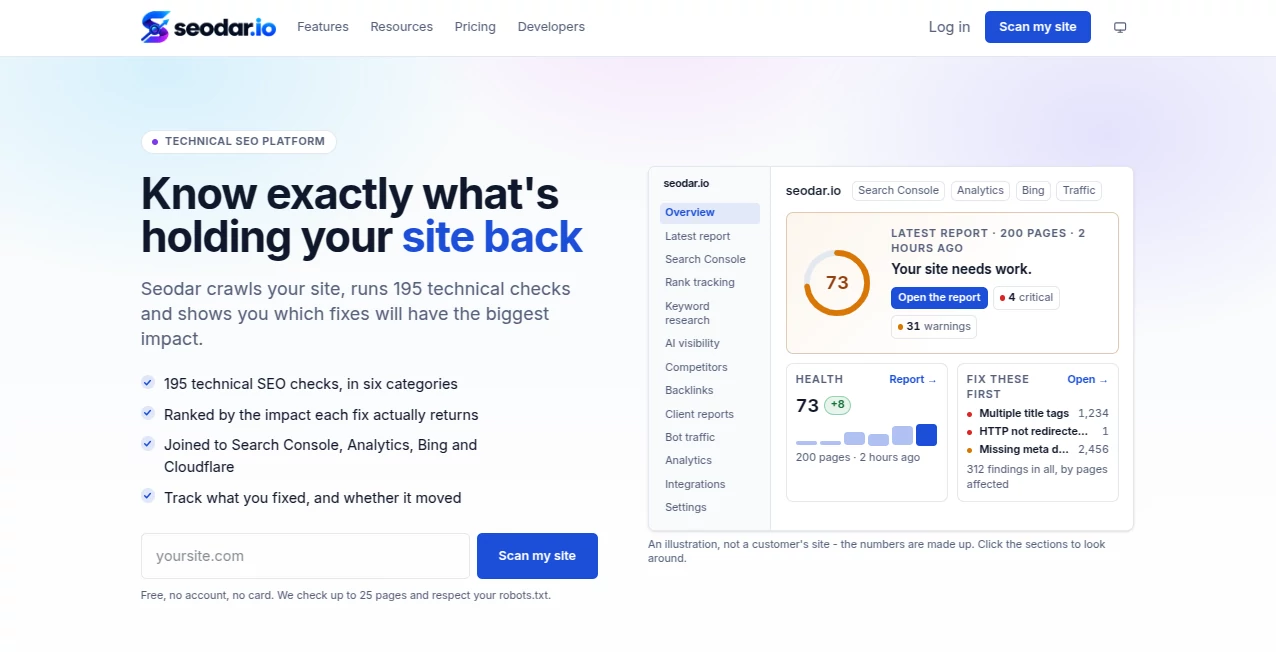
Seodar is a technical SEO platform designed for people who want to understand what is actually happening across their websites instead of working through a long list of disconnected SEO warnings. It crawls a website, runs 195 technical checks, and turns the results into a prioritized list of issues that deserve attention first.
What makes the platform particularly useful is its focus on actionable information. Instead of simply showing hundreds of warnings, it considers factors such as impact, ease of fixing an issue, and the number of affected pages. This gives website owners, developers, and SEO teams a much clearer idea of where their time is best spent.
The platform also connects technical crawling data with sources such as Google Search Console, Analytics, Bing, and Cloudflare. That broader view can reveal problems that a standard crawler alone would never see.
Key Features
- 195 technical SEO checks across multiple areas of website health
- Prioritized SEO issues based on impact, effort, and affected pages
- Technical SEO health score with its underlying calculation shown
- Google Search Console and Analytics integrations
- Bing Webmaster Tools data and index coverage information
- Cloudflare integration for additional crawler and traffic information
- Keyword research with search volume, difficulty, and search intent
- Daily rank tracking with SERP features and Google AI Overview monitoring
- AI visibility tracking across major AI assistants
- Competitor analysis using comparable crawling and SEO checks
- Backlink monitoring
- Accessibility checks based on WCAG 2.2
- Scheduled monitoring and change alerts
- API and MCP access for developers and advanced workflows
User Interface
The interface is built around a practical workflow rather than a collection of complicated SEO dashboards. After entering a website, users can move through areas such as technical audits, Search Console data, rankings, keywords, AI visibility, competitors, backlinks, and analytics.
The reporting structure is especially helpful for users who have inherited a website or need to decide what should be fixed first. Instead of forcing someone to interpret every warning independently, the platform organizes findings according to their potential value.
For an SEO manager looking at a large website, this can save a surprising amount of time. A problem affecting hundreds of pages naturally deserves more attention than an isolated warning on an unimportant page.
Accuracy & Performance
The platform takes a measurement-first approach to SEO. Its crawler checks indexability, metadata, content, links, media, and performance, with individual findings connected to the pages where they were detected.
One useful detail is that the health score is not presented as a mysterious number. The calculation is broken down by category, making it easier to understand why a website received its particular score.
Historical crawls are also retained, allowing users to compare results over time. This makes it possible to see whether a technical cleanup actually changed the site's measured health rather than relying on assumptions.
Capabilities
Beyond technical auditing, the platform covers several parts of the modern SEO workflow. Keyword research provides search volume, keyword difficulty, and intent, while rank tracking records daily positions and important SERP features.
Its AI visibility functionality is another interesting addition. The system checks whether a website is mentioned or cited by AI assistants and Google's AI Overview for relevant searches. This matters because traditional rankings do not necessarily show whether a brand appears in AI-generated answers.
For developers and technically oriented SEO professionals, API and MCP support provides another layer of flexibility. Instead of keeping SEO data locked inside a dashboard, information can be accessed programmatically and incorporated into other workflows.
Security & Privacy
The platform is designed as a measurement and analysis service rather than a system that directly modifies a customer's website. Its crawler respects robots.txt and Crawl-delay, while anonymous scans are rate-limited.
Connected services can provide additional information about search visibility, traffic, indexing, and crawler activity. The platform also offers read-only API access for working with collected SEO data.
For paid subscriptions, payments are processed through Stripe, with card details handled by the payment provider rather than stored directly by the platform.
Use Cases
Website owners can use the platform to identify technical problems before they become larger SEO headaches. A single crawl can highlight issues with metadata, indexability, links, performance, and other parts of a site's structure.
SEO professionals can use it as a central workspace for audits, keyword research, ranking monitoring, competitor research, backlink analysis, and AI search visibility.
Developers can benefit from the prioritized issue list when working on technical SEO improvements. Rather than receiving an unorganized collection of warnings, they can see which fixes affect the greatest number of pages or offer the strongest potential improvement to the site's technical health.
Agencies can also use scheduled reports, client-focused features, larger crawl limits, and white-label reporting to manage SEO work across multiple websites.
Pros and Cons
Pros
- Large collection of 195 technical SEO checks
- Issues are prioritized instead of simply listed
- Health score calculation is transparent
- Combines crawling data with external sources
- Includes keyword research and rank tracking
- AI visibility monitoring adds a modern search perspective
- Historical crawls make progress easier to measure
- API and MCP support are useful for technical users
- Free scanning is available without requiring a card
Cons
- Some advanced features are limited to paid plans
- Rank tracking is not included in the entry-level paid plan
- Large websites require higher-tier plans for larger crawl limits
- AI analysis can consume credits on paid plans
Pricing Plans
A free plan is available for users who want to test the platform before subscribing. It supports one website, up to 200 pages per crawl, and includes 100 one-time credits. The free option does not require a payment card.
The Starter plan costs €29 per month and supports up to three websites, 2,000 pages per crawl, 1,000 monthly credits, AI rewrites, backlinks, keyword lookups, and API requests.
The Pro plan costs €79 per month and increases the allowance to 10 websites and 5,000 pages per crawl. It also adds rank tracking for 100 keywords, scheduled reports, and a significantly larger API allowance.
The Agency plan costs €199 per month and is designed for larger teams and client work. It supports up to 30 websites, 20,000 pages per crawl, 10,000 monthly credits, client seats, scheduled reports, white-label reporting, rank tracking for 500 keywords, and a larger API allowance.
Paid plans are billed monthly, and users can cancel at any time. The platform also states that a failed crawl does not consume crawl credits.
How to Use the Tool
- Enter the website you want to analyze.
- Start a crawl and allow the crawler to follow the site's internal links.
- Review the technical health score and individual findings.
- Open the prioritized issues to identify which problems deserve attention first.
- Connect services such as Search Console, Analytics, Bing, or Cloudflare for additional data.
- Use keyword research to discover search terms based on volume, difficulty, and intent.
- Track important keywords over time through rank tracking.
- Review AI visibility to see whether AI assistants and Google's AI results mention your website.
- Run another crawl after making changes and compare the results with previous scans.
Comparison with Similar Tools
Many SEO platforms concentrate heavily on keyword positions, backlinks, or large collections of technical warnings. This platform takes a somewhat different route by putting technical diagnosis and prioritization at the center of the experience.
Its approach is particularly appealing to users who do not want an SEO dashboard filled with numbers without a clear next step. The combination of technical audits, historical measurements, search data, competitor information, and AI visibility creates a broader picture of how a website is performing.
Another distinction is the transparency of its scoring model. Rather than presenting a score as an unquestionable authority, the platform explains how the number was produced. That makes the report more useful for teams that want evidence behind an SEO decision.
Conclusion
For website owners and SEO professionals who want a practical way to uncover technical problems and decide what to fix first, this platform offers a well-rounded toolkit. Its 195 technical checks provide a strong foundation, while keyword research, rank tracking, competitor analysis, backlinks, and AI visibility extend the usefulness beyond a traditional site audit.
The biggest advantage is the emphasis on clarity. SEO problems are rarely difficult because there are too few metrics; they are difficult because there are too many. By connecting findings to affected pages and ranking fixes according to their potential value, the platform makes the process much easier to navigate.
The free plan also makes it straightforward to test the auditing experience before committing to a subscription. For growing websites, in-house SEO teams, developers, and agencies, it is a compelling option for turning technical SEO data into a more organized action plan.
Frequently Asked Questions (FAQ)
Is there a free plan?
Yes. The free plan supports one website and up to 200 pages per crawl, with 100 one-time credits. A credit-free trial scan is also available without an account or payment card and checks up to 25 pages.
How many technical SEO checks are included?
The platform currently runs 195 technical checks covering areas such as indexability, metadata, content, links, media, and performance.
Does it track keyword rankings?
Yes. Rank tracking records keyword positions daily, looks two pages deep into search results, and records relevant SERP features. Google AI Overview can also be monitored for tracked keywords.
Can it monitor visibility in AI search?
Yes. AI visibility monitoring checks four major AI assistants along with Google's AI Overview and records the answers, cited sources, and competing domains mentioned instead of the tracked website.
Does it offer keyword research?
Yes. Keyword research provides search volume, difficulty, and search intent, with the option to move relevant keywords into rank tracking.
Is an API available?
Yes. API and MCP access are available on plans that include an API request allowance, allowing developers to work with SEO data programmatically.
Does the crawler respect robots.txt?
Yes. The crawler respects robots.txt and Crawl-delay and identifies itself as the platform's crawler when scanning websites.
Who can benefit most from this platform?
It is suitable for website owners, in-house SEO teams, developers responsible for technical fixes, SEO consultants, and agencies managing multiple websites and client reports.
AI SEO Assistant , AI Analytics Assistant .
These classifications represent its core capabilities and areas of application. For related tools, explore the linked categories above.

Seodar Alternatives Product

BlogBuster

Lutains

DidYouSEO

extractkeywo…

CapyQR
Analyse

SeoWebChecker

WRITELO
Surmado