
Skoora
What is Skoora?
Skoora is a decision workspace for founders, entrepreneurs, and builders who want to know whether an idea deserves their time before development begins. Instead of simply encouraging an idea or helping turn it into code, it focuses on the step in between: deciding what is actually worth building.
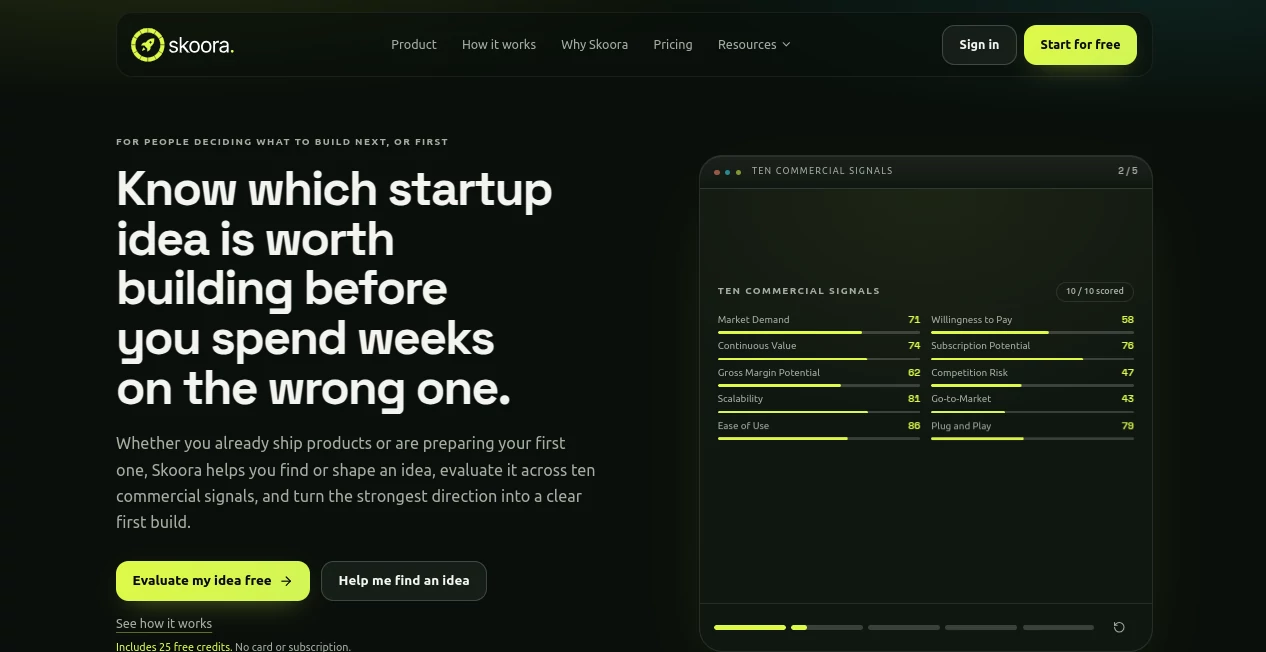
The platform lets users describe an idea in plain language and evaluate it across ten commercial signals covering demand, business potential, and go-to-market considerations. It then turns the assessment into a practical decision: Build, Explore, or Skip. For someone sitting on several startup concepts and unsure which one deserves attention first, that structure can be surprisingly useful.
It also goes beyond an initial score. Users can discover ideas tailored to their background and interests, investigate weak assumptions, create marketing, sales, and finance plans, receive recommended tools, and generate a structured build-ready prompt for AI development platforms.
Key Features
- Startup idea evaluation across ten consistent commercial signals.
- Three clear outcomes: Build, Explore, or Skip.
- Idea discovery based on a user's background and interests.
- Detailed reports covering strengths, weaknesses, customers, value, competition, pricing, risks, and next steps.
- Signal improvement suggestions for areas that need validation.
- Marketing, sales, and finance planning.
- Recommended tools matched to the evaluated idea.
- Build-ready prompts for tools such as Lovable, Cursor, Bolt, and Replit.
- PDF exports for marketing, sales, and finance plans.
- Usage-based credits instead of a recurring subscription.
User Interface
The interface is built around a straightforward workflow rather than a complicated business-analysis dashboard. Users can start by describing an idea in their own words, without preparing a pitch deck, business plan, or technical specification.
The process is divided into intake, evaluation, and decision stages. This makes the experience easy to follow, particularly for first-time founders who may not know which questions to ask about a new product concept.
A useful detail is that the platform can ask focused clarification questions when an idea lacks enough context rather than simply filling in the gaps with assumptions. That makes the evaluation process feel more deliberate and keeps the user's original idea at the center.
Accuracy & Performance
The platform does not present its assessment as proof that a startup will succeed. Instead, it provides a structured commercial reading of an idea and identifies assumptions that still need validation. That distinction matters because no automated evaluation can guarantee market demand or future revenue.
The ten signals look at areas such as market demand, willingness to pay, continuous value, subscription potential, gross margin potential, competition risk, scalability, go-to-market, ease of use, and plug-and-play potential. Each signal comes with an explanation and confidence level, giving users more context than a single unexplained number.
The result is particularly useful as an early filtering mechanism. If an idea looks attractive at first but has serious weaknesses around distribution or willingness to pay, those issues become visible before substantial development time is invested.
Capabilities
The strongest part of the platform is how it connects evaluation with execution. After an idea has been assessed, users can work on the weakest signals, develop a marketing plan, create a sales strategy, model financial assumptions, and generate a recommended tool stack.
The build-ready prompt is another practical touch. Rather than starting from a blank prompt in an AI coding platform, users receive a structured specification containing information such as the product concept, MVP scope, and data structure. This can then be taken into tools including Lovable, Cursor, Bolt, or Replit.
For users without an idea yet, the discovery feature provides another starting point. It can generate ideas around the user's background and interests, which makes the service useful at both the brainstorming and validation stages.
Security & Privacy
Privacy is an important consideration when working with unpublished startup concepts. According to the published privacy policy, submitted ideas and evaluations belong to the user's account, are not published, and are not shared as a dataset. The company also states that identifiable customer idea content is not used to train its own models.
For requested AI features, idea content and relevant profile preferences are sent to Google Gemini models to generate the requested outputs. The service also uses providers such as Supabase for storage and authentication, Stripe for payments, and Resend for transactional email.
The service states that it uses encryption in transit, access controls, least-privilege administration, authentication, logging, and error monitoring. Users can also request access, correction, export, or deletion of their personal data under the applicable privacy rights.
Use Cases
Startup idea validation: Founders can pressure-test an idea before committing weeks or months to development. The Build, Explore, or Skip framework makes the outcome easier to act on.
Comparing multiple ideas: Entrepreneurs with several concepts can use the same framework for each one, making it easier to identify which opportunity deserves further attention.
Finding a startup direction: People who want to build a business but do not yet have a specific concept can use the discovery process to generate ideas suited to their background and interests.
Planning a new product: Once an idea shows potential, marketing, sales, and finance plans provide a more concrete path toward testing the business.
AI-assisted development: Builders can take the generated build-ready prompt into an AI coding environment and begin with a clearer product scope instead of an empty project.
Reducing wasted development time: One of the most compelling use cases is simply knowing when not to build. A weak idea can be reshaped or abandoned before engineering effort starts piling up.
Pros and Cons
- Pros: Clear evaluation framework, practical commercial signals, useful decision outcomes, idea discovery, detailed reports, execution planning, build-ready prompts, and no recurring subscription.
- Pros: The workflow connects strategic thinking with actual next steps instead of stopping at an idea score.
- Pros: New users receive 25 free credits without needing a card or subscription.
- Cons: The evaluation should be treated as decision support rather than definitive proof of market demand.
- Cons: Users working on highly specialized or unusual markets may still need independent customer research and validation.
- Cons: Credit-based pricing means frequent users need to monitor how quickly they consume credits.
Pricing Plans
The pricing model is usage-based, with no monthly subscription. New accounts receive 25 free credits, with no credit card required. Those credits can be used for activities such as discovering ideas, evaluating ideas, or improving a weak signal.
- Starter: $15 for 50 credits as a one-time purchase.
- Builder: $30 for 150 credits as a one-time purchase.
- Studio: $50 for 300 credits as a one-time purchase.
The credit system is flexible because users do not have to commit to a monthly plan. Credits remain available while the account is open, and individual actions have different costs depending on the amount of work involved. An idea evaluation costs 10 credits, while a full execution plan costs 20 credits and a build-ready prompt costs 30 credits.
How to Use Skoora
- Create an account and start with the included free credits.
- Describe your startup idea in plain language, or use the discovery feature if you need inspiration.
- Answer any focused clarification questions needed to provide sufficient context.
- Run the evaluation across the ten commercial signals.
- Review the strengths, weak points, assumptions, competition, customers, pricing considerations, and risks.
- Check whether the result is Build, Explore, or Skip.
- Improve weak signals and validate the areas that could prevent the idea from working.
- Create marketing, sales, or finance plans when the idea is ready for deeper planning.
- Generate a build-ready prompt and take it into an AI development tool when appropriate.
Comparison with Similar Tools
The platform occupies a slightly different position from general-purpose AI assistants and AI coding tools. A chatbot can be excellent for brainstorming and exploring possibilities, while a coding assistant can help turn a defined concept into software. The missing step is often deciding whether the concept deserves the build in the first place.
That is where this service stands out. Its workflow is specifically designed around commercial evaluation, decision-making, validation, and the transition toward execution. It does not try to replace every other tool in the startup stack. Instead, it can sit between idea exploration and product development.
For example, a founder might use a general AI assistant to generate ten possible product concepts, use this platform to compare and challenge those concepts, and then move the strongest direction into an AI coding platform. That division of responsibilities makes more sense than expecting one tool to handle every stage equally well.
Conclusion
Choosing what to build can be harder than building it. With modern AI development tools making software creation increasingly accessible, the bigger risk for many founders is no longer whether they can create an MVP, but whether the MVP deserves to exist.
This platform tackles that problem with a structured commercial evaluation, clear decisions, practical validation steps, and a path from a rough concept toward execution. Its combination of idea discovery, ten-signal analysis, business planning, tool recommendations, and build-ready prompts makes it particularly appealing to founders who want more discipline around the early stages of product development.
The best way to think about it is not as a crystal ball for startup success, but as a structured second opinion before significant time and money are committed. For an entrepreneur deciding between several promising ideas, that alone can make the process considerably clearer.
Frequently Asked Questions (FAQ)
What does this platform do?
It helps founders and builders discover, evaluate, and develop startup ideas. It analyzes an idea across ten commercial signals and produces a Build, Explore, or Skip outcome with recommended next steps.
Can it generate startup ideas?
Yes. The discovery feature can generate ideas tailored to a user's background and interests, which can then be evaluated through the same commercial framework.
Does it guarantee that an idea will succeed?
No. The evaluation is decision support rather than proof of market demand. Users should still validate important assumptions with real customers and market research.
What are the Build, Explore, and Skip results?
Build indicates that the idea has enough commercial shape to justify moving forward. Explore means an important assumption should be tested first. Skip means the current version of the idea does not justify the execution risk or time investment.
Does it create business plans?
Yes. Users can generate marketing, sales, and finance plans covering areas such as positioning, go-to-market strategy, pricing, costs, and unit economics.
Can it help with AI app development?
Yes. The service can create a structured build-ready prompt that can be taken into AI development environments such as Lovable, Cursor, Bolt, or Replit.
Is there a free option?
Yes. New accounts receive 25 free credits, with no credit card and no subscription required.
Does it require a monthly subscription?
No. The service uses one-time credit packs rather than recurring monthly subscriptions. Credits remain available while the account is open.
Are submitted startup ideas private?
The published privacy policy states that ideas and evaluations are not published or shared as a dataset. It also states that identifiable customer idea content is not used to train the company's own models. Requested AI processing sends relevant idea content to Google Gemini models to generate outputs.
Who can benefit most from it?
It is especially useful for startup founders, indie hackers, entrepreneurs, product builders, and teams that have multiple product concepts and want a structured way to decide which one deserves further investment.
AI Marketing Plan Generator , AI Research Tool , AI Business Ideas Generator , AI Consulting Assistant .
These classifications represent its core capabilities and areas of application. For related tools, explore the linked categories above.

Skoora Alternatives Product

ZoraInsights

Harvey

MacroMicro

DidYouSEO

Beat API

Techvorizon …

Skillselion

Hirescope.te…

ModelsLab