

















SparkGPT
What is SparkGPT?
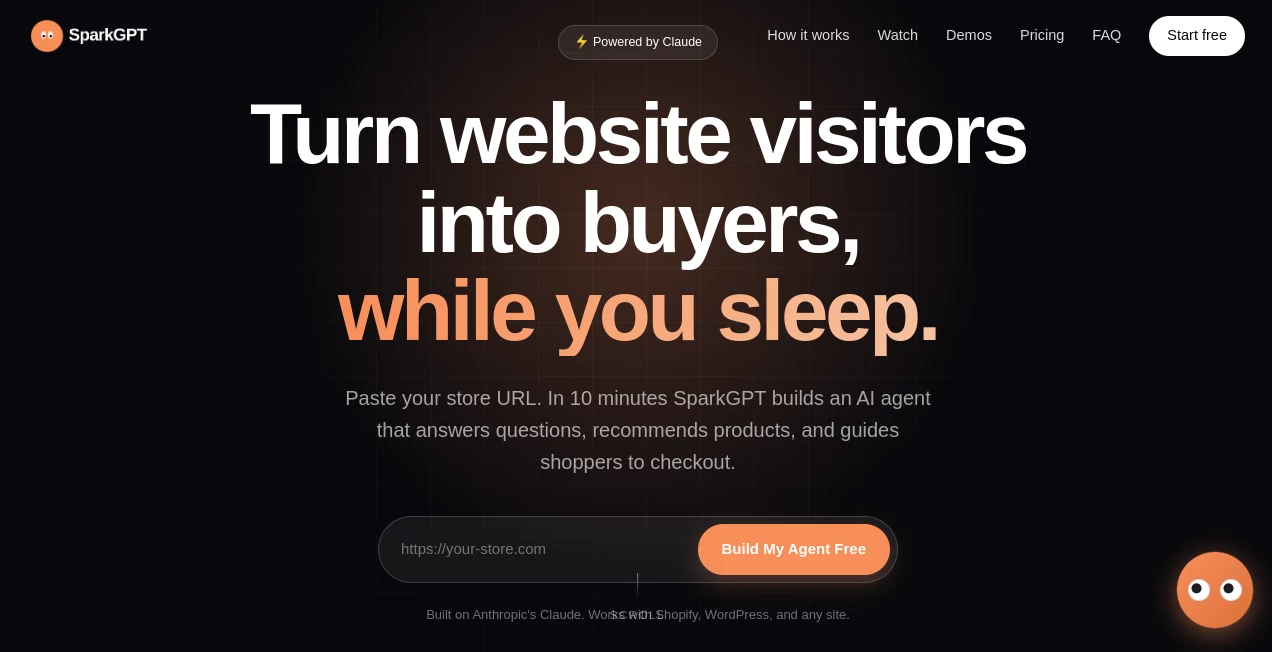
SparkGPT is an AI-powered sales agent designed to help businesses turn website conversations into actual purchases. Instead of relying on a basic chatbot that only answers frequently asked questions, it learns from a website's products, policies, pages, and tone, then interacts with shoppers as they browse. The platform is powered by Anthropic's Claude and can be used with Shopify, WordPress, or other websites.
The setup is particularly appealing for businesses that want a sales assistant without spending weeks configuring a complex conversational system. A store URL can be provided, allowing the platform to analyze the site and create an AI agent in a short time.
Key Features
- Automatically learns from products, website pages, policies, and brand tone.
- Answers customer questions in real time.
- Recommends relevant products from a catalog.
- Handles common customer objections before checkout.
- Guides shoppers toward purchasing decisions.
- Can operate around the clock without requiring a human representative online.
- Supports Shopify, WordPress, and other websites.
- Uses different Claude models depending on the complexity of a question.
- Provides sales attribution so businesses can see orders influenced by the AI agent.
User Interface
The interface is built around simplicity rather than a long list of technical settings. Businesses can start by entering their website address and allowing the system to analyze their existing content. Once the agent has been prepared, it can be deployed with a small amount of technical work.
The customer-facing chat experience is also designed to feel more like a sales conversation than a traditional support widget. For example, a visitor looking for a gift can explain what they have in mind, and the agent can use the available product information to narrow down suitable choices.
Accuracy & Performance
One of the more interesting parts of the platform is its approach to model selection. Simple questions can be handled with a faster, lower-cost model, while more complicated requests can be directed to a more capable model. This is intended to balance response quality with operating costs.
Because the agent learns from the business's own website, its usefulness depends heavily on the quality and completeness of the information available there. For a well-maintained store with clear product descriptions and policies, this approach can make conversations considerably more relevant than a generic chatbot.
Capabilities
The platform goes beyond answering questions. It can greet visitors, discover what they are looking for, recommend products, respond to objections, and direct shoppers toward checkout.
Its flexibility also makes it suitable for different types of businesses. Demonstrations on the website show examples ranging from tea recommendations and travel planning to property advice, restaurant assistance, fitness guidance, fashion recommendations, and course selection.
Security & Privacy
Businesses should review the platform's privacy documentation and the permissions required for their particular integration before deployment. The Shopify integration, for example, requires access to store-related information such as products and online store data, while certain customer and device information may also be available to the application.
For businesses handling sensitive customer information, it is worth checking the applicable data-access permissions and privacy policies before enabling the service in a production environment.
Use Cases
This tool is especially useful for online stores where customers frequently need assistance before making a purchase. An apparel store could use it to help shoppers find an outfit, while a specialty retailer could guide visitors toward products based on preferences, budget, or intended use.
It can also be useful for businesses that receive questions outside normal working hours. A visitor arriving late at night does not necessarily have to wait until the next morning for basic product guidance.
Another practical use is handling repetitive pre-sales conversations. Instead of having staff repeatedly answer questions about products, policies, or suitable choices, the AI agent can take care of much of that initial interaction.
Pros and Cons
Pros
- Fast website-based setup.
- Designed specifically around sales conversations.
- Can recommend products rather than simply answer FAQs.
- Works continuously, including outside business hours.
- Powered by Claude.
- Supports Shopify, WordPress, and custom websites.
- Sales attribution helps businesses connect conversations with orders.
- Free testing is available before committing to a paid plan.
Cons
- The quality of recommendations depends on the information available on the business website.
- Businesses with complex requirements may need additional customization.
- The paid Growth plan combines a monthly fee with a percentage of attributed sales.
- Businesses should carefully review data permissions when connecting the system to an online store.
Pricing Plans
The platform uses an outcome-based pricing model rather than relying entirely on a large fixed subscription. Businesses can build and test one agent for free, with unlimited testing and no credit card required.
The Growth plan costs $49 per month plus 5% of attributed sales. It includes live deployment, unlimited AI agents and conversations, an ROI dashboard, per-agent analytics, improvement insights, and credit-based commission billing.
There is also a custom Done-For-You option for businesses that want the setup handled for them, including brand-matched design and Shopify or custom-site integration.
How to Use SparkGPT
- Enter the URL of your website or online store.
- Allow the platform to analyze the available pages, products, policies, and other relevant information.
- Review and test the generated AI agent.
- Adjust the experience where necessary to match the business and its customers.
- Deploy the agent to the website.
- Monitor conversations, attributed orders, and sales performance through the available analytics.
Comparison with Similar Tools
Traditional customer-support chatbots generally focus on reducing the number of repetitive support requests. SparkGPT takes a more sales-oriented approach. Its purpose is not simply to provide an answer, but to help visitors choose a product and move closer to checkout.
The pricing model is another notable difference. Instead of charging only a large flat monthly subscription, the Growth plan combines a $49 monthly base with a 5% share of attributed sales. This can be attractive to businesses that prefer a cost structure connected to measurable sales results.
For a company that primarily needs ticket management or conventional customer support, a dedicated support platform may still be a better fit. For an online store looking for an AI salesperson that can work directly with shoppers, however, this approach is considerably more focused.
Conclusion
SparkGPT takes a practical approach to AI-powered e-commerce assistance by combining website-based training, conversational AI, product recommendations, and sales attribution in one system. Its biggest strength is the focus on the buying journey rather than treating every visitor interaction as a simple support question.
The ability to test an agent before paying makes it easier for businesses to see whether the conversations actually make sense for their customers. For online stores with a broad product catalog or a steady stream of pre-sales questions, having an AI agent available 24/7 could be a useful addition to the sales process.
Frequently Asked Questions (FAQ)
What is SparkGPT used for?
It is designed to create AI sales agents that answer shopper questions, recommend products, handle objections, and guide visitors toward checkout.
Does it work with Shopify?
Yes. The platform offers Shopify integration and can train an agent using store products, pages, and policies.
Can it work on WordPress?
Yes. The service states that it can work with WordPress as well as custom websites.
What AI model powers the service?
The service is powered by Anthropic's Claude, with model selection based on the complexity of the customer's question.
Is there a free plan?
Yes. Businesses can build and test one agent for free. The free option is intended for testing and does not provide live deployment.
How much does the Growth plan cost?
The Growth plan is listed at $49 per month plus 5% of attributed sales generated by the agent.
Can the AI recommend products?
Yes. The agent can use a business's catalog to recommend products based on what a visitor is looking for.
Does it work 24/7?
Yes. The service is designed to keep answering visitor questions around the clock, making it useful for businesses with customers in different time zones.
AI Chatbot , AI Sales Assistant , AI Customer Service Assistant , AI E-commerce Assistant .
These classifications represent its core capabilities and areas of application. For related tools, explore the linked categories above.

SparkGPT Alternatives Product

Chatzy AI

getgpt

KKV AI

Sales Prospe…

Sleepless Tr…

Clay Read

LSGRO
Sauci.ai

Supawazap
