

















Zyphra Cloud
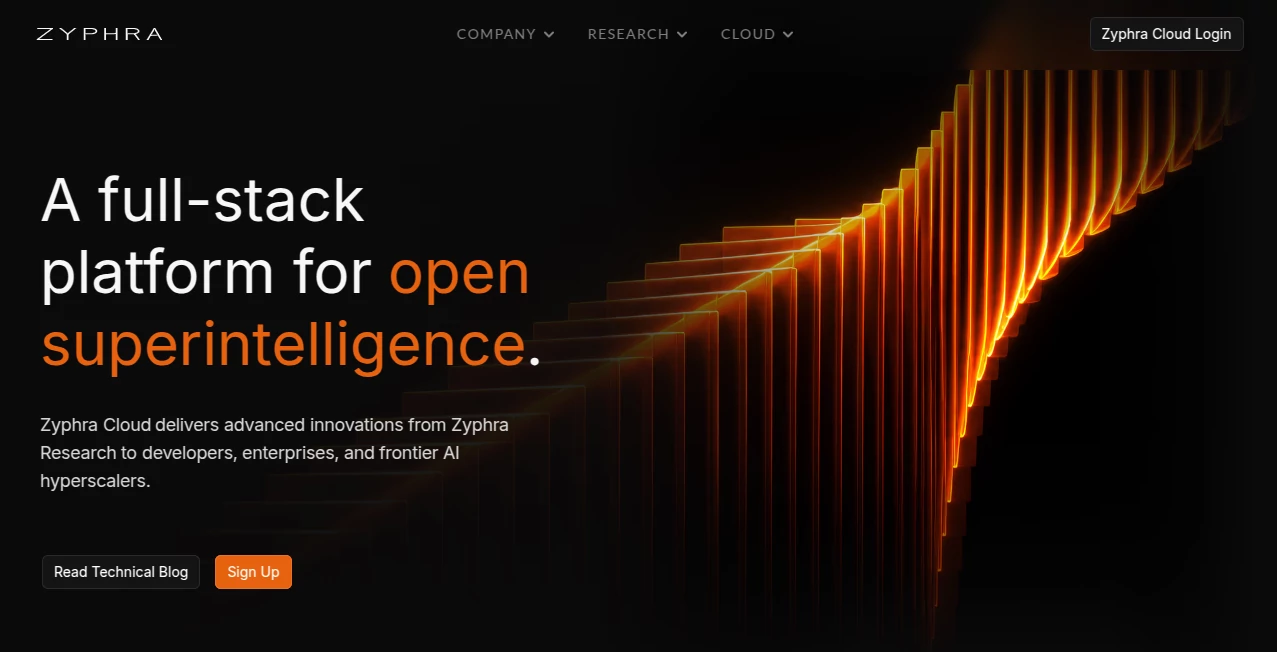
What is Zyphra Cloud?
Building advanced AI systems is rarely just about choosing a model. Developers also need reliable inference, scalable compute, suitable infrastructure, and practical ways to connect models with agents and production applications. Zyphra Cloud brings these pieces together in a full-stack AI platform built for developers, enterprises, and teams working with advanced open AI systems.
The platform puts particular attention on long-context models and long-horizon agentic workloads. Instead of treating inference as a simple endpoint, it combines model serving with compute, agent environments, and infrastructure designed for demanding AI applications. This makes it an interesting option for teams that want more control over how their AI workloads are deployed and scaled.
Key Features
- Full-stack infrastructure for advanced AI applications
- Serverless inference for running open-weight models without managing infrastructure
- Dedicated inference capacity for latency-sensitive production workloads
- Support for long-context and long-horizon agentic workloads
- Agent environments for development, simulation, training, and reinforcement learning workflows
- GPU infrastructure and dedicated compute capacity
- Model and tool orchestration for agent-based systems
- API access for integrating supported models into applications
- AMD-focused infrastructure and optimization
User Interface
The experience is designed more around developers and technical teams than casual AI users. Its cloud environment brings model inference and infrastructure-related services into one ecosystem, while the playground-style access to supported models can make experimentation easier before moving a workload into an application.
For someone testing an AI idea, the main advantage is having a clear path from experimentation to deployment. A developer can explore a model, evaluate its behavior, and then integrate it through an API rather than rebuilding the surrounding infrastructure from scratch.
Accuracy & Performance
Performance is one of the strongest reasons to consider this platform. Its inference infrastructure is specifically designed around large open models, long contexts, and agentic workloads where ordinary inference setups can become expensive or difficult to manage.
The infrastructure uses AMD accelerators and custom optimization work to improve serving efficiency. This focus is particularly relevant for applications that maintain large contexts, run extended agent workflows, or need predictable throughput during production use.
Performance will naturally vary by model, workload, context size, and deployment configuration, so teams should benchmark their own applications before committing to a production architecture.
Capabilities
The platform goes beyond basic model hosting. Its broader roadmap and infrastructure combine inference, compute, agent environments, and specialized systems work. Developers can use serverless inference when they want simplicity, while dedicated capacity is available for workloads where consistent performance and reserved resources matter more.
Agent environments add another useful layer for teams developing systems that need search, chat, tool use, orchestration, simulation, or reinforcement learning. This makes the platform suitable for more ambitious AI applications rather than only simple prompt-and-response projects.
Its model ecosystem also includes open models for different workloads. For example, the provider offers language models as well as audio-focused models, giving developers opportunities to experiment with different AI modalities through the same broader infrastructure.
Security & Privacy
Security and data handling are important considerations for any cloud AI infrastructure. The service operates under dedicated terms governing cloud access, API usage, prompts, submitted data, trials, and purchased services. Organizations evaluating it for production workloads should review the applicable customer agreements, data processing terms, and privacy documentation before sending sensitive information.
For business deployments, it is also sensible to evaluate data retention, access controls, logging, compliance requirements, and the specific policies applicable to the chosen service and model.
Use Cases
- AI application development: Developers can integrate hosted models into applications through APIs instead of maintaining their own inference infrastructure.
- AI agents: Long-running agents that search, reason, call tools, and maintain substantial context can benefit from infrastructure designed around long-horizon workloads.
- Enterprise AI: Teams can use dedicated inference capacity when predictable performance is more important than a purely serverless setup.
- Open-model experimentation: Developers who prefer open-weight models can test and deploy them without building the entire serving stack themselves.
- Model research: Researchers can experiment with inference, model behavior, and larger AI workloads using cloud-based compute.
- Simulation and reinforcement learning: Agent environments and distributed training infrastructure make the platform relevant to more advanced AI development projects.
- Large-context applications: Systems that process substantial amounts of context can take advantage of infrastructure specifically optimized for long-context workloads.
Pros and Cons
Pros:
- Full-stack approach rather than a basic model API
- Strong focus on long-context and agentic workloads
- Serverless and dedicated inference options
- Open-weight model support
- AMD-focused compute and infrastructure optimization
- Useful combination of inference, compute, and agent environments
- Suitable for developers building production AI systems
Cons:
- The platform is primarily aimed at developers and technical teams
- Some capabilities may require a deeper understanding of AI infrastructure
- Pricing can vary according to the model and usage rather than following one simple subscription plan
- The broader platform is still evolving, so some planned infrastructure capabilities may not yet be generally available
Pricing Plans
Pricing is primarily usage-based and depends on the service and model being used rather than following a single flat subscription. The public inference offering lists model-specific rates, while dedicated inference capacity and larger infrastructure requirements can follow different arrangements.
For example, the current public inference catalog lists ZONOS2 at $20 per one million UTF-8 bytes, while ZAYA1-8B is currently listed at no charge for its inference pricing. These rates can change, so developers should check the current pricing information before planning a production budget.
For organizations that need reserved resources, dedicated inference capacity or larger GPU infrastructure, the appropriate option may involve a customized commercial arrangement rather than a standard individual plan.
How to Use the Platform
- Create an account and access the cloud environment.
- Choose an available model or inference service that matches your application.
- Experiment with the model through the available interface where applicable.
- Review the model documentation and API requirements.
- Generate or configure API credentials for application integration.
- Send requests from your application using the supported API interface.
- Monitor the results, latency, usage, and costs of your workload.
- Move to dedicated capacity if your production application requires more predictable performance or reserved resources.
Comparison with Similar Tools
Traditional AI APIs are often designed around a straightforward model-access experience: send a request, receive a response, and pay according to usage. This platform takes a broader approach by combining inference with compute, agent environments, and infrastructure services.
Compared with general-purpose cloud providers, its appeal is the tighter focus on AI workloads and open models. Compared with a simple model hosting service, it provides a wider infrastructure layer for teams developing agents and more complex AI systems.
That does not mean it will be the right choice for every project. A small application that only needs occasional text generation may be better served by a simpler API. Teams building long-running agents, experimenting with open models, or requiring dedicated AI infrastructure have more reason to explore this approach.
Conclusion
For developers looking beyond a basic chatbot API, this platform offers a compelling combination of inference, compute, agent infrastructure, and open-model access. Its emphasis on long-context workloads and long-horizon agents gives it a particularly clear identity in an increasingly crowded AI infrastructure market.
The biggest advantage is the path it creates between experimentation and serious deployment. Instead of assembling every component independently, teams can explore models and gradually move toward scalable inference and dedicated infrastructure. For technically minded developers and organizations building advanced AI applications, it is a platform worth keeping on the shortlist.
Frequently Asked Questions (FAQ)
What is Zyphra Cloud used for?
It is used for AI model inference, application development, agentic workloads, AI compute, and other infrastructure-heavy artificial intelligence projects. It is particularly focused on long-context models and long-horizon agent systems.
Does it support open-weight AI models?
Yes. The platform is designed around open AI systems and provides inference access to supported open-weight models.
Can developers access the models through an API?
Yes. Supported models can be integrated into applications through an API, allowing developers to build AI-powered products without managing the underlying inference infrastructure themselves.
Is it suitable for AI agents?
Yes. Agent workloads are a central focus of the platform. Its infrastructure is designed for long-horizon workloads, while its agent environments support workflows involving search, chat, tools, orchestration, and other agent-related tasks.
Does it provide dedicated infrastructure?
Yes. Dedicated inference capacity is available for production workloads that require reserved resources and more predictable performance. GPU clusters and other compute infrastructure are also part of the broader platform.
Is it suitable for beginners?
It can be explored by developers who are new to AI infrastructure, but the platform is primarily designed for technical users. Teams working with APIs, models, cloud infrastructure, and AI deployment will generally get more value from its advanced capabilities.
How does its pricing work?
Pricing depends on the specific model or infrastructure service being used. Public inference pricing is presented on a per-usage basis, while dedicated capacity and larger infrastructure deployments can require different pricing arrangements.
Can it be used for production AI applications?
Yes. Dedicated inference capacity is specifically positioned for latency-sensitive production deployments, making the platform relevant to teams that need to move beyond experimentation into real-world AI services.
AI API Design , Large Language Models (LLMs) , AI Developer Tools , AI DevOps Assistant .
These classifications represent its core capabilities and areas of application. For related tools, explore the linked categories above.
Zyphra Cloud details
Website unavailable — View Alternatives
Pricing
- Freemium
Apps
- Web App
Categories

Zyphra Cloud Alternatives Product

AI Complianc…

Standard Com…

Project Mela

Mythx AI

CoolVerdict

JSON to TOON…

CodeSpy AI

BetterAntisp…

Chatref
