
1Capture
What is 1Capture?
1Capture is an AI-powered revenue optimization platform built for SaaS companies that want to turn more free-trial users into paying customers. Instead of simply sending another reminder email or changing a pricing page, it focuses on what happens at the moment a visitor starts a trial and throughout the journey toward becoming a subscriber.
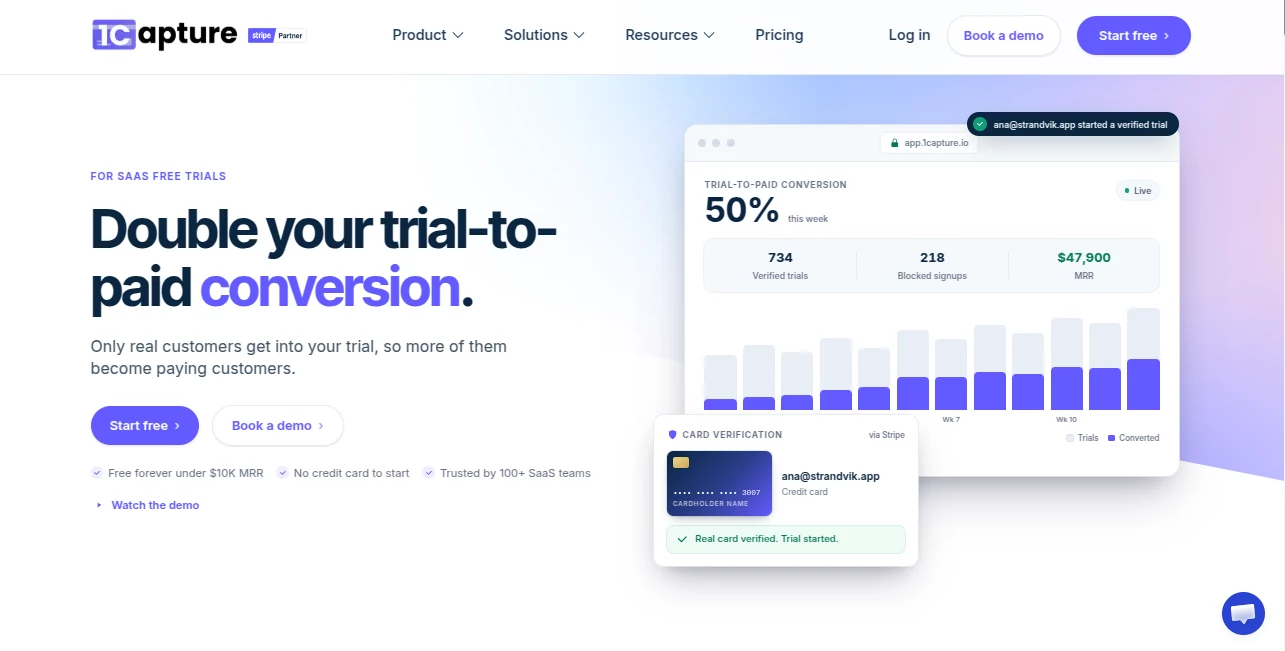
The platform combines Stripe payment pre-authorization, AI-powered trial-page optimization, conversion tracking, and automated payment capture. The idea is straightforward: identify serious customers early, remove common payment problems, and continuously improve the trial experience using real conversion data.
For SaaS businesses, this can be a particularly useful approach because increasing trial-to-paid conversion does not necessarily require buying more traffic. A better-converting trial funnel can produce additional revenue from visitors the company is already attracting.
Key Features
- AI-powered optimization of trial pages and conversion flows.
- Stripe-based payment pre-authorization before a free trial begins.
- Automatic payment capture when the trial period ends.
- Real-time conversion analytics and attribution.
- Built-in A/B testing for trial experiences.
- Integration with analytics and marketing platforms such as Google Analytics, Meta, Segment, Mixpanel, Slack, SendGrid, Intercom, and Crisp.
- Custom trial pages that can be connected to an existing domain.
- Custom statement descriptors designed to make charges easier for customers to recognize.
- Fraud and dispute prevention features for identifying problematic users before they create unnecessary revenue loss.
- Data export options and the ability to disconnect without moving the company's Stripe data elsewhere.
User Interface
The interface is designed around a relatively simple setup process rather than a complicated technical implementation. A SaaS team connects its Stripe account through OAuth, selects its products and pricing, creates a trial page, and then activates the optimization features.
The setup is presented as a five-minute process, with the platform handling much of the underlying configuration. This makes it appealing to founders, growth teams, and product managers who want to experiment with trial conversion without waiting for a lengthy development project.
The dashboard also brings conversion activity and attribution into one place, giving teams a clearer view of visitors, trial signups, and successful conversions.
Accuracy & Performance
Performance here is best measured by business outcomes rather than a conventional software benchmark. The platform continuously compares trial behavior and conversion results, allowing teams to see whether an optimization is actually producing more paying customers.
Its AI optimization system uses GPT-5 to analyze the existing trial flow, test variations, and continue refining the experience based on incoming data. The company reports that typical customers see a 2–3x improvement range, while its VoiceDrop case study increased trial-to-paid conversion from 12% to 57%. That case represents an individual customer result rather than a guaranteed outcome, so businesses should measure their own baseline before judging the impact.
The platform also supports gradual rollouts and rollback capabilities, which is useful when conversion changes affect a live SaaS funnel. Rather than making a large change and hoping for the best, teams can compare results and keep the approach that performs better.
Capabilities
The strongest part of the platform is the way several conversion problems are handled together. When someone begins a trial, the payment method can be pre-authorized without immediately charging the customer. If the customer remains through the trial period, the payment can then be captured automatically.
This approach can reduce failed first payments because the payment method has already been validated. It also gives SaaS businesses a way to distinguish between visitors who are willing to provide a valid payment method and visitors who may be less likely to convert.
On the optimization side, the AI can analyze trial behavior and test different messaging, timing, and page variations. Server-side conversion events can also be sent to advertising platforms and analytics systems, helping teams connect trial activity with the revenue it eventually produces.
Security & Privacy
Payment security is handled through Stripe rather than requiring the platform to become the place where card information is stored. The service uses Stripe OAuth to connect an existing account, and payment information remains within the customer's Stripe environment.
The company states that data is encrypted in transit and at rest and that it does not store card numbers. OAuth authentication also means users do not need to provide their Stripe password directly to the platform.
Another useful detail is the absence of vendor lock-in. Businesses can disconnect the service, while their customers, subscriptions, and payment records remain in their own Stripe account.
Use Cases
This platform is primarily suited to subscription-based SaaS businesses that already offer free trials and want to improve the percentage of trials that become paid subscriptions.
- SaaS startups: Improve monetization without immediately increasing advertising spend.
- Growth teams: Test different trial messages, flows, and page experiences using measurable conversion data.
- Product managers: Experiment with monetization changes while maintaining the ability to roll back unsuccessful tests.
- Subscription businesses: Reduce failed payments by validating payment methods before the trial ends.
- Marketing teams: Connect conversion events with advertising and analytics platforms for better attribution.
- SaaS founders: Set up a conversion experiment without requiring a major engineering project.
Pros and Cons
Pros:
- Very quick setup compared with building a comparable system internally.
- Combines payment verification, trial optimization, analytics, and conversion tracking.
- Works with an existing Stripe account rather than requiring payment migration.
- AI optimization can continuously test and refine the trial experience.
- No usage caps are listed on the pricing plans.
- Free for companies below the stated $10,000 MRR threshold.
- No long-term contracts or cancellation fees.
- Includes rollback functionality for safer experimentation.
Cons:
- Stripe is required, so it is not designed for businesses using another payment processor.
- Asking for payment details at trial signup may reduce the total number of people who begin a trial, even though those who remain may be more qualified.
- The biggest benefits are relevant to SaaS businesses with trial-based subscription models rather than general-purpose websites.
- Paid pricing increases according to monthly recurring revenue, which may become a meaningful expense for larger companies.
- Reported conversion improvements are not guaranteed and depend heavily on traffic quality, product value, pricing, and the existing funnel.
Pricing Plans
The pricing model is unusual because it is based on the company's monthly recurring revenue rather than the number of trials, visitors, or transactions.
- Under $10K MRR: Free forever with all features, no usage caps, and no credit card required.
- $10K–$50K MRR: $95 per month.
- $50K–$150K MRR: $295 per month.
- $150K–$250K MRR: $595 per month.
- $250K–$1M MRR: $995 per month.
- $1M+ MRR: $1,995 per month.
All paid plans use the same feature set and include white-glove onboarding. There are no transaction fees or usage-based charges listed. The company also states that customers can cancel at any time and that a paid plan is refundable if significant improvement is not seen during the first 30 days.
How to Use It
Getting started is intentionally straightforward. First, connect your Stripe account through the secure OAuth flow. Your products and pricing can then be synchronized automatically.
Next, create a trial page by selecting the relevant product, pricing, trial duration, domain, design, and copy. Once the page is ready, activate the optimization system.
From there, the platform can analyze visitor behavior and test different trial experiences. Payment methods are pre-authorized when users enter the trial, while payment capture can occur automatically when the trial reaches its end.
A practical approach is to establish a baseline first. For example, if a SaaS product currently converts 15% of trials into paid subscriptions, the team can compare that result against the optimized flow rather than relying on an impressive percentage without context.
Comparison with Similar Tools
Traditional payment tools generally focus on processing subscriptions, while analytics platforms concentrate on measuring what visitors do. Trial-page builders can help create landing experiences, but they do not necessarily handle payment pre-authorization and automatic capture as part of the same workflow.
The main distinction here is the combination of these functions. A SaaS company can connect Stripe, create a dedicated trial experience, verify payment methods, measure conversion activity, and allow AI to optimize the journey without replacing its existing payment infrastructure.
This makes the platform particularly interesting for teams that already have a functioning SaaS product and enough trial traffic to run meaningful conversion experiments. For a company with only a handful of trials each month, the optimization data may simply not be large enough to justify a dedicated conversion platform.
Conclusion
For SaaS companies, the difference between a successful trial and an abandoned one can have a direct impact on recurring revenue. This platform takes a focused approach to that problem by combining payment verification, AI-driven experimentation, analytics, and automated subscription capture.
Its five-minute setup, Stripe integration, free tier for companies below $10K MRR, and no-code workflow make it particularly accessible to smaller SaaS teams. Larger companies can also benefit from the deeper experimentation and attribution capabilities, provided they have enough traffic to generate useful data.
The most compelling aspect is that it does not ask businesses to completely rebuild their existing stack. Instead, it works around the Stripe account and systems they already use. For a SaaS founder looking for a practical way to improve trial monetization, that makes it worth testing against a clear baseline.
Frequently Asked Questions (FAQ)
What is this platform used for?
It is designed to help SaaS companies increase trial-to-paid conversion by combining AI optimization, payment pre-authorization, trial pages, analytics, and automated payment capture.
Does it require Stripe?
Yes. Stripe is required because payment verification, subscription information, and payment processing operate through the company's existing Stripe account.
Is it free?
Yes. Companies with less than $10,000 in monthly recurring revenue can use the platform for free without a credit card or usage cap.
How long does setup take?
The company states that the standard setup can be completed in about five minutes. It involves connecting Stripe, creating a trial page, and activating the optimization system.
Does it charge customers during the free trial?
The payment method can be pre-authorized when the customer begins the trial without immediately charging the customer. If the customer remains through the trial, the payment can then be captured automatically.
Does it store credit card numbers?
No. Payment processing remains with Stripe, and the company states that it does not store card numbers.
Can it work with an existing website?
Yes. The platform can create standalone trial pages that can be connected to an existing domain, meaning a SaaS company does not necessarily need to rebuild its current website.
Does the AI automatically change the trial experience?
The AI optimization system analyzes trial behavior and can test variations in messaging, timing, and flow before continuously refining the experience based on performance.
Is there a long-term contract?
No. The pricing information states that customers can cancel at any time without a long-term contract or cancellation fee.
Who is this platform best suited for?
It is best suited to SaaS businesses with free trials, recurring subscriptions, a Stripe-based payment system, and enough trial traffic to measure meaningful differences in conversion performance.
AI Analytics Assistant , Business .
These classifications represent its core capabilities and areas of application. For related tools, explore the linked categories above.

1Capture Alternatives Product

X Growth Eng…

TrackRev

SeoWebChecker

CitedSpy

Fina Money

PortBackLinks

Sellerview.ai

Crawlly AI

Lebesgue: AI…