

















TrackRev
What is TrackRev?
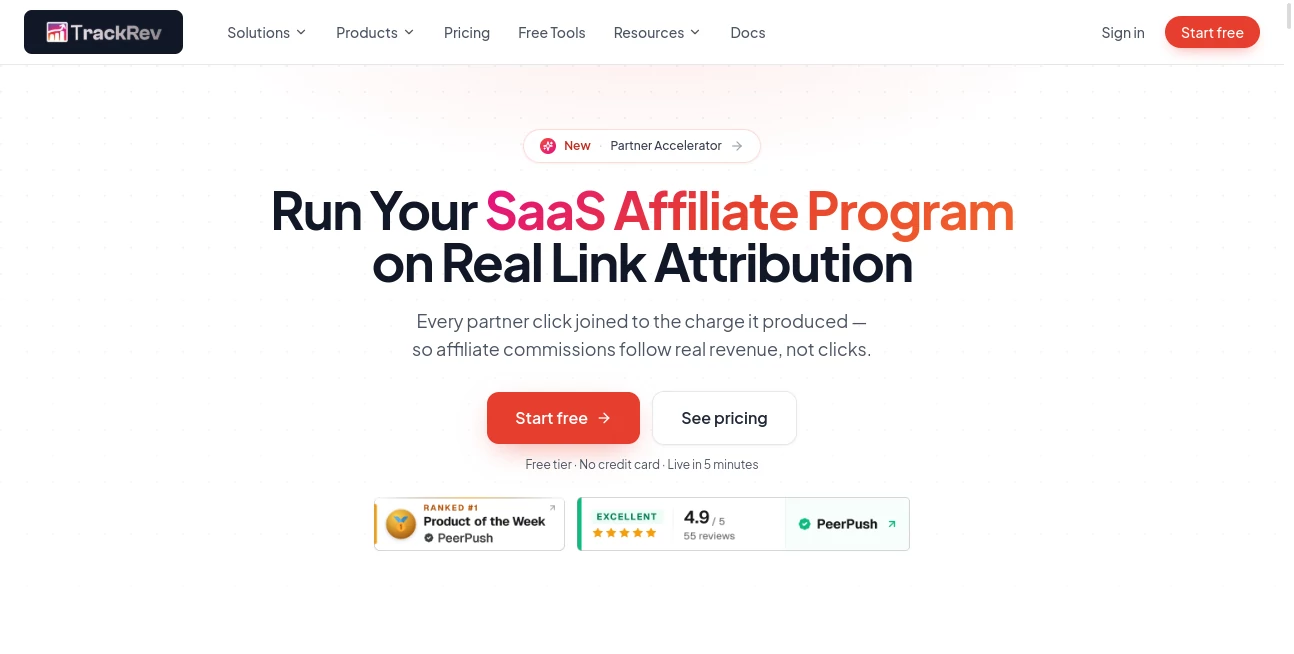
TrackRev is built for SaaS teams that want a clearer answer to a deceptively simple marketing question: which channel actually generated the revenue? Instead of stopping at clicks, visits, or affiliate referrals, the platform connects links and visitor activity with real billing events so teams can see which channels are producing paying customers and MRR.
The platform brings link tracking, revenue attribution, and affiliate management together around a shared data model. That makes it particularly useful for founders and small marketing teams that have outgrown basic link shorteners but do not want to stitch together several separate analytics and affiliate products.
It supports attribution from services including Stripe, Paddle, Polar, and Lemon Squeezy, allowing subscription revenue to be connected back to the acquisition source. The free tier also makes it practical for a new SaaS product that is still testing its first marketing channels.
Key Features
- Revenue attribution based on actual billing data rather than estimated advertising results.
- Branded short links and custom domains for marketing campaigns.
- First-touch, last-touch, and linear attribution models.
- Affiliate and partner program management with recurring commissions.
- Branded affiliate portals on a company's own domain.
- Channel-level reporting across affiliates, newsletters, paid campaigns, organic traffic, and other sources.
- QR codes and UTM building for campaign tracking.
- Server-side tracking designed to reduce attribution gaps caused by browser restrictions and ad blockers.
- Revenue connections for Stripe, Paddle, Polar, and Lemon Squeezy.
- CSV export for keeping a copy of attribution and reporting data.
User Interface
The product is designed around the information a SaaS marketer actually needs to act on. Rather than forcing users to dig through complicated analytics reports, the dashboard focuses on channels, clicks, conversions, and attributed revenue.
A useful example is a founder promoting a product through a newsletter, an affiliate, and several social posts. Instead of seeing only how many people clicked each link, the reporting can show which of those sources eventually produced paying customers. That makes the interface feel more like a decision-making workspace than a collection of raw traffic statistics.
Accuracy & Performance
Attribution is where the platform makes its strongest case. Traditional browser-based tracking can lose conversion information because of privacy restrictions, Safari's tracking protections, or ad blockers. The service uses first-party tracking and server-side mechanisms to improve the connection between a visitor's interaction and the eventual billing event.
Revenue attribution can then be tied to real charges from supported payment platforms. For SaaS companies, this distinction matters because a channel that generates thousands of clicks is not necessarily the channel that generates meaningful recurring revenue.
There are still situations where attribution can be incomplete. For example, unusual third-party checkout configurations or payments collected manually outside supported billing systems may prevent a clean same-session match. Testing the setup with a real conversion before relying on the reporting is a sensible step.
Capabilities
The platform covers three closely connected jobs: link management and analytics, revenue attribution, and affiliate program management. Businesses can use branded links to identify individual campaigns, connect revenue to acquisition channels, and then create an affiliate program when they are ready to scale a successful source.
Affiliate functionality includes commission rules, recurring commissions, branded partner portals, payouts, and referral tracking. Revenue can also be viewed beyond affiliates, which is valuable for teams comparing partner marketing with email, organic search, paid acquisition, and community promotion.
For SaaS founders, the shared data model is one of the more practical advantages. Instead of maintaining separate definitions of a conversion in a link tracker, affiliate platform, and analytics tool, the different reports are designed to work from the same underlying attribution data.
Security & Privacy
The security approach is deliberately straightforward. First-party tracking can run on a company's own domain, reducing reliance on third-party cookies. Billing integrations use restricted, read-only Stripe keys for relevant customer and payment information rather than write access.
The service also describes GDPR-aware practices including IP truncation, hashed identifiers, configurable retention, and the ability to export workspace data. For businesses handling revenue information, the read-only integration model is an important detail because the tracking system does not need permission to modify billing records.
Use Cases
SaaS revenue attribution: Founders can identify whether their MRR is coming from affiliates, newsletters, organic traffic, paid campaigns, or other acquisition sources.
Affiliate programs: Companies can create referral links, define commission rules, provide partners with a branded portal, and track recurring subscription commissions.
Newsletter marketing: A unique link can be assigned to a newsletter campaign so clicks can eventually be connected with actual purchases rather than measured only as traffic.
Product launches: Startups can create separate links for Product Hunt, Reddit, X, communities, email campaigns, and other launch channels, then compare the revenue generated by each source.
Marketing experiments: A founder testing several acquisition ideas can give each experiment its own tracking link and use conversion data to decide which channels deserve more attention.
Bootstrapped SaaS: Small teams can start with the free tier while validating demand, avoiding the need to pay for several separate marketing tools before the product has meaningful revenue.
Pros and Cons
Pros:
- Connects marketing activity with actual SaaS revenue.
- Combines attribution and affiliate management in one platform.
- Supports several major SaaS billing platforms.
- Offers branded links and custom domains.
- Includes multiple attribution models.
- First-party and server-side tracking can help reduce common browser-based attribution gaps.
- A free tier is available for early-stage products.
- Useful for teams that want to compare affiliate performance with other acquisition channels.
Cons:
- It is primarily aimed at SaaS and revenue-driven marketing rather than general-purpose web analytics.
- Teams using unsupported payment or manual billing workflows may not get the same level of automated attribution.
- Enterprise businesses looking for a large partner marketplace or complex PRM infrastructure may need a more specialized platform.
- Some advanced attribution scenarios still require careful implementation and testing.
Pricing Plans
The platform offers a free tier covering up to 1,000 tracked events per month, with attribution included and no credit card required. This makes the starting point particularly attractive for side projects and early-stage SaaS products that are still validating their acquisition strategy.
Paid plans start at $39 per month for the broader platform offering. The pricing is positioned as an alternative to paying separately for a link tracking service and an affiliate management product. The available product options include affiliate program functionality, links and analytics, and revenue attribution, with features varying by the selected offering.
Pricing can change over time, so businesses should verify the current plan limits before making a purchasing decision.
How to Use TrackRev
- Create an account and set up a workspace for the SaaS product or marketing operation.
- Install the first-party tracking pixel on the website or configure the required tracking setup.
- Connect a supported billing provider such as Stripe, Paddle, Polar, or Lemon Squeezy.
- Create branded tracking links for individual campaigns, affiliates, newsletters, social posts, or other acquisition sources.
- Configure the preferred attribution model, such as first-touch, last-touch, or linear attribution.
- Review channel-level reporting to see which sources are producing conversions and revenue.
- If an affiliate program is required, create partner links, commission rules, and the branded affiliate portal.
- Compare attributed revenue across channels and use the results to decide where future marketing effort should go.
Comparison with Similar Tools
Traditional link shorteners are excellent for creating and measuring links, but they generally focus on clicks rather than the recurring revenue generated by those clicks. Affiliate platforms, meanwhile, can handle commissions and partner relationships without necessarily giving the marketing team a complete picture of non-affiliate acquisition.
This platform sits between those categories by combining branded link tracking, revenue attribution, and affiliate management. For a small SaaS business, that can remove the need to maintain separate systems for links, affiliate referrals, and revenue reporting.
It is not intended to replace every enterprise marketing or partner-management platform. Companies with large reseller ecosystems, extensive partner marketplaces, or highly complex enterprise compliance requirements may still need dedicated infrastructure. For self-serve SaaS teams that mainly want to understand which acquisition sources pay the bills, however, the narrower focus can be an advantage.
Conclusion
Marketing dashboards can make a campaign look successful simply because the numbers at the top are impressive. Clicks and visitors are useful, but SaaS founders ultimately need to know what turned into revenue.
This platform takes a practical approach by connecting the journey from link to customer payment and putting affiliate management alongside broader channel attribution. The combination is especially compelling for early and growth-stage SaaS teams that want meaningful attribution without assembling a complicated collection of tools.
With a free starting tier, support for several popular billing systems, branded links, affiliate capabilities, and multiple attribution models, it provides a solid foundation for teams that want to stop measuring marketing purely by traffic and start evaluating it by the revenue it creates.
Frequently Asked Questions (FAQ)
What is TrackRev used for?
It is used for SaaS link tracking, marketing revenue attribution, and affiliate program management. It helps businesses connect acquisition channels with the revenue those channels generate.
Does it track affiliate revenue?
Yes. Affiliate links, commissions, recurring subscription revenue, and partner activity can be managed within the platform.
Which payment platforms are supported?
The platform supports revenue attribution through Stripe, Paddle, Polar, and Lemon Squeezy.
Does it have a free plan?
Yes. The free tier supports up to 1,000 tracked events per month and includes attribution functionality without requiring a credit card.
Can it track more than affiliate traffic?
Yes. One of its main advantages is that attribution can cover channels such as newsletters, paid marketing, organic traffic, and other sources alongside affiliates.
Which attribution models are available?
First-touch, last-touch, and linear attribution models are available for evaluating how different acquisition sources receive credit for revenue.
Is it suitable for a small SaaS?
Yes. The free tier and relatively simple setup make it suitable for founders validating a new SaaS product, while the paid offering is designed for teams that need broader tracking and affiliate capabilities as they grow.
Does it replace Google Analytics?
It serves a different purpose. General analytics platforms are useful for understanding website behavior and traffic, while this platform focuses more heavily on connecting acquisition activity with actual SaaS revenue and affiliate performance.