
ShadiBiodata
What is ShadiBiodata?
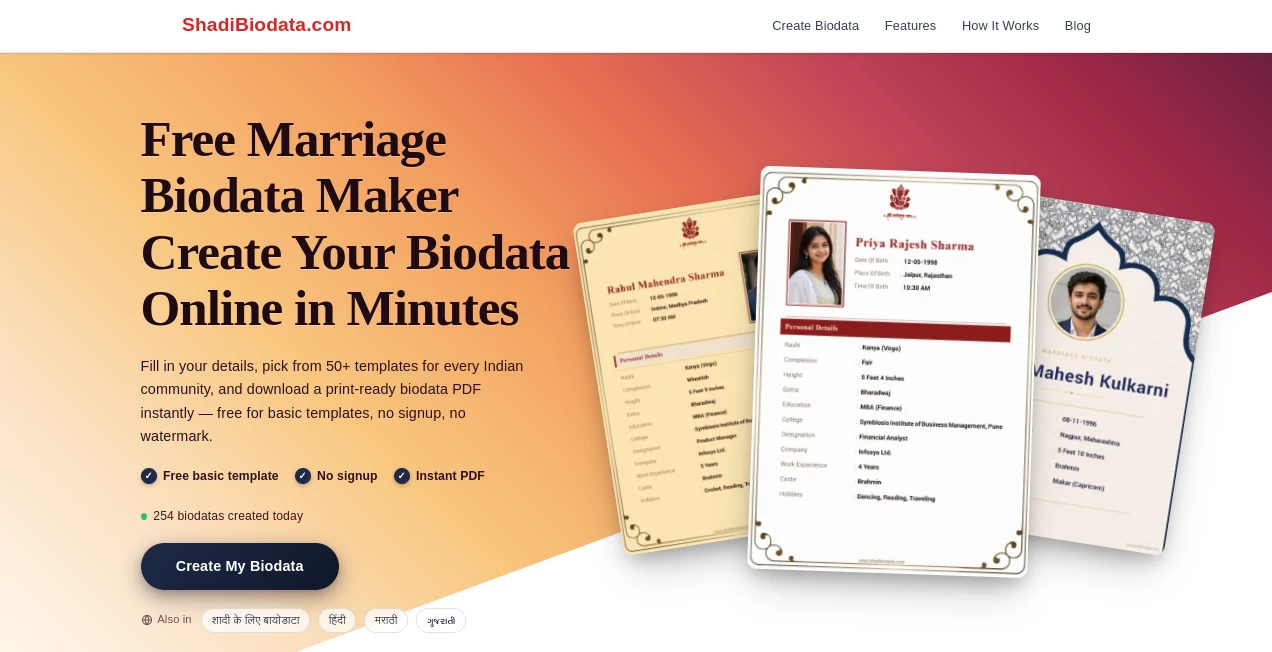
ShadiBiodata is a simple online marriage biodata maker designed for people and families who want to prepare a polished matrimonial profile without spending hours working with design software. Instead of starting with a blank document, users can enter their personal, family, education, professional, and contact details, select a suitable format, and generate a ready-to-share biodata PDF.
The platform is particularly useful for Indian matrimonial profiles, where a biodata often needs to present more than basic personal information. Depending on the chosen format, users can include details such as religion, education, occupation, family background, photograph, and other information commonly expected in marriage biodata.
One of its biggest advantages is the straightforward workflow. There is no complicated editor to learn and no account is required for the basic creation process. Someone helping a parent, sibling, relative, or friend can create a presentable biodata quickly, even without previous design experience.
Key Features
- More than 50 marriage biodata templates covering traditional, modern, floral, and elegant designs.
- Templates suitable for different Indian communities and matrimonial preferences.
- Personal, family, educational, professional, and contact information fields.
- Profile photo support for creating a more complete matrimonial profile.
- Instant generation of print-ready PDF biodata.
- Basic templates available without registration.
- No watermark on the free basic biodata downloads.
- Browser-based creation that keeps the process quick and convenient.
- Multilingual options including Hindi, Marathi, and Gujarati.
User Interface
The interface is built around a guided form rather than a complicated design canvas. This is a sensible choice for the target audience because the goal is not to teach users graphic design; it is to help them finish a marriage biodata.
The template selection process also makes the experience more practical. Users can browse different visual styles before deciding which presentation fits their profile. Someone looking for a traditional family-oriented format can choose accordingly, while another person may prefer a cleaner modern appearance.
The form focuses on information people actually expect to see in a matrimonial profile, including name, date of birth, height, religion, city, education, occupation, and contact information. A photograph can also be added to make the final document more personal.
Accuracy & Performance
For a biodata creation service, accuracy is less about generating written content and more about correctly transferring the information supplied by the user into the selected document layout. The guided form helps reduce the chance of forgetting important profile sections.
The platform is also designed around a short creation process. Users can enter their information, select a template, and produce the final PDF without moving between several different applications. This makes it particularly convenient when a biodata needs to be prepared quickly for sharing with relatives or matrimonial contacts.
For Hindu marriage profiles, an additional astrology-focused feature can automatically calculate information such as Rashi and Nakshatra from birth details. This can save users from manually looking up those details before completing their biodata.
Capabilities
The core capability is turning structured personal information into a professionally arranged marriage biodata. Rather than forcing everyone into one generic layout, the service provides a broad selection of formats so users can choose a presentation that suits their family and cultural preferences.
The templates cover several visual directions, including traditional, modern, floral, and royal-inspired designs. The resulting PDF can be saved, printed, or shared digitally through common communication channels such as WhatsApp and email.
The platform is also useful for creating biodata for both men and women. Because the information is entered through structured fields, it is possible to include the details that matter most to a particular family instead of trying to squeeze everything into a generic resume template.
Security & Privacy
Privacy matters when creating a marriage biodata because the document can contain personal information, contact details, family information, and photographs. The service states that information entered into the basic browser-based creation process remains in the user's browser rather than being stored on its servers.
The no-signup approach is another useful privacy feature. Users do not have to create an account simply to prepare a basic biodata. Even so, users should always review the information they include before sharing the finished PDF, particularly when sending it to people they do not know personally.
Use Cases
The most obvious use case is preparing a marriage biodata for matrimonial introductions. A person can create their own profile, but the service is equally useful for parents and relatives who frequently help prepare biodata for family members.
It can also be useful when a family needs several versions of a profile with different visual presentations. For example, one template may work well for sharing in a family WhatsApp group, while another may be better suited to printing for a matrimonial meeting.
Hindu families who normally include horoscope-related information may also benefit from the astrology auto-fill functionality. Instead of manually searching for Rashi and Nakshatra details, the relevant birth information can be used to populate those fields.
Another practical scenario is last-minute preparation. If someone suddenly asks for a marriage biodata before a family introduction, there is little reason to open a word processor, search for a template, adjust spacing, and fight with page breaks. A dedicated biodata maker removes much of that work.
Pros and Cons
- Pros: Easy guided workflow, 50+ templates, no signup for basic use, instant PDF creation, photo support, community-oriented formats, and a selection of traditional and modern designs.
- Pros: Useful fields for personal, family, education, occupation, and contact information make the result more appropriate for matrimonial use than a conventional resume template.
- Pros: Hindu biodata users can benefit from automated Rashi and Nakshatra calculations.
- Cons: The service is highly focused on marriage biodata, so it is not intended as a general-purpose resume or document design platform.
- Cons: Users looking for highly advanced graphic-design controls may find a dedicated design application more flexible.
Pricing Plans
The basic experience is available free of charge, including basic template creation without requiring an account. The platform also promotes premium-style template options and paid downloads, giving users a way to access additional presentation choices when a more distinctive biodata is required.
This approach makes sense for occasional users. Someone who simply needs a clean biodata can start with the free option, while users who care more about design variety can consider the available paid options.
How to Use ShadiBiodata
- Open the marriage biodata maker and begin creating a new profile.
- Enter your personal information, including your name, date of birth, height, religion, and city.
- Add education, occupation, phone number, email, and other relevant profile details.
- Complete family, cultural, or horoscope information where required.
- Add a suitable profile photograph.
- Browse the available biodata templates and choose a design that matches your preference.
- Review the information carefully before generating the final document.
- Download the completed biodata as a PDF and share or print it as needed.
Comparison with Similar Tools
Traditional word processors and general design platforms can certainly be used to make a marriage biodata, but they usually require more manual formatting. Users have to find an appropriate template, arrange sections, adjust fonts, position photographs, and make sure the final document fits correctly on the page.
A dedicated marriage biodata maker takes a different approach. The fields and layouts are built around matrimonial profiles from the beginning, so the user spends more time entering meaningful information and less time fixing document formatting.
The large collection of community-friendly templates is another advantage for people who want something more culturally appropriate than a generic resume design. The choice between traditional and modern layouts also means the final document can reflect the family's preferred style without requiring professional design skills.
Conclusion
Creating a marriage biodata does not need to become a small design project. This platform keeps the process focused on what actually matters: entering accurate information, choosing an appealing format, and producing a document that is ready to share.
Its combination of numerous templates, structured matrimonial fields, photo support, instant PDF generation, and a no-signup basic experience makes it a practical option for individuals and families preparing marriage profiles. The additional astrology functionality gives Hindu users another useful reason to consider the service, especially when Rashi and Nakshatra information is part of the expected biodata format.
For someone who wants a presentable marriage biodata without wrestling with document formatting, it offers a considerably more focused experience than starting from a blank page.
Frequently Asked Questions (FAQ)
Can I create a marriage biodata online?
Yes. You can enter your personal and family information online, select a suitable template, and generate a marriage biodata without needing to design the document from scratch.
Is the basic marriage biodata maker free?
Yes. Basic templates can be used without signing up, and the service provides free basic biodata creation with PDF download.
Do I need to create an account?
No account is required for the basic creation process, which makes it convenient for users who only need to prepare a biodata occasionally.
Can I add my photograph?
Yes. The biodata form supports adding a profile photograph so the final matrimonial profile can be more personal and complete.
How many templates are available?
The platform currently offers more than 50 marriage biodata templates, with styles ranging from traditional and floral designs to modern and royal-inspired formats.
Can I download the biodata as a PDF?
Yes. After completing the profile and selecting a template, the finished biodata can be generated as a print-ready PDF.
Does it support different Indian communities?
Yes. The available templates are designed with different Indian communities and preferences in mind, including Hindu, Muslim, Sikh, and Christian users.
Can Hindu users add Rashi and Nakshatra?
Yes. The Hindu-focused functionality can calculate Rashi and Nakshatra using birth information, helping users complete commonly requested astrology sections more easily.
Can I share the finished biodata digitally?
Yes. The PDF format makes it suitable for digital sharing through services such as WhatsApp and email, as well as for printing.
Is this a resume builder?
No. A marriage biodata has a different purpose from a professional resume. It focuses on matrimonial information such as personal details, family background, cultural information, education, occupation, and contact details.
Other .
These classifications represent its core capabilities and areas of application. For related tools, explore the linked categories above.

ShadiBiodata Alternatives Product

steam worksh…

gpt-plus.ai

GoDices

Pixel Flow L…

Remove My Me…

mainaro
CRIMSON DESE…

Aback Tools

MBTI Compati…