
Agency Rank Tracker
What is Agency Rank Tracker?
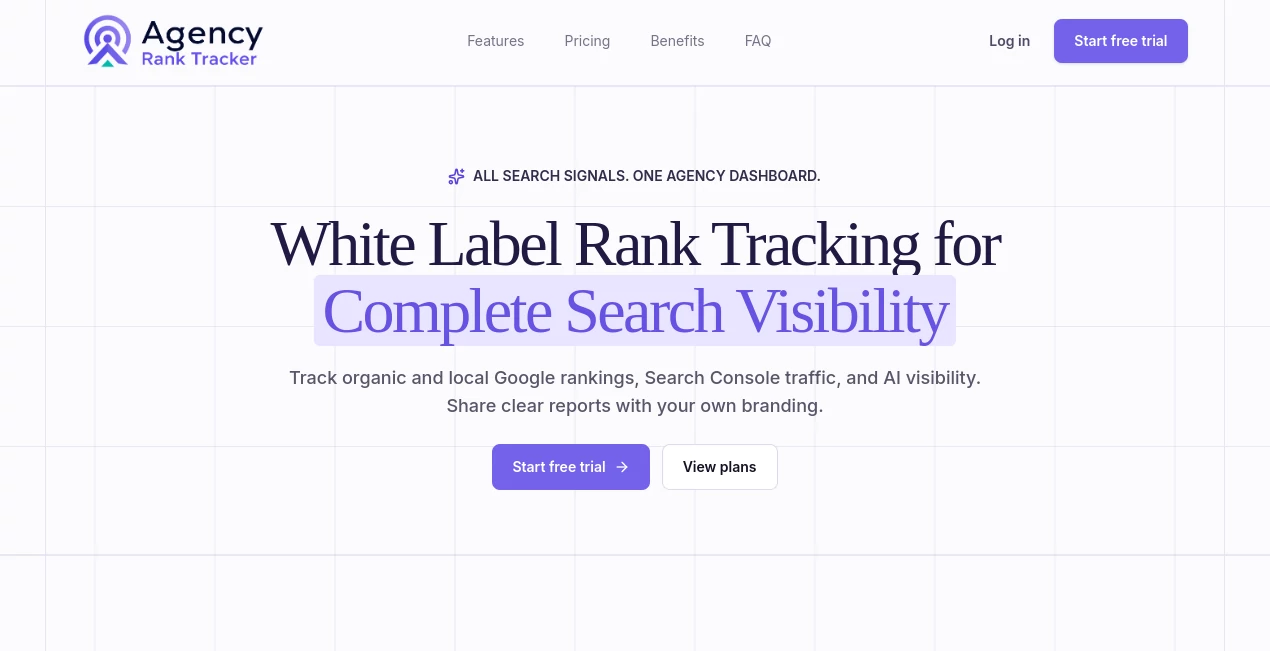
Agency Rank Tracker is built for SEO agencies, consultants, marketing teams, and businesses that need a clearer way to monitor search performance and communicate results. Instead of switching between several platforms to check rankings, local visibility, Search Console data, and AI search presence, users can bring these signals together in one practical dashboard.
The platform focuses strongly on agency workflows. It combines organic Google rank tracking with local rankings, AI visibility analysis, website health monitoring, opportunities from Search Console, and client-ready reporting. That makes it particularly useful for teams managing several websites or regularly preparing SEO reports for clients.
For example, an agency can monitor a client's keyword positions, see whether its Google Business Profile is appearing in the Local Pack, review mentions across AI platforms, and then turn those findings into a branded report. The result is a more organized reporting process and a much easier way to explain SEO progress to clients.
Key Features
- Weekly Google keyword rank tracking with position history and keyword movement.
- Local Pack tracking by city or postal code for supported markets.
- AI visibility monitoring across ChatGPT, Gemini, Perplexity, and Google AI Overview.
- Search Console integration for clicks, impressions, CTR, average position, pages, countries, and keyword opportunities.
- Search opportunity discovery for keywords approaching page one and missed Search Console queries.
- Website health monitoring covering uptime, HTTPS, SSL, noindex tags, robots.txt, sitemaps, and other checks.
- Automated weekly or monthly email reports.
- White-label reports with an agency's own logo, brand name, and color.
- Public read-only tracking links that clients can access without signing in.
- Rank tracking across more than 190 countries.
- Multiple projects and team seats on higher plans.
User Interface
The dashboard is designed around the information an SEO team typically needs during a reporting cycle. Rankings, traffic, AI visibility, opportunities, monitoring, and reports are presented as separate areas rather than being buried inside a complicated interface.
The ranking view provides useful details such as keyword position, movement, search volume, ranking URL, and historical performance. This makes it easier to move from a simple question like “Did rankings improve?” to the more useful question of which pages and keywords actually changed.
The white-label section is another practical touch for agencies. Branding can be added to reports and public tracking links, allowing client-facing materials to feel like part of the agency's own reporting system.
Accuracy & Performance
Rank tracking is scheduled weekly, while newly added keywords receive an initial check before joining the regular weekly tracking cycle. This approach gives teams a current starting point without requiring them to wait for the next scheduled update.
Local tracking is designed around Google's Local Pack, with locations selected by city or postal code. The platform also separates standard organic rankings from local visibility, which is important when a business relies heavily on location-based searches.
AI visibility analysis extends monitoring beyond traditional search results. Active prompts can be reviewed across four major AI environments, helping teams understand whether a brand is being mentioned or cited when potential customers ask relevant questions.
Capabilities
One of the strongest aspects of the platform is the combination of different search signals. An SEO manager can review keyword movement alongside Search Console performance, AI mentions, local visibility, and website health instead of treating each metric as a separate reporting task.
The opportunity section is especially useful for turning data into next steps. It can surface keywords that are close to page one, queries appearing in Search Console that may have been missed, and pages experiencing declining impressions. These findings can give an SEO team a practical starting point for the next optimization cycle.
For agencies, reporting is equally important. Automated reports can be scheduled, while live read-only links can be shared with clients. This reduces the need to repeatedly export data or ask clients to create their own accounts.
Security & Privacy
The platform provides account-based access and client-facing reports through read-only links. Public report links can be configured to control which sections clients can see, giving agencies more control over the information they present externally.
As with any SEO platform connected to website and Search Console data, teams should review the provider's current privacy policy and terms before connecting client properties. Agencies managing sensitive client information should also establish internal access and sharing policies for team members and public reports.
Use Cases
SEO agencies: Manage rankings for multiple clients, prepare branded reports, and give clients a simple way to review progress without requiring another login.
Local SEO campaigns: Track Google Local Pack positions by location and compare local visibility with standard organic rankings.
AI search monitoring: Check how frequently a brand appears across ChatGPT, Gemini, Perplexity, and Google AI Overview, then identify areas where visibility could improve.
Monthly SEO reporting: Combine ranking changes, Search Console metrics, website health, and AI visibility into a more complete client update.
Internal SEO teams: Monitor multiple websites and identify keywords with potential for additional traffic without maintaining several disconnected reporting systems.
Pros and Cons
Pros
- Combines traditional, local, and AI search visibility in one dashboard.
- Strong white-label features for agencies and consultants.
- Client reports can be shared without requiring clients to sign in.
- Search Console data adds useful traffic and keyword context.
- Website health monitoring is included on Growth and higher plans.
- Supports tracking in more than 190 countries.
- Pricing starts at a relatively accessible level for smaller projects.
Cons
- Weekly rank tracking may not suit teams that require daily position monitoring.
- Local Pack tracking is currently limited to selected countries.
- Higher project and keyword limits require upgrading to more expensive plans.
- The platform is primarily focused on monitoring and reporting rather than being an all-in-one SEO suite with every possible optimization feature.
Pricing Plans
The Starter plan costs $10 per month and supports one project, 30 keywords, 30 AI prompts, one team seat, four reports per month, local rankings, white-label reports, and a white-label tracking link. Eligible new customers can also start a seven-day trial.
The Growth plan costs $15 per month and increases capacity to three projects, 75 keywords, 75 AI prompts, three team seats, and 12 reports per month. It also adds website monitoring.
The Pro plan costs $49 per month and supports 10 projects, 300 keywords, 300 AI prompts, 10 team seats, and 40 reports per month. Premium support and website monitoring are included.
The Agency plan costs $129 per month and is intended for larger multi-client teams. It supports 30 projects, 1,000 keywords, 1,000 AI prompts, 30 team seats, and 120 reports per month, along with white-label reporting, tracking links, site monitoring, and premium support.
Yearly billing is also available with a stated 25% saving compared with monthly pricing.
How to Use the Platform
Start by creating a project for the website you want to monitor. Add the keywords that matter to the campaign and select the appropriate market. If local search is important, configure the relevant location for Local Pack tracking.
Next, connect a Google Search Console property when you want to bring clicks, impressions, CTR, average position, pages, countries, and additional keyword opportunities into the dashboard.
For AI visibility monitoring, add the prompts you want to track. The system can then evaluate visibility across ChatGPT, Gemini, Perplexity, and Google AI Overview.
Once the data is available, review ranking movement, local results, AI mentions, website health, and suggested opportunities. Agencies can then customize their branding and schedule reports or share a read-only live report with clients.
Comparison with Similar Tools
Many SEO platforms concentrate heavily on traditional keyword rankings, while others focus on reporting or broader website optimization. This platform takes a more focused approach by combining rank tracking with local search, AI visibility, Search Console insights, and agency-oriented reporting.
That combination makes it particularly appealing to teams that want a lightweight reporting and monitoring system rather than a large SEO suite packed with features they may rarely use. An agency primarily interested in client rankings, visibility trends, and clear reporting may find this focused workflow easier to manage.
The main consideration is update frequency. Teams that require very frequent or daily rank checks should compare tracking schedules carefully before choosing a platform. For agencies comfortable with weekly tracking and interested in combining conventional SEO with emerging AI search visibility, the feature set is compelling.
Conclusion
For agencies and SEO professionals, the real value of a reporting platform comes from how easily it turns scattered search data into something useful. This solution does that by bringing organic rankings, local visibility, AI search presence, Search Console insights, website monitoring, and branded client reporting into one workspace.
The white-label functionality gives it an especially practical advantage for agencies. Clients can receive branded reports and view live results without navigating a complicated SEO platform themselves. At the same time, the opportunity and monitoring features give internal teams more context for deciding what deserves attention next.
With plans starting at $10 per month, it is also positioned as an approachable option for smaller SEO projects while providing substantially more capacity for established agencies. For teams looking for a straightforward way to monitor modern search visibility and present results professionally, it is a strong option worth considering.
Frequently Asked Questions (FAQ)
How often are keyword rankings updated?
Tracked keywords are checked weekly. Newly added keywords receive an initial rank check immediately and then enter the regular weekly tracking schedule.
Which AI platforms can be monitored?
AI visibility tracking covers ChatGPT, Gemini, Perplexity, and Google AI Overview for active prompts.
Can Google Search Console be connected?
Yes. A Search Console property can be connected to import clicks, impressions, CTR, average position, pages, countries, and additional keyword opportunities.
Can clients access reports without signing in?
Yes. Agencies can create public, read-only white-label report links and control which sections clients can view.
Does the platform support local SEO tracking?
Yes. Local Rankings can monitor Google Local Pack positions by city or postal code. Local Pack tracking is currently available in the United States, United Kingdom, Canada, Australia, Ireland, and New Zealand.
Can multiple business locations be tracked?
Yes. Each Google Business Profile location can be configured as a separate project, with each location using one available project slot.
Is there a free trial?
Eligible new customers can start a seven-day Starter trial with a card. Billing begins after the trial ends unless the subscription is canceled.
Who is this platform best suited for?
It is particularly well suited to SEO agencies, consultants, marketing teams, and businesses that want to monitor organic rankings, local search visibility, AI mentions, and website health while producing professional client-facing reports.
AI SEO Assistant , AI Analytics Assistant .
These classifications represent its core capabilities and areas of application. For related tools, explore the linked categories above.
Agency Rank Tracker details
Website unavailable — View Alternatives
Pricing
- Free
Apps
- Web App
Categories

Agency Rank Tracker Alternatives Product

SupaTraffic

Pinpoint Ans…

CitedSpy
Marketbetter…

Ecom Tool AI

Surmado

Website Traf…

extractkeywo…

AI Entity