


















AIMovieFinder
What is AIMovieFinder?
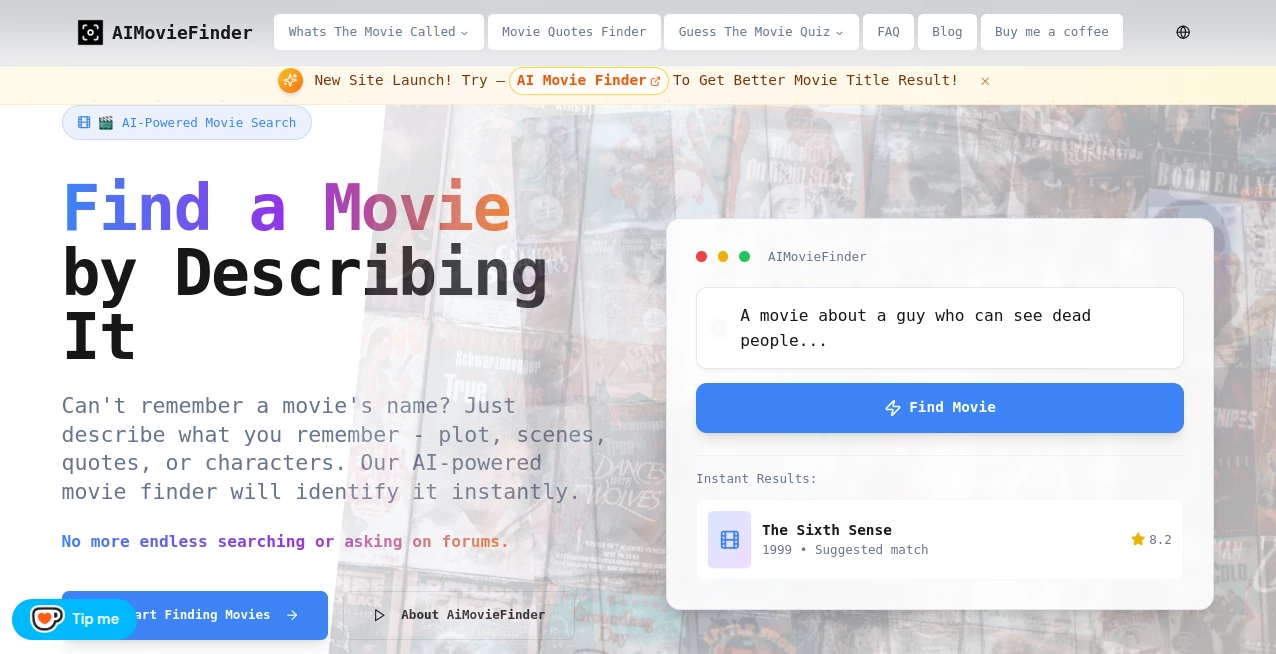
Forgetting the name of a movie can be surprisingly frustrating, especially when all you remember is one strange scene, a line of dialogue, an actor’s face, or a few details from the plot. AIMovieFinder takes a much easier approach: instead of trying to remember the title, you simply describe what you remember and let AI search for the most likely match.
The platform is built around AI-powered movie identification and supports several ways to search. Users can describe a plot, enter a quote, provide character or actor details, or upload a movie screenshot or poster. The service is designed to work even when memories are incomplete or slightly inaccurate, which makes it particularly useful for those “What was that movie called?” moments.
The service is free to use, does not require registration, and supports searches for films from different countries and languages. Its homepage also states that the system can return movie details such as the title, release year, cast, director, plot summary, and streaming availability.
Key Features
- Natural-language movie search based on plots, scenes, characters, and memories.
- Movie quote and dialogue recognition, including partial or slightly misremembered quotes.
- Visual identification from screenshots, still images, posters, and even hand-drawn sketches.
- Fuzzy matching for incorrect names, confused plot details, and inaccurate release years.
- Instant movie suggestions with useful information about potential matches.
- Support for movies from different countries and multiple languages.
- Dedicated search methods for descriptions, quotes, pictures, and movie posters.
User Interface
The interface is deliberately straightforward. The main experience revolves around a search area where users can explain what they remember and request a movie match. This makes the service approachable even for people who do not know exactly what information they should enter.
The example searches shown on the site are also helpful because they demonstrate how naturally a person can describe a movie. You do not need to construct a perfect database-style query. A sentence about the story, a memorable character, or a distinctive scene can be enough to begin the search.
Accuracy & Performance
The platform states that its movie identification system achieves more than 95% accuracy, while the homepage highlights a 99% accuracy figure. These figures should be viewed as service claims rather than a guarantee for every individual search. As with any identification system, the quality and uniqueness of the information provided can affect the result.
What makes the approach useful is its tolerance for imperfect memories. Someone might remember the wrong year, spell an actor's name incorrectly, combine details from two movies, or remember only one unusual scene. The system is designed to account for these kinds of fuzzy inputs and return likely matches rather than requiring an exact title.
Capabilities
The platform covers several different movie discovery situations. Natural-language search can interpret descriptions of plots and characters, while quote search is useful when a particular line is the strongest memory you have. Visual analysis adds another option for users who have a screenshot, poster, promotional image, or similar visual reference.
The visual search capability is especially interesting for situations where text-based searching would be difficult. The system can examine visual characteristics such as characters, locations, cinematography, colors, and scene composition to help narrow down the film.
Search results can also provide additional movie information, including the year, cast, director, plot summary, and streaming availability, turning the identification process into a useful starting point for discovering more about the film.
Security & Privacy
The service does not require an account for its movie searches, which keeps the basic experience simple. The website also provides dedicated privacy policy and terms pages for users who want to review its policies in more detail.
When using image-based search, users should still be sensible about the material they upload. A movie screenshot or poster is naturally suited to the service, while private or unrelated personal images should not be uploaded unnecessarily.
Use Cases
This tool is useful whenever the title of a movie has slipped your mind. Imagine remembering a science-fiction film where a programmer discovers that reality is a simulation, but being unable to remember anything else. Instead of scrolling through search results, you can describe the scene and let the system suggest the likely title.
It is equally useful for people who remember a quote but not the movie. A partial line can be entered without necessarily knowing the exact wording. The platform is designed to handle variations and incomplete phrases, making it practical for those moments when you remember the meaning of a line more clearly than the exact words.
Image-based searches offer another practical scenario. If you have a screenshot from an old movie, a poster with the title cropped out, or a recognizable scene saved on your device, uploading the image can provide a direct route toward identification.
For international cinema fans, multilingual and international movie support can make the service particularly convenient. A search does not have to be limited to well-known English-language productions.
Pros and Cons
- Pros: Free to use, no registration required, several search methods, natural-language understanding, support for incomplete memories, visual movie identification, quote searching, and international movie discovery.
- Cons: Results can still depend on the quality and uniqueness of the information supplied, and AI-generated matches should be reviewed rather than treated as infallible.
Pricing Plans
The service is currently free to use. According to its website, users can perform unlimited movie searches without creating an account. The platform is supported by non-intrusive advertising rather than requiring users to purchase a subscription for basic movie identification.
How to Use the Tool
- Open the movie search page.
- Think about the strongest details you remember, such as the plot, characters, setting, actor, quote, genre, or approximate release period.
- Describe those details naturally in the search box.
- Submit the description and review the suggested movie matches.
- If you remember a quote instead, use the quote search option and enter the line or the part you remember.
- If you have a screenshot or poster, use the image-based search option and upload the picture.
- Compare the suggested title, year, cast, plot, and other details to confirm the correct movie.
Comparison with Similar Tools
Traditional movie search engines generally work best when you already know a title, actor, keyword, or other precise piece of information. This platform takes a different route by focusing on memories and descriptions. That distinction is important: instead of asking the user to know the right search terms, it lets them explain the mystery in ordinary language.
It also brings several identification methods together in one place. A person can move from plot search to quote search or visual recognition depending on what information they have available. For casual movie discovery, that flexibility can be more convenient than switching between several unrelated search services.
Conclusion
Finding an old movie should not require remembering its exact title. This service makes the process much more natural by allowing people to search through the details they actually remember, whether that is a strange plot, a memorable quote, a character, or a visual scene.
Its combination of natural-language search, quote recognition, image analysis, fuzzy matching, and multilingual movie discovery gives it a practical place among AI-powered entertainment tools. The fact that basic searches are free and require no registration makes it particularly easy to try when a movie title is just out of reach.
Frequently Asked Questions (FAQ)
Is the movie finder free?
Yes. The website states that movie searches are free and can be used without registration.
Can I find a movie if I only remember the plot?
Yes. You can describe the storyline, characters, scenes, setting, genre, or other details you remember and receive possible movie matches.
Can I search using a movie quote?
Yes. The quote search supports memorable lines, partial quotes, and phrases that may not be remembered word for word.
Can it identify a movie from a screenshot?
Yes. The visual search feature allows users to upload movie screenshots and other relevant images for identification.
What if I remember the movie incorrectly?
The system is designed to work with incomplete or slightly inaccurate information. Providing additional clues, such as the genre, approximate year, characters, or setting, can help narrow down the results.
Can it find international movies?
Yes. The website states that its database covers movies from around the world and supports searches in multiple languages.
Do I need to create an account?
No. Basic movie searches can be performed without registration.
AI Fun Tools , AI Search Engine .
These classifications represent its core capabilities and areas of application. For related tools, explore the linked categories above.
AIMovieFinder details
Website unavailable — View Alternatives
Pricing
- Freemium
Apps
- Web App
Categories

AIMovieFinder Alternatives Product

FortuneTelle…
Robux Tax Ca…

KalonAI

Face Shape D…

Wolfcut Onli…

SomniaScope …

Lessgames

AI Hug

Kitchendary
