
Ameba
What is Ameba?
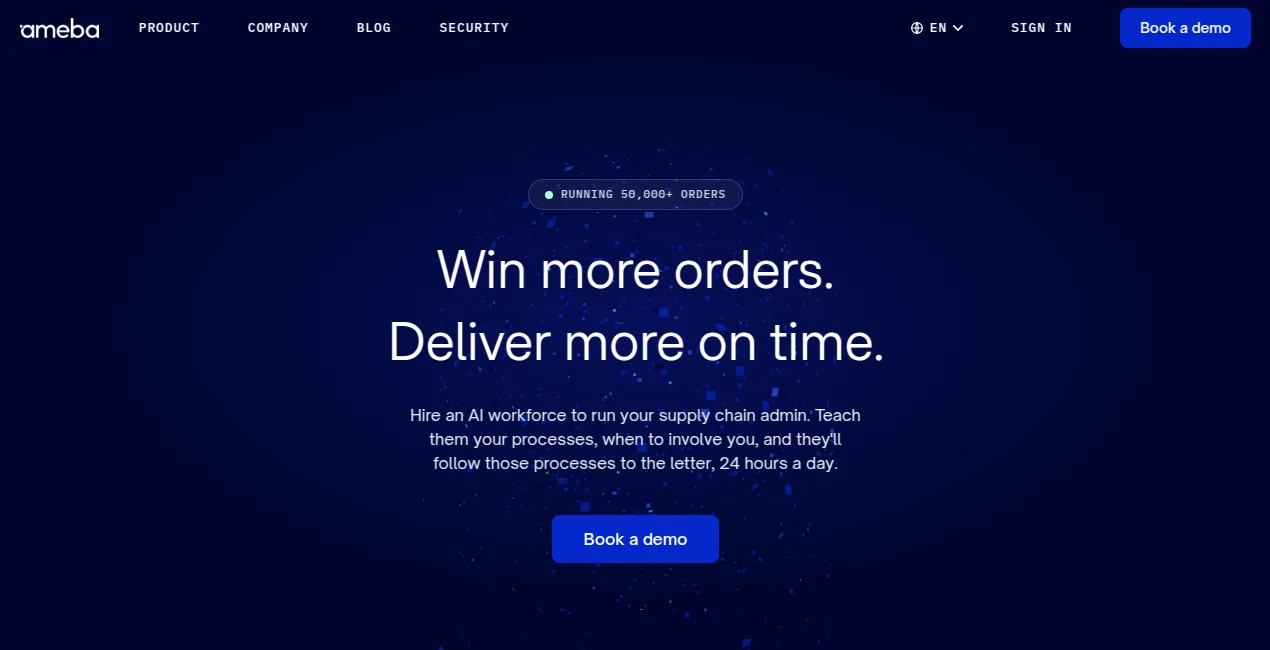
Ameba is an AI workforce built for manufacturers that want to keep orders, suppliers, documents, and delivery dates moving without adding another layer of manual administration. Instead of simply presenting information in a dashboard, it can follow the processes a team teaches it, monitor orders around the clock, read incoming emails and files, and take action when something needs attention.
The idea is particularly useful for businesses where a single order can generate dozens of emails, spreadsheets, PDFs, confirmations, approvals, and follow-ups. The platform connects with existing systems rather than asking teams to replace everything they already use. Its website reports that more than 50,000 orders have been tracked, along with 80,000 line items, 580,000 emails, 30,000 files, and 27,000 identified exceptions.
Key Features
- AI-powered order and supplier administration
- Automated supplier follow-ups through familiar communication channels
- Process-based workflows written in plain English
- Extraction of information from emails, PDFs, images, Excel files, and messages
- ERP and PLM connectivity
- Automatic detection of missing information, delayed milestones, and exceptions
- Drafted responses and escalation when human approval is required
- Continuous monitoring of orders and shipments
- Document and approval tracking
User Interface
The experience is designed around the way supply chain teams already work. Rather than forcing suppliers to learn another portal, the system can communicate through channels such as email and WhatsApp. Internally, workflows can be described using straightforward instructions, such as checking an order two weeks before its planned factory date and following up if the latest supplier update does not confirm that everything is on track.
This approach makes the platform feel less like another complicated enterprise application and more like an additional member of the operations team. A business can connect the systems it already relies on, define its processes, and let the automation operate within those boundaries.
Accuracy & Performance
One of the more practical aspects is the connection between extracted information and its original source. The platform states that each data point can be traced back to the email, message, or system from which it originated. This gives operations teams a way to check where an update came from instead of blindly trusting an automatically generated summary.
The company reports up to a 10% improvement in on-time delivery, up to 80% less manual data entry, and an average reduction in delays of around 50%. These are vendor-reported results rather than guarantees, but they illustrate the type of operational improvement the product is designed to target.
Capabilities
The platform can watch orders from the moment they enter the workflow through shipment and delivery. It can follow up when a supplier goes quiet, identify an overdue milestone, track missing certificates, notice changes to delivery dates, and flag issues that require internal attention.
Its document handling is another useful component. For example, an incoming booking confirmation can be read and connected with the appropriate purchase order, while information such as shipment dates and references can be extracted for use elsewhere in the workflow. It can also compare invoice information with purchase-order details and handle structured information coming from supplier documents.
Businesses can decide which actions should happen automatically and which should wait for approval. That distinction is important for sensitive operational decisions: instead of giving automation unrestricted control, teams can define where a person should remain in the loop.
Security & Privacy
Security is positioned as a core part of the service. The company states that the platform is SOC 2 Type II and GDPR compliant. Its AI agents are designed to access only the selected communication threads and databases rather than an entire inbox, and customer data is kept separate.
For organizations handling supplier contracts, commercial documents, pricing information, and production data, these controls are especially relevant. The ability to trace information back to its source also provides an additional layer of visibility when reviewing automated actions.
Use Cases
This platform is a strong fit for manufacturers and operations teams that spend significant time chasing suppliers and keeping order information synchronized. A purchasing team could use it to follow up on unanswered supplier messages, while a production team could monitor dates and identify potential delays before they become serious problems.
It can also help with document-heavy processes. Supplier certificates, booking confirmations, invoices, drawings, and other files can be processed as part of an existing workflow. For businesses dealing with sustainability documentation and product passport requirements, the system can chase suppliers for required information, extract relevant details, and associate the data with the appropriate product.
A simple example is a purchase order whose shipment date suddenly moves several days later. Instead of waiting for someone to notice the change in a crowded inbox, the workflow can identify the new date, flag the problem, and prepare an appropriate supplier response or escalation according to the instructions provided by the team.
Pros and Cons
Pros:
- Designed specifically around manufacturing and supply chain administration
- Works with existing ERP, PLM, email, WhatsApp, Excel, and document workflows
- Processes can be taught using plain-language instructions
- Automates repetitive supplier follow-ups
- Can extract useful information from common business documents
- Supports human approval for actions that should not be fully automated
- SOC 2 Type II and GDPR compliant according to the company
- Useful for teams managing large numbers of orders and supplier communications
Cons:
- It is primarily aimed at manufacturers and supply chain operations rather than general business users
- Pricing is not publicly displayed on the website
- Businesses need to connect their existing systems and define their processes before getting the full benefit
- Some automated actions may still require human approval depending on the workflow
Pricing Plans
No standard public pricing plans are listed on the website. Instead, the company encourages prospective customers to book a demonstration and run the platform against their own orders and processes. This makes sense for an enterprise-oriented product because the required integrations, workflows, order volumes, and automation requirements can vary considerably between manufacturers.
The company offers a practical demonstration approach where a process and several real orders can be used to show what the system can chase, read, and write back. Prospective customers should therefore contact the team directly to discuss their requirements and obtain current pricing.
How to Use the Platform
- Connect the relevant ERP, inbox, messaging channels, or other systems already used by the business.
- Define the operational processes that should be monitored.
- Describe the rules and actions in plain language, including when the system should involve a person.
- Allow the platform to monitor orders, supplier communications, documents, and important dates.
- Review automated drafts, alerts, extracted information, and escalations where required.
- Let the configured workflows continue running across new orders without repeatedly setting them up from scratch.
Comparison with Similar Tools
Traditional supply chain software often focuses on giving teams a central place to view orders, inventory, suppliers, and performance metrics. That can be valuable, but someone still has to read the latest email, chase the supplier, update the relevant record, and react when a delivery date changes.
The main distinction here is the emphasis on performing those administrative tasks rather than simply displaying their status. The system is intended to connect communication, documents, and business systems, understand the processes defined by the team, and then carry out the appropriate next step.
For a small company with only a handful of suppliers, this level of automation may be unnecessary. For a manufacturer managing hundreds or thousands of active orders, however, removing repetitive follow-ups and manual data entry can make a much bigger difference.
Conclusion
Ameba takes a focused approach to AI automation by targeting one of the less glamorous but highly time-consuming parts of manufacturing: keeping orders on track. Its ability to monitor supplier conversations, understand business documents, follow predefined processes, and take action makes it considerably more hands-on than a typical reporting or chatbot product.
The strongest reason to consider it is the way it works alongside existing operations. Suppliers do not necessarily need another portal, and internal teams do not have to abandon their current ERP or communication tools. For manufacturers dealing with constant supplier follow-ups, document chasing, changing delivery dates, and repetitive order administration, this could be a practical way to give operations teams more time for work that actually requires their judgment.
Frequently Asked Questions (FAQ)
Who is this platform designed for?
It is primarily designed for manufacturers and supply chain teams that manage suppliers, purchase orders, production milestones, documents, and shipments.
Does it replace an ERP system?
No. It is designed to work alongside existing ERP and PLM systems. It can read information from connected systems and, where appropriate, write information back or generate an import file.
Do suppliers need to use a new platform?
No. Suppliers can continue communicating through channels they already use, including email and WhatsApp.
Can it process PDFs and Excel files?
Yes. The service states that it can read attachments and documents including PDFs, Excel files, and images, then extract relevant information for the appropriate workflow.
Can I decide what the AI is allowed to do?
Yes. Workflows can specify which actions should happen automatically and which situations should be escalated for human approval.
How does it handle supplier delays?
It can monitor dates and supplier updates, identify situations where an order is no longer on track, follow up with the supplier, and alert or escalate the issue according to the configured process.
Is the service secure?
The company states that the platform is SOC 2 Type II and GDPR compliant. It also says that agents only access the selected threads and databases rather than an entire inbox.
Is pricing available publicly?
No standard pricing table is currently published. Businesses are encouraged to book a demonstration and discuss their specific processes and requirements.
AI Workflow Management , AI SOP , AI Documents Assistant , AI Email Assistant .
These classifications represent its core capabilities and areas of application. For related tools, explore the linked categories above.

Ameba Alternatives Product

Remove Handw…

Transcribe A…

Sendmux

AI text clea…

Ryne AI

Duct Tape AI…

The #1 Text …
Dedoctive
aipen.ink