
AnswerScout
What is AnswerScout?
For two decades, the marketing playbook was simple: rank on Google, win the click, earn the trust. That playbook is quietly breaking. More and more buyers now open ChatGPT or Claude and type "what's the best tool for..." and just take whatever comes back at face value, no scrolling through ten blue links required. The uncomfortable question for any brand owner is this: when someone asks an AI assistant for a recommendation in your category, does your name even come up? This tool exists to answer exactly that, replacing guesswork with a daily, measurable score.
Key Features
User Interface
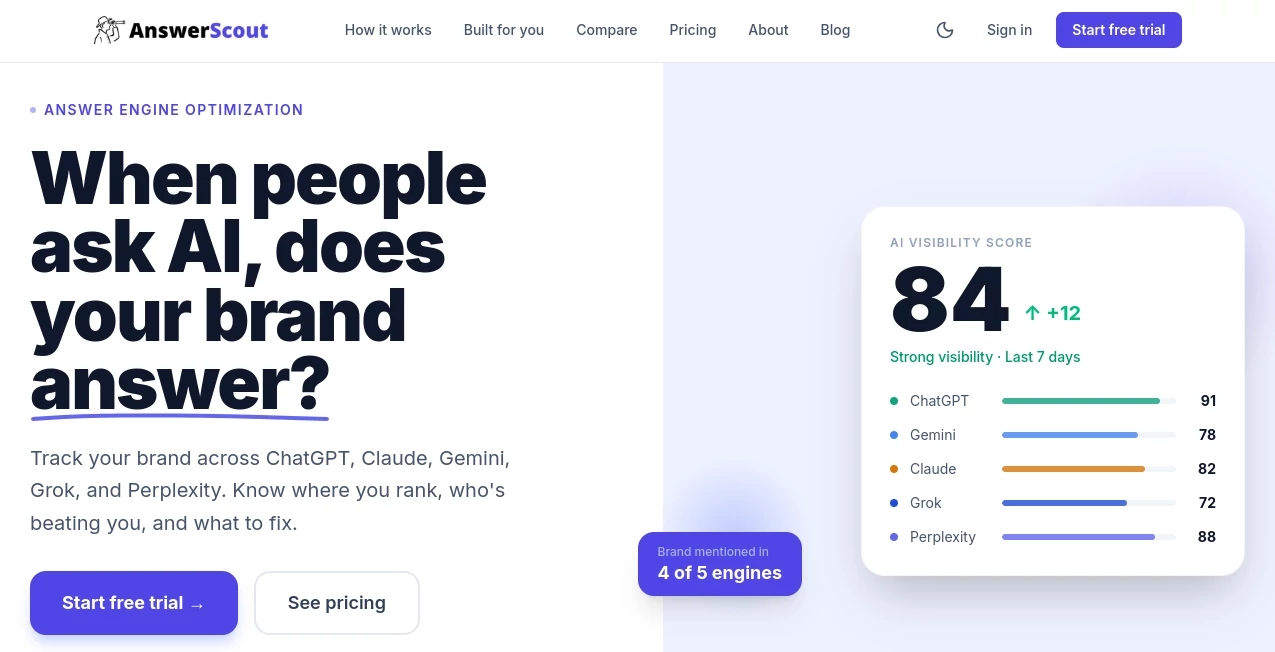
The dashboard is built around a single, immediately readable number — a visibility score between 0 and 100 — sitting alongside a breakdown by engine. Rather than burying you in charts you'll never open again, it surfaces what matters first: how visible are you right now, and is that trend moving up or down over the last week. Setup takes about five minutes: enter your brand name, website, and category, and the system generates the buying questions real customers are likely typing into AI assistants.
Accuracy & Performance
Every day, the same set of buying questions gets submitted to the AI models you're tracking, and every response gets captured and classified — not just whether you were mentioned, but where in the answer, and with what tone. That daily cadence matters more than it sounds. AI answers shift as models update and as competitors publish new content, so a one-time snapshot tells you almost nothing useful a month later. Daily runs mean you actually see momentum, not just a single data point frozen in time.
Capabilities
Beyond the core score, there's a competitor view that shows exactly who's outranking you for each question, including rivals you might not have been watching. There's a citations feature that reveals which sites and pages each AI model actually pulled from to build its answer — useful intelligence if you're trying to figure out where to earn a mention. And instead of leaving you to interpret raw data, the recommendations engine turns each run into a ranked list of specific actions, like publishing a comparison page or earning a spot on a review roundup, sorted by how much they're projected to move your score.
Security & Privacy
For teams that don't want to babysit a dashboard, alerts can be pushed straight into Slack or fired as signed webhooks whenever your score drops, a competitor overtakes you, or you lose a position you used to hold. Every webhook payload is HMAC-SHA256 signed, which is a small but meaningful detail for anyone piping this data into an internal BI stack or automation tool like Zapier or Make.
Use Cases
- A solo founder who is, realistically, the entire marketing department and needs a fast daily read without hiring an analyst
- A small marketing team that wants to walk into a Monday meeting already knowing exactly where the brand stands against named competitors
- An in-house marketing lead at a SaaS company who needs a defensible, recurring metric to bring into quarterly planning
- A B2B software brand trying to identify which review sites or comparison pages are actually being cited by AI models in their category
- Anyone who's noticed organic search traffic plateauing and suspects buyers have started researching somewhere else entirely
Pros and Cons
Pros:
- Tracks across five major AI engines from one dashboard instead of manually checking each one
- Daily automated runs mean you catch a dip in visibility the same week it happens, not months later
- Recommendations are ranked by projected impact rather than generic advice
- Citation tracking shows exactly which sources AI models trust in your category
- Pricing is built for solo founders and small teams, not enterprise procurement budgets
Cons:
- Full five-engine coverage, including Claude and Perplexity, is reserved for the top pricing tier
- The number of tracked prompts and competitors is capped by plan, which may feel limiting for larger catalogs
- As a relatively new category of tool, the underlying AI answers it measures are themselves a moving target
Pricing Plans
Every plan includes a 7-day free trial with no credit card required.
- Starter — $39.99/mo: 1 brand, 15 tracked prompts, 2 AI engines (ChatGPT and Gemini), 2 competitors tracked, and 25 content audits a month. Built for solo founders just getting started.
- Growth — $79.99/mo: 1 brand, 30 tracked prompts, 3 AI engines (adding Grok), 3 competitors, 75 content audits a month, plus Slack alerts and webhooks.
- Growth & More — $129.99/mo: the most popular tier, unlocking all 5 AI engines including Claude and Perplexity, 30 tracked prompts, 3 competitors, and 150 content audits a month, along with Slack alerts and webhooks.
How to Use AnswerScout
- Add your brand name, website, and category to start the setup
- Let the system generate the real buying questions customers are likely asking AI assistants in your space
- Review your daily visibility score and see how it breaks down by engine
- Check the competitor view to see exactly who's outranking you and where
- Work through the ranked recommendations list, then watch your score move as you act on them
Comparison with Similar Tools
Most visibility tools that exist today were built with enterprise procurement teams in mind: long sales cycles, brand-sentiment dashboards loaded with features nobody on a five-person team will ever click into, and pricing that assumes a six-figure marketing budget. What sets this one apart is its narrow, founder-first focus — answering one question clearly (does AI recommend us, and who's beating us) instead of trying to be an all-purpose brand intelligence platform. The daily-run cadence and impact-ranked recommendations also push it closer to an action tool than a passive reporting dashboard.
Conclusion
The shift toward AI-driven research isn't a future trend to prepare for — it's already happening, quietly, every time someone asks ChatGPT instead of typing into Google. Brands that can't see their own position in that conversation are, in a very real sense, flying blind. What makes this tool worth a look isn't just that it measures the problem, but that it turns the measurement into a short, prioritized list of things to actually go do. For a founder or small marketing team without the bandwidth to chase five different AI assistants manually, that combination of visibility and direction is the real value.
Frequently Asked Questions (FAQ)
Which AI engines does it track?
ChatGPT, Gemini, Claude, Grok, and Perplexity, with engine coverage varying by plan.
How often is the data updated?
Every day, automatically, with no manual work required from you.
Is there a free trial?
Yes, every plan includes a 7-day free trial and no credit card is required to start.
Can I track competitors as well as my own brand?
Yes, all plans include competitor tracking so you can see exactly who AI is recommending instead of you.
Does it integrate with other tools?
Yes, on Growth plans and above you can connect Slack alerts and outbound webhooks for tools like Zapier, Make, or your own BI stack.
AI SEO Assistant , AI Marketing Plan Generator , AI Research Tool , AI Analytics Assistant .
These classifications represent its core capabilities and areas of application. For related tools, explore the linked categories above.

AnswerScout Alternatives Product

ShipGrowth
langextract.…

EstatePass

StatMate

Treeova

Linkedora

ModelsLab

Arobis AI Vi…

Diploria AI