
















Diploria AI
Verified Blue CheckMark
Verified Blue CheckMark products are featured above free or unverified listings.
This badge indicates authenticity and builds trust, giving your product higher visibility across the platform.
Upgrade to get verified
Verified Blue CheckMark products are featured above free or unverified listings. This badge indicates authenticity and builds trust, giving your product higher visibility across the platform.
Upgrade to get verified
What is Diploria AI?
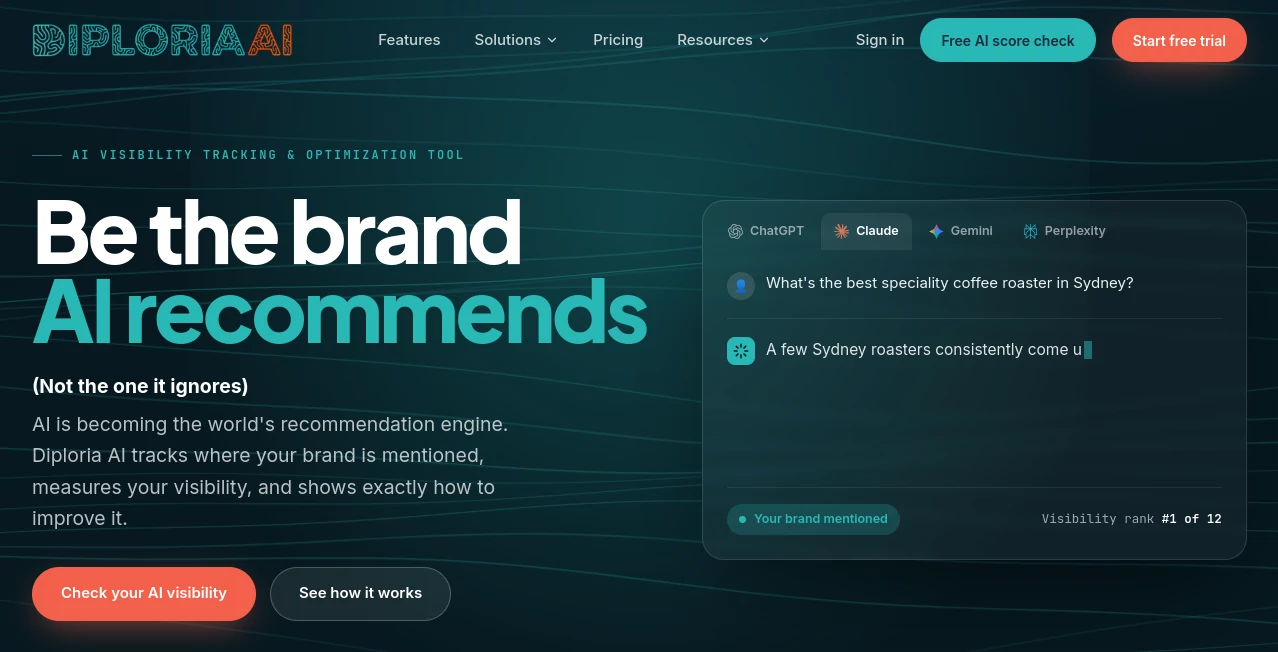
Diploria AI is an AI visibility platform that tracks, analyzes and helps optimize how brands are mentioned and recommended across AI engines. As AI becomes the world's recommendation engine, Diploria AI shows exactly where your brand appears (or doesn't) in AI answers, measures your visibility, benchmarks you against competitors, and gives you a prioritized action plan to improve. It is NOT an AI research or qualitative-data-analysis tool - that description is entirely incorrect and should be removed.
The product works across three pillars: Track, Analyze, Optimize.
- Track: Runs your prompts through live APIs on ChatGPT, Claude, Gemini, Perplexity, Grok, Copilot, Google AI Mode and Google AI Overviews (8 surfaces), storing every real response - never estimates. Poll daily, weekly, monthly or on demand, with AI-suggested prompts most likely to surface your brand.
- Analyze: A 0-100 Visibility Score benchmarks how often your brand appears in AI answers, weighted across prompts, engines and locations. Track sentiment and recommendation tone over time, benchmark competitors, and simulate multiple geographic markets (up to 10).
- Optimize: The AI Readiness Scan audits any URL out of 100 across five pillars (crawler access, structure, evidence, schema and freshness), then provides a prioritized, auto-checked readiness checklist. It also connects to Google Analytics 4 to show real AI referral traffic reaching your site from ChatGPT, Perplexity, Claude, Gemini, Grok and 15+ other AI sources.
Built for both brands and agencies: manage unlimited client brands from one account, export branded white-label PDF reports, and invite your team with role-based access (Super Admin, Editor, Viewer).Key Features
User Interface
The platform provides a simple and intuitive workspace designed for professionals who need powerful analysis without unnecessary complexity. The interface helps users manage research materials, explore findings, and review generated insights in an organized environment.
Its user-friendly approach makes it accessible for both experienced analysts and teams that are new to AI-powered research workflows. Users can spend less time learning software and more time extracting value from their information.
Accuracy & Performance
The system is built to analyze large volumes of qualitative information with speed and consistency. By identifying patterns, organizing themes, and connecting findings with their original context, it helps reduce repetitive manual work while supporting more reliable analysis.
For teams handling extensive interviews or research documents, the ability to quickly identify important topics can significantly improve productivity and shorten reporting cycles.
Capabilities
- - Multi-engine AI tracking across ChatGPT, Claude, Gemini, Perplexity, Grok, Copilot, AI Mode and AI Overviews via live APIs (real stored responses, never estimated)
- - Automated, scheduled prompt polling (daily, weekly, monthly or on demand)
- - AI-suggested prompts based on your site and industry
- - Brand mention detection, including misspellings and aliases
- - 0-100 Visibility Score with week-over-week trends
- - Sentiment and recommendation analysis per mention
- - Competitor benchmarking and share of voice
- - Geographic/market tracking (up to 10 markets)
- - Citation and source tracking (which URLs each engine cites)
- - AI Readiness Scan (any URL scored /100 across five pillars) with a persistent, prioritized readiness checklist
- - GA4 AI referral traffic tracking
- - White-label branded PDF reports
- - Multi-brand management for agencies
- - Role-based team access (Super Admin, Editor, Viewer)
Security & Privacy
Protecting research data is essential for organizations working with customer feedback, interviews, and internal studies. The platform is designed with responsible data handling practices to help teams analyze information while maintaining control over their valuable research assets.
Use Cases
- In-house marketing teams monitoring where their brand stands in AI search and proving impact to leadership
- Agencies and consultants managing AI visibility and reporting across multiple client brands from one account
- Brands wanting plain-English fixes to improve how AI engines describe and recommend them
Businesses can also benefit by reviewing customer opinions, employee feedback, and strategic research more efficiently. Academic researchers and innovation teams can use AI-assisted analysis to manage qualitative information and discover meaningful patterns.
Pros and Cons
Pros
- - Uses real, stored AI responses from live APIs - never modeled or estimated data
- - Covers 8 AI surfaces including ChatGPT, Claude, Gemini, Copilot, Perplexity, Grok, AI Mode and AI Overviews
- - Goes beyond tracking with actionable optimization (AI Readiness Scan + prioritized checklist)
- - GA4 integration shows real AI referral traffic, not just mention counts
- - Built for both individual brands and multi-brand agencies
- - Free plan available, no credit card requi
Cons
- - Newer product without a long independent review track record yet
- - Credit-based usage means heavy tracking (many engines/prompts/locations) consumes more credits
Pricing Plans
Credit-based pricing (1 credit = 1 prompt x 1 location x 1 LLM):
- Free: $0/mo - 50 credits, 1 brand, 3 AI surfaces (Memory only), monthly polling. No credit card required.
- Starter: $29/mo - 1,500 credits, 1 brand, 8 surfaces, weekly polling
- Pro: $89/mo - 10,000 credits, 1 brand, 8 surfaces, daily polling, 10 locations, 3 team members
- Multi-Brand: $399/mo - 70,000 credits, unlimited brands, 50 locations, unlimited team members
- Enterprise: Custom
How to Use the Tool
Getting started is simple. Users can upload or provide research materials, allow the system to process the information, and review organized insights generated from the analysis. The workflow is designed to help transform raw information into structured knowledge with fewer manual steps.
A typical workflow begins with collecting data, continues with AI-assisted organization and analysis, and finishes with reviewing insights that can support business strategies and professional decisions.
Comparison with Similar Tools
Many AI platforms focus on general text generation or basic summarization. This solution takes a more specialized approach by concentrating on research analysis, information structure, and meaningful interpretation.
Compared with generic AI assistants, it is designed for users who need deeper organization of qualitative information rather than simple answers. Its focus on structured insights makes it particularly valuable for research-driven teams.
Conclusion
For organizations that work with interviews, customer research, and complex qualitative information, having a reliable analysis assistant can make a significant difference. This platform helps transform scattered information into useful insights while allowing professionals to spend more time on strategic thinking.
By combining artificial intelligence with structured research workflows, it offers a practical way to improve productivity, strengthen analysis, and support better decisions across different industries.
Frequently Asked Questions (FAQ)
What type of information can be analyzed?
The platform is designed for qualitative information such as interviews, research materials, and other text-based sources that require organization and interpretation.
Is it suitable for business research teams?
Yes. It can help market researchers, consultants, analysts, and business teams process information and discover valuable insights more efficiently.
Does it replace human researchers?
No. It works as an intelligent assistant that supports researchers by reducing repetitive tasks and helping them focus on deeper analysis.
Can it improve reporting workflows?
Yes. By organizing findings and helping create structured outputs, it can make research reporting faster and more consistent.