















Anti Noise Feynman: AI Study
Verified Blue CheckMark
Verified Blue CheckMark products are featured above free or unverified listings.
This badge indicates authenticity and builds trust, giving your product higher visibility across the platform.
Upgrade to get verified
Verified Blue CheckMark products are featured above free or unverified listings. This badge indicates authenticity and builds trust, giving your product higher visibility across the platform.
Upgrade to get verified
What is Anti Noise Feynman: AI Study?
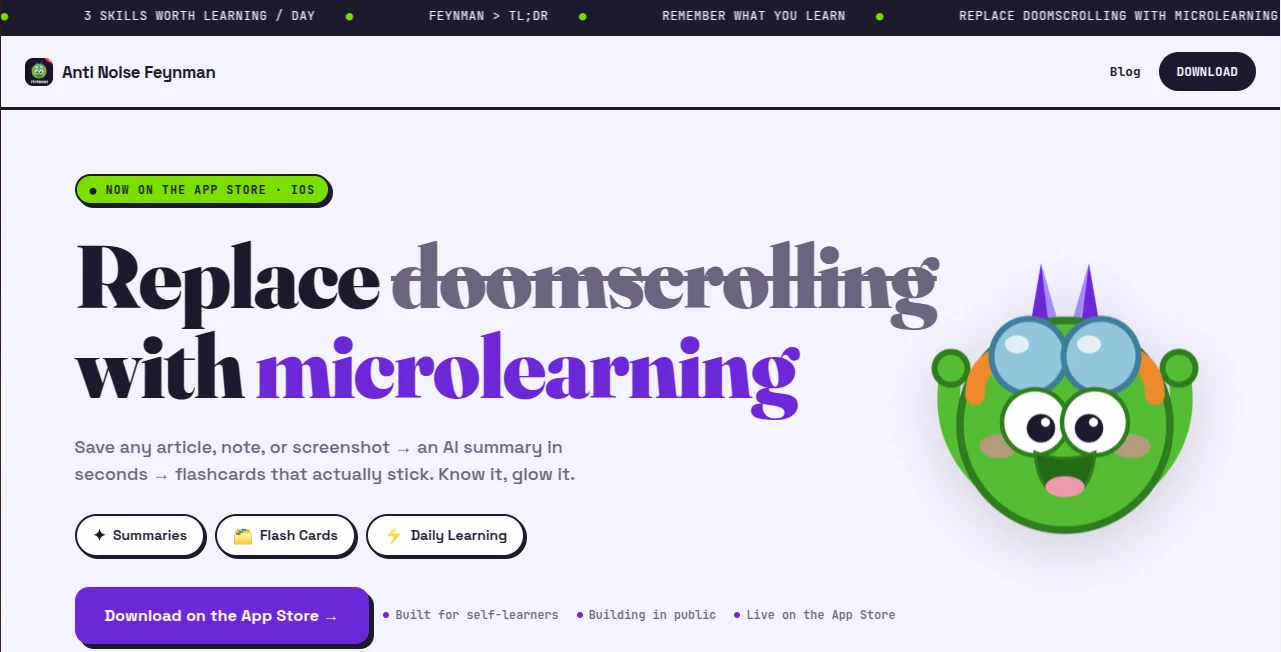
Most people don’t struggle with finding information anymore—they struggle with keeping it. Articles are saved, highlights are marked, tabs are left open, and yet very little actually turns into long-term understanding. This is where this modern read-it-later learning platform takes a different approach.
Instead of acting like a passive bookmark tool, it transforms saved content into something active. Articles, notes, and ideas are reshaped into flashcards, structured summaries, and interactive quizzes that help the brain actually retain what it reads. It feels less like collecting content and more like building personal knowledge.
What makes it stand out is the combination of simplicity and intelligence. You don’t need to design study systems or manually convert notes. The platform quietly does the heavy lifting in the background, turning everyday reading into a structured learning flow.
Key Features
User Interface
The interface is designed to feel familiar from the first moment. Saving content is quick, and everything flows into a clean library where items are automatically organized. There’s no clutter or unnecessary complexity.
Each saved piece of content can be opened as a reading view, a flashcard set, or a quiz session. Switching between modes feels natural, almost like flipping between different ways of thinking about the same idea.
Accuracy & Performance
The system performs especially well when breaking down long-form content into structured learning units. Instead of random summaries, it identifies key ideas, core arguments, and supporting details.
The flashcards feel meaningful rather than mechanical. They are designed to reinforce understanding instead of just testing memory. The quiz generation also adapts to difficulty, making repetition feel more purposeful over time.
Capabilities
This platform goes beyond traditional read-it-later apps by introducing multiple layers of learning interaction.
- Convert saved articles into structured flashcards
- Generate quizzes from reading material automatically
- Apply Feynman-style explanations to simplify complex topics
- Take and organize smart notes alongside content
- Build a personal knowledge library from saved resources
- Revisit content through spaced repetition-style learning
One of its most powerful aspects is how it turns passive reading into active recall. Instead of rereading the same article multiple times, users interact with the ideas in different formats until they truly stick.
Security & Privacy
User data is handled with a focus on privacy and personal ownership. Saved content remains tied to the user’s account and is not exposed publicly. The system is designed to function as a private knowledge workspace rather than a shared content platform.
This makes it especially suitable for students, researchers, and professionals who deal with sensitive or personal reading material.
Use Cases
This platform fits naturally into different learning and productivity workflows.
- Students converting lecture notes into revision flashcards
- Professionals saving industry articles for continuous learning
- Researchers organizing complex reading material into structured knowledge
- Self-learners building long-term understanding from online content
- Writers collecting and processing reference material for future use
For example, someone reading a long article about artificial intelligence can save it, generate flashcards, and then test themselves a few days later—all without manually rewriting anything.
Pros and Cons
Pros
- Turns passive reading into active learning
- Automatic flashcard generation saves time
- Feynman-style explanations improve understanding
- Clean and distraction-free interface
- Strong for long-term knowledge retention
- Combines reading, notes, and quizzes in one system
Cons
- May feel advanced for users who only want basic bookmarking
- Learning features work best with structured content
- Requires consistent use to get full value from spaced learning
Pricing Plans
The platform typically follows a flexible model that allows users to start with basic reading and saving features before upgrading to advanced learning tools.
- Free Tier: Save content and access basic reading features
- Pro Tier: Unlock flashcards, quizzes, and AI learning tools
- Premium Tier: Advanced personalization, deeper AI explanations, and enhanced knowledge organization
This structure makes it easy for new users to explore the system before committing to a full learning workflow.
How to Use the App
Getting started is simple, even if you’ve never used a learning tool like this before.
- Save an article or piece of content you want to learn from
- Let the system analyze and structure the material
- Switch between reading mode, flashcards, or notes
- Generate a quiz to test your understanding
- Revisit the content later for reinforcement and retention
Over time, the saved library becomes a personalized learning system built entirely around your interests and goals.
Comparison with Similar Tools
Traditional read-it-later tools focus mainly on saving content for later consumption. Note-taking apps help organize thoughts but require manual effort to structure information. Flashcard apps are effective but usually require users to create their own cards.
This platform merges all three approaches into one system. Instead of switching between multiple tools, users can save, understand, and test themselves in a single workflow.
The key difference is automation. Rather than asking users to build their learning system manually, it builds it for them based on what they read.
Conclusion
Modern learning is no longer about access to information—it’s about retention and understanding. This platform addresses that challenge by turning everyday reading into a structured learning experience.
By combining flashcards, AI-generated explanations, smart notes, and quizzes, it creates a continuous loop of learning that feels natural rather than forced. For anyone who reads frequently and wants to actually remember what they read, it offers a practical and thoughtful solution.
Frequently Asked Questions (FAQ)
Is it just a bookmarking tool?
No. It goes beyond saving content by turning it into structured learning material such as flashcards and quizzes.
Do I need to manually create flashcards?
No. The system automatically generates them from saved content.
Is it suitable for students?
Yes. It is especially useful for revision, exam preparation, and long-term learning.
Can I use it for professional development?
Absolutely. Many users save industry articles and turn them into long-term knowledge resources.
Does it replace note-taking apps?
It can complement or partially replace them depending on how you structure your workflow, especially for learning-focused use cases.