













Medical Scribe
Verified Blue CheckMark
Verified Blue CheckMark products are featured above free or unverified listings.
This badge indicates authenticity and builds trust, giving your product higher visibility across the platform.
Upgrade to get verified
Verified Blue CheckMark products are featured above free or unverified listings. This badge indicates authenticity and builds trust, giving your product higher visibility across the platform.
Upgrade to get verified
What is Medical Scribe?
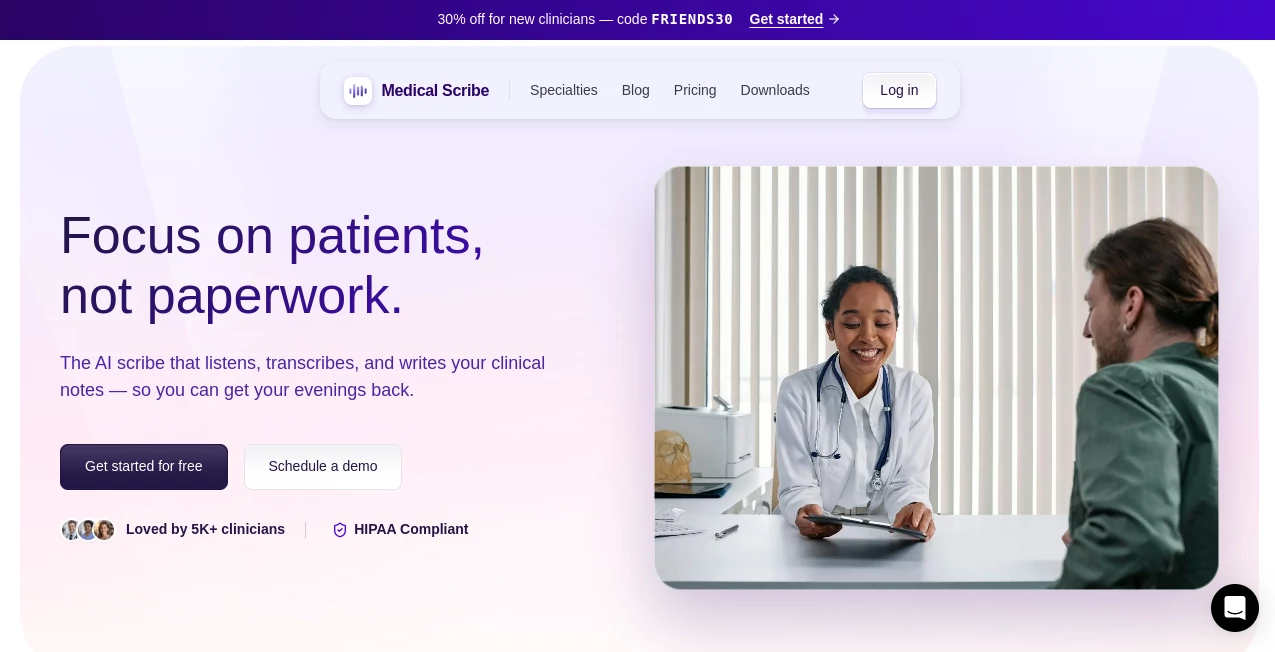
Medical Scribe is an AI-powered clinical documentation assistant designed to take much of the manual work out of patient note-taking. It listens to patient consultations, converts conversations into text, and turns the important information into structured clinical documentation such as SOAP notes.
The idea is refreshingly practical: instead of spending the evening catching up on charts, clinicians can review and refine a prepared note while the details of the consultation are still fresh. The platform is built specifically around medical terminology and clinical workflows, making it more focused than a general-purpose transcription service.
It supports healthcare professionals across specialties including family medicine, cardiology, physical therapy, psychology, acupuncture, direct primary care, and veterinary medicine. The service is available across web and mobile devices, including iPhone and Apple Watch.
Key Features
- AI-powered transcription of patient and clinician conversations.
- Automatic generation of structured SOAP notes.
- Support for custom note formats and templates.
- Medical terminology recognition for drugs, procedures, anatomical terms, and clinical language.
- Support for 57 languages.
- Native support across Web, iOS, Android, and Apple Watch.
- Specialty-oriented templates for different healthcare professions.
- HIPAA-compliant infrastructure with encryption for sensitive information.
- Options for individual clinicians as well as clinics and healthcare organizations.
User Interface
The interface is designed around one simple goal: keeping documentation from becoming the center of the consultation. The workflow is straightforward enough that a clinician can start a recording, conduct the visit, and later review the generated documentation without navigating an unnecessarily complicated system.
The platform has also received a design refresh focused on making the experience faster and cleaner. On supported devices, clinicians can begin recording from an Apple Watch and later review the resulting note on a phone or computer. That small detail can make a meaningful difference during busy clinical sessions.
Accuracy & Performance
Accuracy is particularly important for a medical documentation system because ordinary speech recognition is not always comfortable with drug names, diagnoses, procedures, or anatomical terminology. The platform states that its speech-to-text models are designed specifically around medical terminology.
For example, terms such as Metformin, Hypertension, Bradycardia, and Bilateral are highlighted as examples of the type of clinical language the system is built to recognize. Generated documentation is intended to be reviewed and edited by the clinician before it becomes part of the medical record.
The company describes note generation as taking minutes rather than requiring clinicians to spend the same amount of time manually documenting a visit. In practice, the biggest advantage is not simply transcription speed, but having the conversation organized into a usable clinical format.
Capabilities
The platform goes beyond basic speech-to-text. It can transform a recorded consultation into structured clinical notes and supports different documentation styles. SOAP notes are a central part of the workflow, while custom templates allow practices to adapt documentation to their own requirements.
Specialty-specific templates are another useful feature. A cardiologist, physical therapist, psychologist, veterinarian, or family physician does not necessarily document visits in exactly the same way, so having templates designed around different disciplines can reduce the amount of manual restructuring after transcription.
Multilingual support is also a notable capability. The service supports 57 languages, helping clinicians work with patients who prefer to communicate in languages other than English.
Security & Privacy
Privacy is a critical consideration when working with clinical conversations. The platform states that it is HIPAA compliant and uses encryption to protect information in transit and at rest. Its security approach is designed specifically for healthcare documentation rather than general-purpose audio transcription.
The company also states that medical information provided to the service is used for documentation generation and is not retained for other purposes. Even with these safeguards, healthcare professionals should always follow their organization's privacy policies, consent procedures, and applicable regulations when recording patient interactions.
Use Cases
The most obvious use case is everyday clinical charting. A physician can record a consultation instead of constantly switching attention between the patient and a keyboard, then review the generated note afterward.
For a family physician handling a packed schedule, this can help reduce the pile of unfinished documentation at the end of the day. A physical therapist can use specialty-oriented documentation for rehabilitation visits, while a psychologist can structure session notes around the way their practice works.
Direct primary care practices can also benefit from flexible templates because their consultations may cover a broader range of topics than a short, highly standardized appointment. Veterinary professionals are another audience supported by the platform, giving the service a wider scope than tools designed exclusively for human primary care.
It can also be useful for clinicians working across locations. A practitioner might begin a consultation using an iPhone or Apple Watch and later review the documentation from a computer, keeping the workflow consistent across devices.
Pros and Cons
Pros
- Designed specifically for clinical documentation.
- Strong focus on medical terminology and speech recognition.
- Automatic SOAP note generation.
- Customizable note templates.
- Supports 57 languages.
- Works across web and mobile platforms.
- Apple Watch support can make recording less intrusive during consultations.
- HIPAA-compliant infrastructure and encryption.
- Supports multiple medical and healthcare specialties.
Cons
- Generated notes still need professional review before being finalized.
- The most useful features are primarily aimed at healthcare professionals rather than general users.
- Advanced team and enterprise functionality requires a higher-tier arrangement.
- Clinicians must still consider patient consent and their organization's policies when recording consultations.
Pricing Plans
The service offers a free plan with 10 trial visits, SOAP note generation, web access, medical terminology recognition, and HIPAA-compliant infrastructure.
The Professional plan is listed at $42 per month per user when billed annually, with an annual price of $499. It includes unlimited patient visits, SOAP and custom note formats, web, iOS, and WatchOS applications, 57-language support, priority support, and custom templates.
Healthcare organizations can choose an Enterprise plan with custom volume pricing. It adds features such as team management, a dedicated account manager, custom integrations, SSO, advanced security, onboarding support, and SLA options.
Pricing can change over time, so clinicians should check the current plan details before subscribing.
How to Use the AI Medical Scribe
- Create an account and start with the available free option or trial.
- Choose the device you want to use for recording, such as a phone, computer, or supported wearable.
- Start recording during the patient consultation according to applicable consent and privacy requirements.
- Allow the AI system to transcribe the conversation and organize the information.
- Review the generated SOAP note or selected custom format.
- Edit any information that needs correction or clarification.
- Review the final documentation carefully before signing or adding it to the patient's record.
Comparison with Similar Tools
The AI medical scribe market includes several products aimed at reducing clinical documentation time. The main difference here is the combination of medical-focused speech recognition, customizable templates, specialty-oriented workflows, multilingual support, and broad device availability.
Compared with general transcription applications, the workflow is much more clinical. The objective is not simply to produce a transcript of a conversation. The system is intended to turn that conversation into useful medical documentation that a clinician can review and adapt.
It also competes with dedicated medical scribes such as Freed, Heidi, PatientNotes, Commure, and Twofold. The strongest reason to consider this platform is its balance between structured SOAP documentation and customization, particularly for professionals who want their notes to reflect the way their own practice operates.
Conclusion
Clinical documentation can quietly consume a large portion of a healthcare professional's working day. The value of an AI scribe is therefore measured by more than how quickly it can transcribe audio. It needs to understand medical language, produce useful documentation, fit into real clinical routines, and handle sensitive information responsibly.
This platform takes a focused approach to that problem. Its medical terminology support, SOAP note generation, specialty templates, multilingual capabilities, and cross-device workflow make it a compelling option for clinicians who want to spend less time typing and more time with patients.
It is not a replacement for professional judgment. The generated documentation should be reviewed carefully by the clinician. Used in that role, however, it can turn a repetitive administrative task into a much shorter review-and-edit process.
Frequently Asked Questions (FAQ)
What is an AI medical scribe?
An AI medical scribe listens to or processes clinical conversations and uses artificial intelligence to create structured documentation. Instead of manually writing every detail, clinicians can review and edit an automatically generated note.
Can it generate SOAP notes?
Yes. SOAP note generation is one of its core functions. It can organize information from a patient consultation into Subjective, Objective, Assessment, and Plan sections.
How many languages does it support?
The platform states that it supports 57 languages, including multilingual medical terminology recognition.
Does it work on mobile devices?
Yes. It is available through the web and supports iOS, Android, and Apple Watch workflows. Supported Apple devices can be used to record consultations and the resulting notes can later be reviewed on another device.
Is it HIPAA compliant?
Yes. The service states that its infrastructure is HIPAA compliant and uses encryption to protect clinical information.
Does it have a free plan?
Yes. The current free plan includes 10 trial visits along with SOAP note generation and web access. A Professional plan is available for clinicians who need unlimited visits and additional features.
Can clinics use it?
Yes. There is an Enterprise option designed for clinics and healthcare organizations, with features such as team management, custom integrations, SSO, advanced security, and onboarding support.
Should clinicians review the generated notes?
Absolutely. AI-generated clinical documentation should be reviewed and corrected by the responsible healthcare professional before it is finalized. The system is a documentation assistant, not a substitute for clinical judgment.