APIPASS
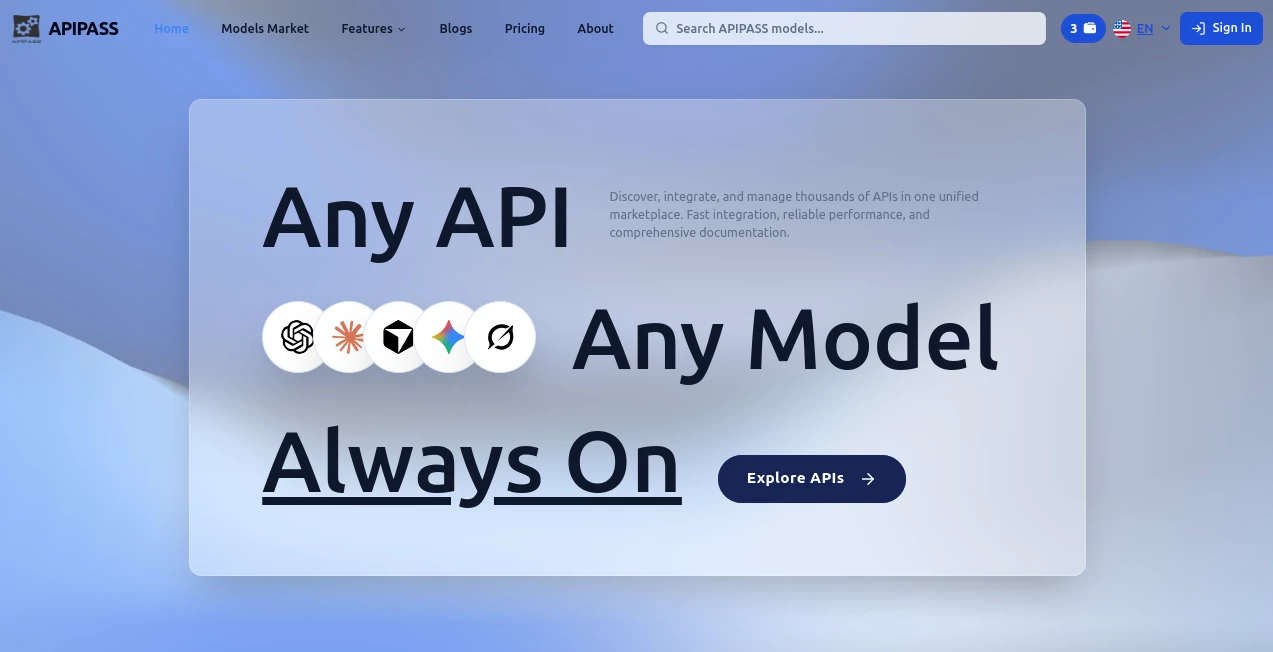
What is APIPASS?
I used to juggle multiple API keys, read different documentation for every model, and deal with inconsistent pricing just to access the latest AI tools. It was exhausting. Then I started using this platform and everything simplified. Now I have one clean API key that opens the door to Claude, Gemini, Midjourney, Kling, Runway, Luma, and dozens more. The integration is straightforward, the performance reliable, and the cost often lower than going direct. For developers and teams building AI features, it removes a huge layer of friction and lets you focus on what actually matters — creating great products.
Introduction
Accessing powerful AI models shouldn’t feel like a full-time job. ApiPass brings together the best image, video, and text models into one unified marketplace. You get a single, well-documented API that lets you switch between top providers without changing your code. Whether you need text generation, stunning visuals, or video creation, everything lives in one place with transparent pricing and fast response times. It’s built for developers who want premium AI capabilities without the usual integration headaches. The result is faster development, lower costs, and the freedom to experiment with different models until you find the perfect fit for each feature.
Key Features
User Interface
The developer dashboard is clean and practical. You can browse models by category, test them directly in a built-in playground, and generate API keys instantly. Documentation is clear with code examples in multiple languages, and usage analytics show exactly how much you’re spending in real time. Everything feels designed by developers for developers — no unnecessary clutter, just the tools you need to move fast.
Accuracy & Performance
The platform delivers consistent, high-quality output across all connected models. Response times stay fast even during peak hours, and the unified routing ensures you get reliable performance no matter which backend model you choose. In practice, teams report fewer failed requests and more predictable costs compared to managing multiple separate APIs.
Capabilities
You get access to leading models for text (Claude, Gemini), image generation (Midjourney, DALL-E, Stable Diffusion, Flux), and video (Kling, Runway, Luma, Veo). It supports various output formats, resolutions up to 4K, and offers both synchronous and asynchronous options. The unified endpoint means you can swap models with minimal code changes, making A/B testing and optimization much easier. There are also practical tools for cost management, usage monitoring, and easy scaling.
Security & Privacy
Enterprise-grade security with proper encryption, rate limiting, and detailed access controls. Your API keys and usage data stay protected, and the platform follows industry standards for data handling. For companies building customer-facing AI features, that reliability and security provide real confidence.
Use Cases
A startup building an AI content tool switches between different models depending on the task — Claude for reasoning, Midjourney for visuals — all through one integration. An agency creates marketing videos using Kling and Runway without managing separate accounts. A solo developer experiments with multiple image models to find the best style for their app before committing to one. Teams use the analytics to optimize costs and performance across projects. It adapts naturally to different team sizes and use cases.
Pros and Cons
Pros:
- One API key for dozens of top AI models — massive time saver.
- Competitive pricing often lower than direct provider rates.
- Excellent playground and documentation for fast testing.
- Unified analytics and cost management across all models.
- Reliable performance with good uptime and support.
Cons:
- Some very new models may take time to be added.
- Advanced enterprise features require higher-tier plans.
Pricing Plans
It starts with free credits so you can test models and integration quality without risk. Usage-based pricing is transparent and often more affordable than going direct. Paid plans offer higher limits, priority support, and team features. The model rewards experimentation while scaling smoothly as your needs grow.
How to Use ApiPass
Sign up, generate your API key, and start making requests to the unified endpoint. Choose the model you want in each call (or set defaults). Test ideas quickly in the playground, then implement in your code. Monitor usage and costs from the dashboard. When you want to try a different model, just change the parameter — no new integration needed. The entire process is designed to keep you moving fast from idea to production.
Comparison with Similar Tools
Direct provider APIs force you to manage multiple accounts and integrations. Other aggregators can feel limited or expensive. This platform stands out with its broad selection, clean unified API, transparent pricing, and strong developer experience. It strikes an excellent balance between choice, simplicity, and cost that many alternatives miss.
Conclusion
Building with AI should be exciting, not exhausting. This platform removes the friction of managing multiple services and lets you focus on creating value. With one integration you get access to the best models available today, plus the flexibility to adapt as new ones emerge. For developers and teams serious about shipping AI features quickly and affordably, it’s become an essential part of the toolkit.
Frequently Asked Questions (FAQ)
How many models are available?
Dozens, covering text, image, and video from leading providers like Anthropic, Google, Midjourney, Kling, Runway, and more.
Do I need to change my code when switching models?
Minimal changes — usually just the model name parameter.
Is there a free way to test?
Yes, new users get free credits to explore different models.
What about pricing transparency?
Very clear per-model rates with usage tracking and no hidden fees.
Is support available?
Yes — responsive technical support for integration and optimization questions.
AI Research Tool , AI Developer Tools , AI API Design .
These classifications represent its core capabilities and areas of application. For related tools, explore the linked categories above.

APIPASS Alternatives Product
DiRe-RAPIDS

globalize.now

Vurge

Geoleaper

Grow A Garde…

Blackbox AI

obbylist

CodeSpy AI

LSGRO