













globalize.now
Verified Blue CheckMark
Verified Blue CheckMark products are featured above free or unverified listings.
This badge indicates authenticity and builds trust, giving your product higher visibility across the platform.
Upgrade to get verified
Verified Blue CheckMark products are featured above free or unverified listings. This badge indicates authenticity and builds trust, giving your product higher visibility across the platform.
Upgrade to get verified
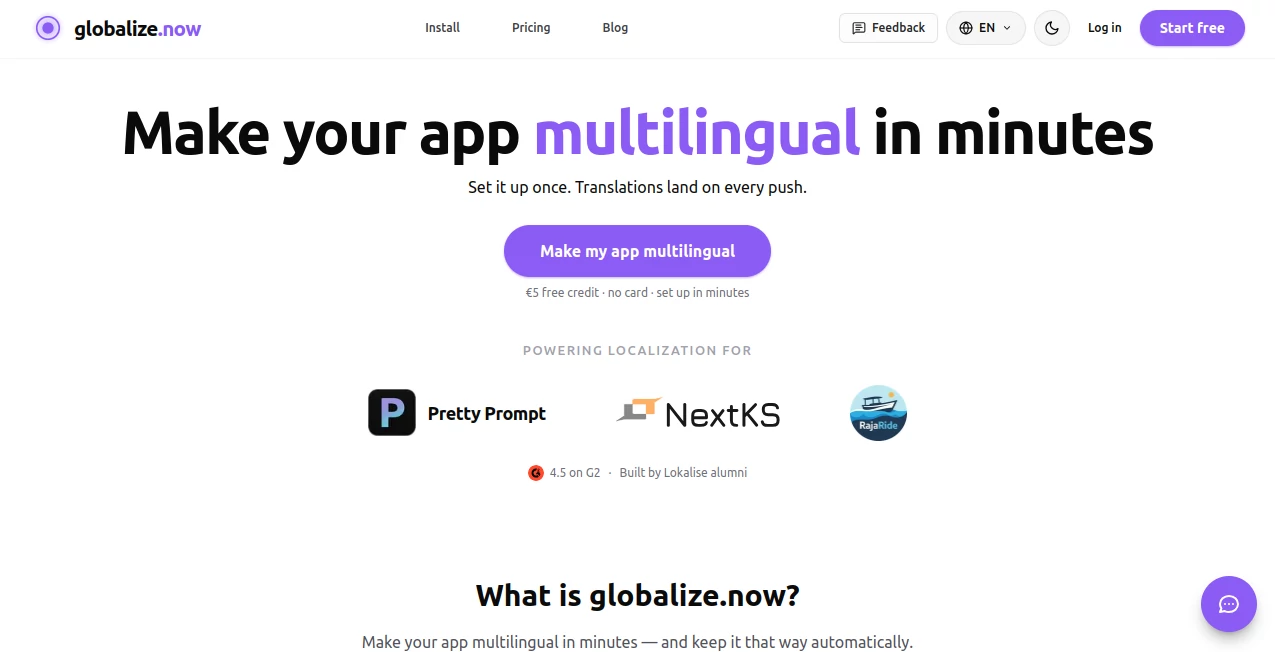
What is globalize.now?
Building software for a global audience is no longer optional. Users expect products to speak their language from day one, yet traditional localization often becomes an expensive and time-consuming process. This platform changes that experience by helping development teams transform applications into multilingual products with minimal effort.
Instead of relying on spreadsheets, manual exports, or disconnected translation workflows, the platform integrates directly into modern development environments and Git-based workflows. It automatically prepares projects for internationalization, generates localization files, and keeps translations synchronized whenever new content is added. The result is a faster release cycle, cleaner code, and a significantly smoother experience for developers working on global applications.
Key Features
User Interface
The setup process is refreshingly straightforward. Developers work inside familiar coding environments such as Cursor, Claude Code, or Codex without switching between multiple dashboards. Clear installation steps and guided prompts make onboarding simple even for teams with limited localization experience.
Accuracy & Performance
Rather than translating isolated strings without context, the platform creates structured localization files directly inside the repository. New interface text is detected automatically after each code update, ensuring translations remain synchronized while reducing repetitive manual work. Support for more than 50 languages, including right-to-left languages, makes it suitable for products targeting international markets.
Capabilities
- Automatic internationalization setup for supported projects.
- Extracts hardcoded interface text into structured translation files.
- Continuous translation updates on every Git push.
- Works with existing localization libraries.
- Creates locale files owned by the development team.
- Supports modern React and Next.js applications.
- GitHub workflow integration.
- Context-aware AI translation process.
- Handles multilingual applications without disrupting development.
- Supports over 50 global languages.
Security & Privacy
Translation files remain inside the project's own repository, giving developers complete ownership over their localization assets. Changes are reviewed through pull requests before merging, helping teams maintain quality control while protecting production environments. This Git-first workflow also provides transparency for every localization update.
Use Cases
- Localizing SaaS platforms for international customers.
- Preparing startup applications for global launches.
- Managing multilingual React and Next.js projects.
- Automating localization during continuous deployment.
- Reducing engineering time spent on translation maintenance.
- Supporting right-to-left languages for international expansion.
- Scaling products without creating localization debt.
Pros and Cons
Pros
- Fast implementation with minimal manual configuration.
- Fits naturally into existing Git workflows.
- Automates repetitive localization tasks.
- Supports numerous languages, including RTL languages.
- Keeps translation files synchronized automatically.
- No separate translation management dashboard required.
Cons
- Primarily focused on modern web application frameworks.
- Native mobile projects have limited support.
- Requires Git-based development workflows to unlock its full value.
Pricing Plans
The service offers a straightforward pricing model with a single workspace subscription. A free signup includes translation credits, allowing developers to evaluate the platform before committing. Monthly pricing includes millions of translated characters, while larger projects can purchase additional translation capacity as needed.
How to Use globalize.now
Install the provided development skill inside your preferred AI coding environment, then let the setup process analyze your application. The system detects your framework, prepares internationalization, generates translation resources, and connects localization to your Git workflow. After setup, every new interface string added during development is translated automatically and synchronized through pull requests, making multilingual releases part of the normal development cycle.
Comparison with Similar Tools
Many localization platforms focus mainly on managing translators and translation projects after internationalization has already been completed. This solution takes a different approach by helping developers prepare applications for multilingual support from the beginning. Instead of relying on external dashboards and manual synchronization, it integrates directly into the software development workflow, automatically maintaining localization alongside the source code. For AI-assisted software development, this creates a noticeably smoother and more developer-friendly experience.
Conclusion
For development teams building products with international ambitions, this platform offers an impressive balance of automation, simplicity, and developer convenience. By eliminating repetitive localization tasks and integrating directly into existing coding workflows, it allows teams to focus on building features instead of managing translations. Whether launching a startup product or expanding an established application into new markets, it provides an efficient foundation for delivering multilingual experiences at scale.
Frequently Asked Questions (FAQ)
Is it suitable for existing applications?
Yes. Existing projects with localization libraries can connect without rebuilding their entire translation infrastructure.
How many languages are supported?
The platform supports more than 50 languages, including several right-to-left languages.
Does it work with Git workflows?
Yes. Translation updates are synchronized through pull requests, making them part of the normal development process.
Who benefits the most from this platform?
Software developers, startups, SaaS companies, and engineering teams building multilingual web applications.
Can developers keep ownership of translation files?
Yes. Localization files remain inside the project's repository, allowing complete ownership and version control.