
Apirro
What is Apirro?
Online shopping is changing quickly. Instead of opening several websites, comparing products manually, and deciding what to buy, customers are increasingly asking AI assistants to do the research for them. That shift creates a new challenge for brands: being visible in an AI-generated answer is becoming just as important as appearing in a traditional search result.
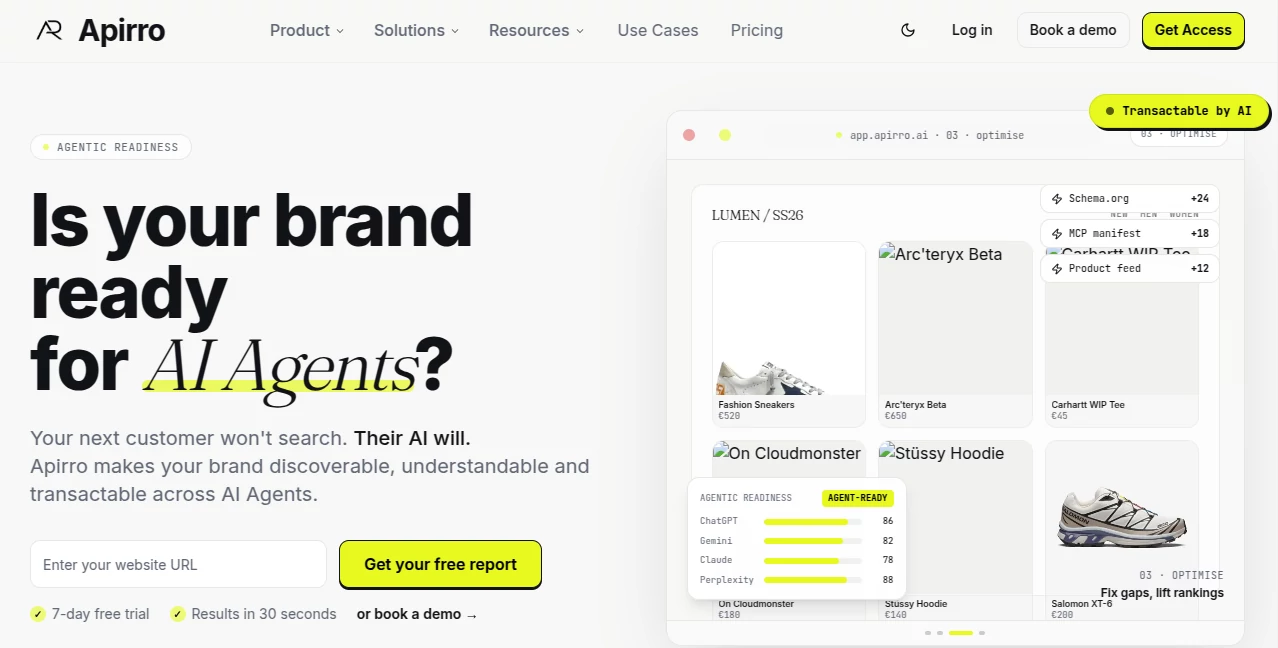
Apirro is built around this emerging form of commerce. It helps brands understand how AI shopping assistants see their products, how frequently those products are recommended, and what information AI agents need in order to understand and transact with a catalogue. Rather than asking businesses to replace their existing commerce platform, the service works alongside it and provides structured data, feeds, and agent-facing infrastructure.
For an e-commerce team, the idea is practical. A product may be perfectly optimized for a conventional search engine and still be difficult for an AI agent to understand. Product details, offers, policies, and purchasing information need to be presented in a format that automated systems can reliably interpret. This platform focuses directly on that gap.
Key Features
The platform combines AI visibility monitoring with technical optimization for agentic commerce. Its features are designed around three important questions: Can AI systems discover a brand? Can they understand its products correctly? And can an autonomous agent actually move toward a transaction?
- AI visibility monitoring across major AI assistants
- Prompt tracking based on customer search behavior
- Competitor mention monitoring
- Agent-readable product and organization data
- Structured schema generation for products, offers, and policies
- llms.txt and sitemap generation
- Crawler rules designed for AI extraction pipelines
- Product feeds for autonomous agents
- MCP manifests and agent endpoints
- Agent-payment discovery documents
User Interface
The experience is designed around visibility and action rather than overwhelming users with technical dashboards. Businesses can focus on how their brand appears in AI recommendations, which competitors are being mentioned instead, and where improvements are needed.
This is particularly useful for marketing and e-commerce teams that do not want to spend their day interpreting raw technical data. The underlying infrastructure can be complex, but the business questions remain straightforward: Are customers finding us through AI? Does the AI understand our catalogue? Can an agent interact with our commerce infrastructure?
Accuracy & Performance
One of the more useful aspects of the platform is its focus on real prompts rather than relying entirely on conventional SEO measurements. Businesses can track how often AI assistants recommend their brand for prompts that resemble the questions customers actually ask.
The system also compares competitor mentions and monitors changes over time. That makes the data more actionable than a one-time visibility check. A brand can identify a weak area, make changes to its product information or agent infrastructure, and then monitor whether its AI visibility improves.
The service also provides a free AI visibility report that evaluates Visibility, Understandability, and Transactability, followed by a prioritized list of potential fixes. This gives businesses a relatively simple starting point before committing to a paid plan.
Capabilities
The capabilities go beyond simply monitoring AI responses. The Agent Optimiser can generate structured information for organizations, products, offers, and policies. It can also produce technical resources such as llms.txt files, sitemaps, and crawler rules to help AI extraction systems interpret a catalogue correctly.
For businesses moving toward agentic commerce, the agent endpoint functionality is especially interesting. Product feeds, MCP manifests, and payment discovery documents can give autonomous agents a more direct way to interact with a store's product and purchasing infrastructure.
Security & Privacy
Security matters when a platform sits close to commerce infrastructure, product data, and purchasing workflows. The public product information focuses primarily on AI visibility, structured data, feeds, and agent endpoints rather than providing an extensive public breakdown of security architecture.
Businesses considering the service should therefore review the provider's current privacy, security, data-processing, and integration documentation before connecting production commerce systems. This is especially important for organizations handling sensitive customer, payment, or internal business information.
Use Cases
The platform is a natural fit for e-commerce brands that want to prepare for AI-mediated shopping. A retailer, for example, may discover that customers are asking AI assistants for recommendations in its product category while competitors are being mentioned more frequently. Visibility monitoring can reveal that gap and provide a measurable way to track changes.
It can also help brands with large product catalogues. When hundreds or thousands of products are involved, manually maintaining every piece of information required by different AI systems can become difficult. Structured product data and feeds provide a more scalable approach.
Agencies can also use the platform when helping multiple brands adapt to agentic commerce. Instead of treating AI discovery as another isolated marketing experiment, they can incorporate visibility measurement and technical optimization into an existing digital strategy.
Another useful scenario is an established online store that does not want to migrate to a new commerce platform. Because the service is designed to operate alongside an existing store, companies can explore AI-agent readiness without rebuilding their entire commerce stack.
Pros and Cons
Pros:
- Focused specifically on AI-driven product discovery and agentic commerce.
- Monitors brand recommendations across several major AI assistants.
- Tracks competitor mentions and changes over time.
- Provides structured data generation for products, offers, organizations, and policies.
- Supports agent-facing resources such as product feeds and MCP manifests.
- Offers a free visibility report before requiring a subscription.
- Designed to work alongside an existing commerce platform.
Cons:
- The pricing is relatively high for small businesses and individual sellers.
- The platform is aimed more at brands, agencies, and professional commerce teams than casual users.
- Some of the more advanced capabilities require the higher-priced plan.
- Businesses should evaluate security and data-processing documentation carefully before connecting production systems.
Pricing Plans
The service currently provides two self-serve subscription options, and both include a 7-day free trial.
- Discovery – $299 per month: Includes AI visibility monitoring, prompt tracking, competitor mentions, and weekly reports covering ChatGPT, Gemini, Claude, and Perplexity.
- Activate – $999 per month: Includes everything in Discovery plus agent optimization, agent-readable schema generation, product feeds, an MCP manifest, a storefront agent widget, and agent-payment discovery documents.
Subscriptions can be cancelled at any time, with access continuing until the end of the paid billing period. The pricing structure clearly positions the product toward businesses that see AI-driven commerce as a strategic channel rather than a casual marketing experiment.
How to Use the Platform
Start by reviewing the free AI visibility report for your public website. This gives you an initial picture of how your brand performs from the perspective of AI discovery and identifies areas that may require attention.
Next, examine the prompts that matter most to your customers. Look at which competitors appear in AI recommendations and identify situations where your products are missing or poorly represented.
For deeper optimization, configure the structured product information and agent-readable resources required for AI systems to interpret your catalogue. Depending on the selected plan, you can then use feeds, MCP infrastructure, and other agent endpoints to make product information more accessible to autonomous systems.
The best approach is to treat the process as an ongoing optimization cycle rather than a one-time setup. Monitor visibility, make improvements, and check how AI recommendations change over time.
Comparison with Similar Tools
Traditional SEO platforms and this type of agentic-commerce infrastructure solve related but different problems. SEO generally focuses on helping pages appear in ranked search results. Here, the objective is to make a brand discoverable, understandable, and actionable inside AI-generated answers and autonomous shopping workflows.
That distinction matters. A traditional search engine can send a customer to a product page after displaying a list of results. An AI shopping assistant may instead summarize several products, recommend one option, answer follow-up questions, and potentially interact with commerce infrastructure on the customer's behalf.
For brands already investing heavily in conventional SEO, the platform is therefore better viewed as a complementary layer rather than a direct replacement. SEO remains valuable for traditional discovery, while agent optimization addresses the growing number of interactions that happen directly inside AI assistants.
Conclusion
AI-powered shopping is creating a new layer between customers and online stores. Brands can no longer assume that having a well-designed website and strong search rankings automatically means AI assistants will understand their products or recommend them correctly.
This platform takes a focused approach to that problem by combining AI visibility monitoring with structured product information and agent-facing commerce infrastructure. Its ability to monitor recommendations, compare competitor mentions, generate machine-readable data, and support agent endpoints makes it particularly relevant to established e-commerce brands preparing for autonomous shopping.
The pricing means it is unlikely to be the first tool a small store reaches for. For a serious brand, agency, or commerce organization, however, the bigger question is not simply whether AI shopping is happening today. It is whether the business will be ready when more customers let AI assistants decide what they discover, compare, and buy.
Frequently Asked Questions (FAQ)
What is agentic commerce?
Agentic commerce is a shopping model in which AI assistants or autonomous agents discover products, compare options, and help complete purchases on behalf of customers instead of requiring the customer to browse websites manually.
How is this different from traditional SEO?
Traditional SEO is primarily focused on visibility in ranked search results. This platform focuses on whether AI agents can discover a brand, understand its products, recommend them, and interact with the information required for a transaction.
Does it require changing my existing commerce platform?
No. The service is designed to sit alongside an existing store and provide the structured information, feeds, and endpoints that AI agents need without requiring a complete commerce-platform migration.
Which AI assistants are monitored?
The Discovery plan currently includes monitoring across ChatGPT, Gemini, Claude, and Perplexity.
Is there a free option?
A free AI visibility report is available for public websites. Paid subscriptions also include a 7-day free trial.
Who is the platform best suited for?
It is best suited to e-commerce brands, agencies, and businesses with meaningful product catalogues that want to improve their visibility and readiness for AI-mediated shopping.
What does the higher-priced plan add?
The higher plan adds agent optimization and infrastructure such as agent-readable schema generation, product feeds, an MCP manifest, a storefront agent widget, and agent-payment discovery documents.
Can subscriptions be cancelled?
Yes. Subscriptions can be cancelled at any time and remain active until the end of the paid subscription period.
AI SEO Assistant , AI E-commerce Assistant , AI Analytics Assistant , AI Developer Tools .
These classifications represent its core capabilities and areas of application. For related tools, explore the linked categories above.