
Claude API
What is Claude API?
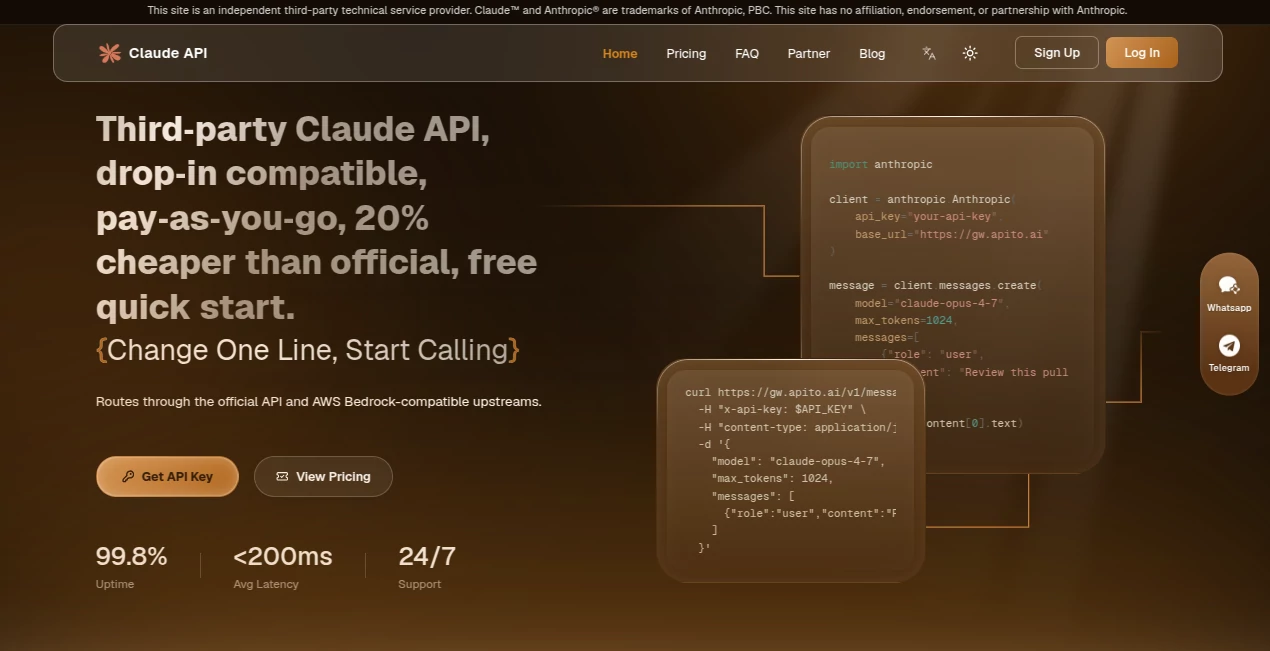
Accessing powerful language models should be simple, flexible, and cost-effective. This platform provides developers with a seamless way to integrate advanced AI capabilities into existing applications without rewriting their codebase. Designed as a drop-in compatible service, it allows teams to switch providers with minimal effort while maintaining familiar API behavior.
One of its strongest advantages is the combination of competitive pricing and broad compatibility. By routing requests through official infrastructure and AWS Bedrock-compatible upstreams, developers receive reliable performance while reducing operational costs. The pay-as-you-go billing model also removes long-term commitments, making it suitable for startups, independent developers, and enterprise teams alike.
Whether you are building an AI assistant, automating customer support, generating content, or creating developer tools, the platform offers an efficient gateway to powerful language intelligence while keeping integration straightforward.
Key Features
- Drop-in compatible API for existing applications.
- Minimal migration with only small code changes.
- Pay-as-you-go pricing with no fixed subscription.
- Lower API costs compared to the standard provider.
- Official API routing for dependable responses.
- AWS Bedrock-compatible upstream support.
- Quick onboarding for new developers.
- Scalable infrastructure for projects of all sizes.
- Suitable for production-ready applications.
- Simple integration with modern development frameworks.
User Interface
The developer experience focuses on simplicity. Documentation is easy to follow, and the setup process requires very little time. Developers who have previously integrated language model APIs can begin sending requests almost immediately, reducing development overhead and speeding up deployment.
Accuracy & Performance
The service forwards requests through trusted upstream providers, delivering consistent response quality while maintaining excellent speed. Stable infrastructure helps reduce interruptions during production workloads, making it appropriate for both experimental projects and commercial applications that require dependable performance.
Capabilities
Developers can build conversational assistants, document processing systems, content generation workflows, coding assistants, translation services, summarization tools, research platforms, and automation pipelines. Because the API follows familiar standards, existing software often requires only minimal adjustments before deployment.
A practical example would be a SaaS company that already uses AI for customer support. Instead of redesigning its backend, the team can redirect requests through this compatible service, lower API expenses, and continue serving users without noticeable workflow changes.
Security & Privacy
The platform routes requests through official infrastructure and compatible cloud services while emphasizing reliable API delivery. Organizations that value stable integrations and trusted upstream connectivity can adopt the service without introducing unnecessary complexity into their existing architecture.
Use Cases
- Building AI chatbots and virtual assistants.
- Customer support automation.
- Content generation platforms.
- Programming assistants.
- Document summarization.
- Knowledge management systems.
- Translation and localization.
- Business workflow automation.
- Research applications.
- Enterprise AI integrations.
Pros and Cons
Pros
- Very easy migration from compatible APIs.
- Competitive pay-as-you-go pricing.
- Lower operating costs for developers.
- Fast setup with minimal configuration.
- Reliable routing through official and compatible upstreams.
- Scales well for growing applications.
Cons
- Requires API integration knowledge.
- Internet connectivity is necessary.
- Feature availability depends on supported upstream services.
Pricing Plans
The platform follows a pay-as-you-go pricing model, allowing users to pay only for the requests they consume. A free quick-start option helps developers test the service before committing to larger production workloads. Compared with the official pricing, it is positioned as a more economical alternative while maintaining compatibility.
How to Use Claude API
Begin by creating an account and obtaining your API credentials. Update your existing application with the provided endpoint information, keeping the integration changes to a minimum. Once connected, send requests using the familiar API format, monitor usage, and scale the implementation as your application grows. This streamlined workflow allows development teams to move from testing to production quickly.
Comparison with Similar Tools
Compared with many AI API providers, this solution emphasizes compatibility rather than requiring developers to learn an entirely new interface. The ability to keep existing integrations while benefiting from lower costs makes it especially attractive for businesses looking to optimize infrastructure expenses. Teams seeking a straightforward migration path may find this approach significantly more convenient than rebuilding applications around a different API design.
Conclusion
For developers searching for an affordable, dependable, and production-ready gateway to advanced language models, this platform offers an impressive balance of compatibility, performance, and value. The minimal migration effort, flexible billing, and reliable infrastructure make it suitable for startups launching their first AI product as well as established organizations managing high-volume applications. Instead of spending valuable engineering time rewriting integrations, teams can focus on creating better AI-powered experiences for their users.
Frequently Asked Questions (FAQ)
Is the service compatible with existing integrations?
Yes. It is designed to be drop-in compatible, allowing developers to migrate with minimal code changes.
Does it offer a free trial?
A free quick-start option is available so developers can evaluate the platform before scaling usage.
Who is the platform best suited for?
It is suitable for startups, independent developers, SaaS companies, and enterprises building AI-powered applications.
Can it be used in production environments?
Yes. The infrastructure is intended to support reliable production workloads while remaining easy to integrate.
Why choose this platform over direct integration?
Its combination of API compatibility, flexible pricing, and reduced operational costs makes it an attractive option for teams looking to optimize AI infrastructure.
AI Code Assistant , AI API Design , Large Language Models (LLMs) , AI Developer Tools .
These classifications represent its core capabilities and areas of application. For related tools, explore the linked categories above.

Claude API Alternatives Product

Vurge

Luma AI

Toonifyit

KaneAI

Ito AI

AI Workflow …

HostFinder

WhatsMyName …

Nestify