
Asteroid
What is Asteroid?
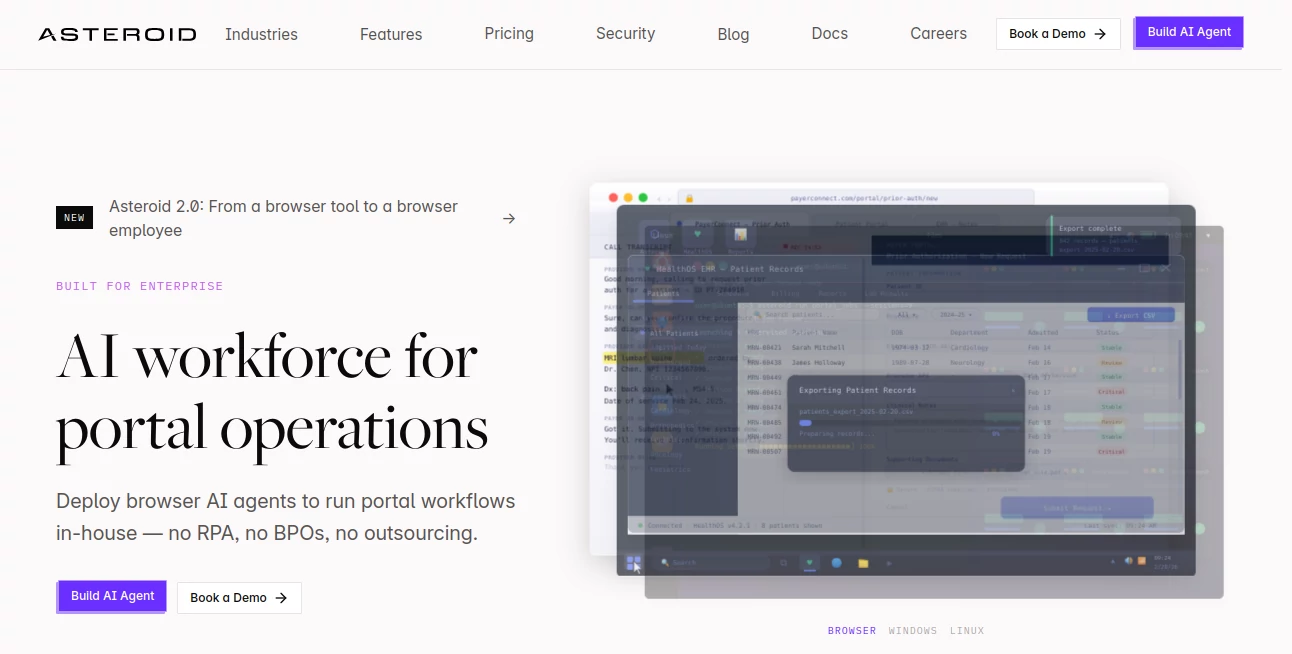
I’ve sat through too many meetings where teams complained about repetitive browser tasks eating up hours every day — filling forms in legacy systems, copying data between portals, chasing down information that should be simple. Then I saw this platform in action, and it felt like someone finally built the right tool for the job. You describe a workflow in plain language, and it turns into a reliable AI agent that actually operates the browser like a careful employee. No brittle scripts, no expensive outsourcing, just agents you can watch, guide, and trust to get the work done.
Introduction
Most companies still rely on humans (or fragile RPA) to handle browser-based back-office work because legacy systems don’t have clean APIs. Asteroid changes that equation. It lets both technical and non-technical teams build, deploy, and supervise AI agents that work directly in real browsers — Chrome, Edge, even Linux or Windows environments. The agents are self-healing, observable, and built for real enterprise use cases like healthcare data entry, insurance quoting across carrier portals, or connecting voice AI to old systems. What makes it special is the balance: powerful enough for complex workflows, approachable enough that domain experts can build without writing heavy code. It’s shifting from “we tolerate this inefficiency” to “we now control it with AI that works under our rules.”
Key Features
User Interface
The builder (called Astro) feels refreshingly human. You map out workflows as graphs of focused steps instead of one giant prompt, add tools, set guardrails, and include human-in-the-loop points where needed. Live supervision lets you watch agents in real time, pause them, or step in to guide. Everything is visual and clear — you see exactly what the agent sees in the browser. It’s designed so operations teams and engineers can collaborate without one side feeling left out.
Accuracy & Performance
These agents are built for reliability in messy real-world environments. They handle dynamic websites, recover from errors, and maintain consistency across long-running tasks. Users report massive time savings — one team went from six minutes per workflow to under 70 seconds. The combination of graph-based logic and live observability means fewer surprises and faster fixes when something changes on a portal.
Capabilities
You can run agents in Browser, Linux, or Windows environments. They support complex multistep processes, integrate with Slack, email, Sheets, and APIs, and allow full supervision with intervention. Healthcare teams automate prior auth and EHR entry. Insurance teams quote across dozens of carrier portals. Voice AI teams bridge to legacy systems. Offshore replacement teams use it to bring control back in-house. The platform scales from single automations to full AI workforce deployments.
Security & Privacy
Enterprise readiness is baked in — HIPAA compliant, SOC 2 Type II certified, with agents running under your credentials and full visibility. Data stays controlled, and the system is designed for sensitive industries where compliance isn’t optional. That level of trust lets big organizations actually adopt browser AI without the usual security nightmares.
Use Cases
A healthcare provider uses agents to handle prior authorization across multiple payers, dramatically cutting manual work while staying compliant. An insurance team automates quoting across 50+ portals, getting results in minutes instead of hours. A voice AI company connects their agents to old legacy systems without expensive custom integrations. Operations leaders replace repetitive offshore data entry with agents they can monitor and improve over time. The common thread is taking painful, repetitive browser work and turning it into something reliable and controllable.
Pros and Cons
Pros:
- Build complex agents without writing heavy code — domain experts can participate.
- Live supervision and intervention give real control and peace of mind.
- Works across Browser, Linux, and Windows environments.
- Strong enterprise security and compliance credentials.
- Self-healing capabilities reduce maintenance headaches.
Cons:
- Best results still benefit from clear SOP documentation upfront.
- Very niche or rapidly changing portals may need occasional human guidance.
- Full enterprise features (advanced analytics, team controls) are on higher tiers.
Pricing Plans
It’s built for real business use with flexible options that scale as you grow. Starting teams can begin with targeted automations, while larger organizations move to enterprise plans with dedicated support, higher volume, and advanced security features. The pricing reflects the value — many teams see payback quickly through time saved and reduced outsourcing costs.
How to Use Asteroid
Describe your workflow or upload an SOP. Use the visual builder to map steps, add tools, and set guardrails. Test in a safe environment, then deploy with live monitoring enabled. Watch the agent run in real time — step in only when needed. Review transcripts and outcomes, then refine the graph as the process evolves. It’s a cycle of build, run, supervise, and improve that gets smarter over time.
Comparison with Similar Tools
Traditional RPA tools often break when websites change and require heavy maintenance. Pure prompt-based agents can be unreliable on complex tasks. Asteroid sits in a stronger middle ground — graph-based for reliability, browser-native for flexibility, and human-supervisable for control. It gives enterprises the best of both worlds without the usual trade-offs.
Conclusion
Browser work isn’t going away, but the way we do it can evolve. This platform turns repetitive, error-prone tasks into reliable AI processes that teams can actually trust and control. It respects the complexity of real enterprise systems while making automation accessible to the people who know the workflows best. For any organization tired of trading speed for control (or paying for both), it offers a smarter path forward.
Frequently Asked Questions (FAQ)
Do I need coding experience to build agents?
No — the visual builder and plain-language steps make it accessible to domain experts.
Is it secure enough for healthcare or finance?
Yes — HIPAA compliant and SOC 2 Type II certified with strong enterprise controls.
Can agents handle dynamic or changing websites?
Yes — they’re designed to be self-healing and can be supervised live when needed.
How fast can I get an agent running?
Many teams have their first useful agent live within hours or days, not weeks.
What environments do agents run in?
Browser, Linux, and Windows environments are all supported.
AI Workflow Management , AI App Builder , AI Research Tool , AI Developer Tools .
These classifications represent its core capabilities and areas of application. For related tools, explore the linked categories above.

Asteroid Alternatives Product

ClawBridge

Scillus

EstatePass

Grok

AyeWatch AI

CitedSpy

ClearWork

DeepSeek V4

Where Is Thi…