
Astrologer AI
What is Astrologer AI?
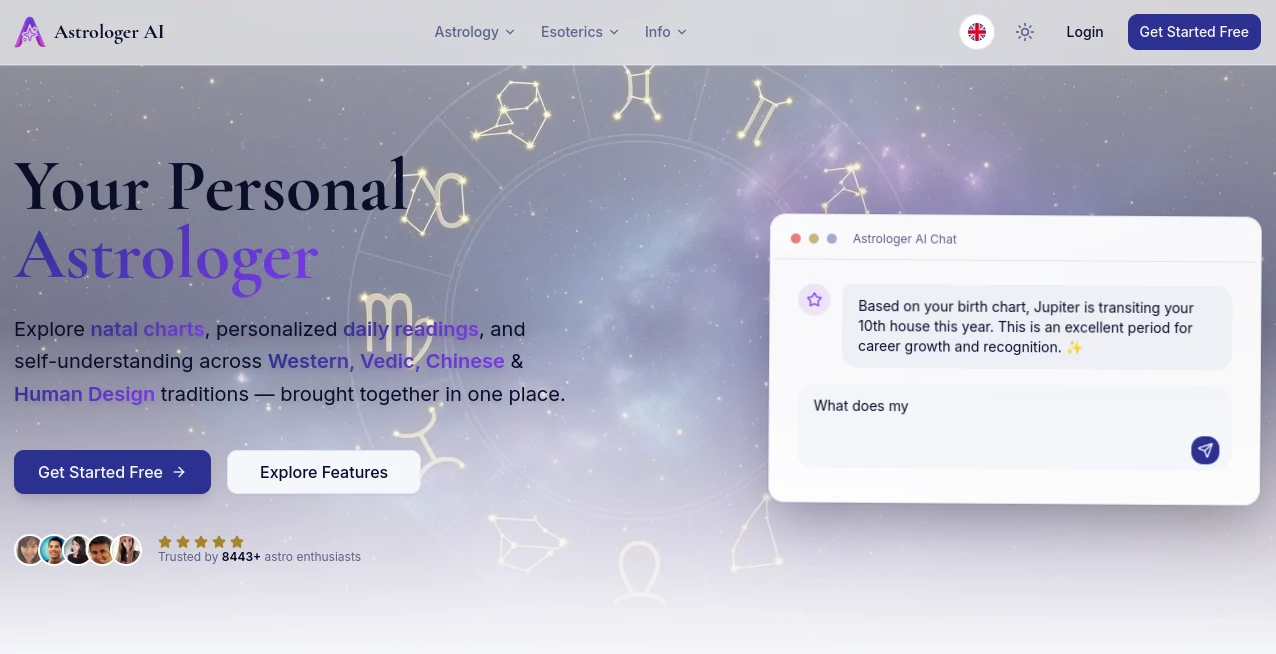
Astrologer AI is a personal astrology workspace that brings birth charts, planetary transits, numerology, and several major astrological traditions together in one place. Instead of relying on a simple Sun-sign horoscope, users can enter their birth date, time, and location and explore interpretations based on a much richer personal profile.
The platform supports Western and Vedic astrology, Chinese astrology and BaZi, Human Design, astrocartography, numerology, and life-cycle analysis. It also adds an AI chat experience, making it possible to ask follow-up questions rather than simply reading a fixed report. The website currently says it is trusted by more than 8,000 astrology enthusiasts.
Key Features
- Personalized Western natal charts with planets, houses, angles, aspects, and chart interpretation.
- Vedic astrology with Kundli charts, Nakshatras, divisional charts, and Dasha periods.
- Chinese astrology and BaZi Four Pillars analysis, including Day Master, elements, luck cycles, and other chart details.
- Numerology readings covering Life Path, Expression, Soul Urge, Personality, Master Numbers, and personal cycles.
- Human Design bodygraph analysis with types, authority, profiles, centers, gates, and channels.
- Astrocartography for exploring planetary lines and potentially significant locations around the world.
- Life Cycles that combine longer-term astrological periods and planetary timing into an interactive timeline.
- Conversational AI that lets users ask questions about their own chart and continue exploring a topic through follow-up questions.
- Personalized daily readings and planetary transit tracking.
- Support for 52 languages, making the experience accessible to users beyond English-speaking audiences.
User Interface
The interface is designed around a single workspace rather than a collection of disconnected calculators. Recent conversations, chart previews, and different astrological systems can be accessed from the same environment. The Western astrology section, for example, presents the Big Three, chart angles, planets, houses, aspects, temperament, and interpretation in a structured format.
The visual chart information is complemented by plain-language explanations. That combination is useful for beginners who may recognize terms such as Moon sign or Ascendant but do not yet know how the individual pieces fit together. More experienced users can also move beyond the introductory information and inspect detailed chart data.
Accuracy & Performance
A major strength is the separation between calculation and interpretation. The platform uses birth date, exact birth time, and birthplace to calculate astronomical and astrological chart information before using AI to explain the results. Its Western chart interface includes precise planetary degrees, houses, aspects, and angles, while its Vedic section calculates elements such as Nakshatras and Dasha periods.
This approach is more useful than a generic horoscope because the interpretation is tied to the user's actual birth information. Accuracy still depends on providing reliable birth details, particularly the exact time and location. The Ascendant, for example, can change considerably with differences in birth time.
Capabilities
The breadth of the platform is what makes it particularly interesting. A user can start with a Western natal chart, switch to a Vedic Kundli, examine a BaZi profile, explore numerology, or look at Human Design without creating separate profiles for each system.
The conversational layer adds another useful dimension. Rather than stopping after a generated report, users can ask questions such as what a particular planetary placement means for relationships or career, then continue with more specific questions. The Life Cycles feature also brings longer periods into focus, including Vimshottari Dasha periods, Sade Sati, Saturn returns, Jupiter returns, and other major transits.
Security & Privacy
Because the service works with personal birth information, users should treat their date, time, and birthplace as personal data and review the platform's current privacy terms before creating an account or entering information they consider sensitive. The service is designed around individual profiles, so using accurate information is important for generating personalized charts.
It is also worth keeping expectations realistic: AI-generated astrology should be viewed as an interpretive and entertainment or self-reflection experience rather than a substitute for professional advice in medical, financial, legal, or other high-stakes decisions.
Use Cases
For someone discovering astrology for the first time, the platform can act as a friendly starting point. Instead of opening several websites to calculate a chart and then searching for explanations of every placement, the essential information and interpretation are presented together.
Astrology enthusiasts can use it to compare different traditions. Someone interested in both Western and Vedic astrology, for example, can examine the same birth profile through different systems. Users interested in relocation can explore astrocartography, while those interested in longer-term timing can investigate planetary cycles and Dasha periods.
It can also be useful for simple personal exploration. You might look at your chart before starting a conversation about career, relationships, or a major life transition, then use the AI chat to explore the symbolism that catches your attention. The experience feels less like opening a static report and more like having an interactive reference guide available when curiosity strikes.
Pros and Cons
Pros
- Combines multiple astrology and esoteric systems in one workspace.
- Provides detailed natal chart information rather than relying only on Sun signs.
- Offers conversational follow-up questions about personal chart information.
- Includes Western, Vedic, Chinese astrology, BaZi, Human Design, numerology, and astrocartography.
- Provides longer-term life-cycle and planetary timing features.
- Useful for both beginners and experienced astrology enthusiasts.
- Available in 52 languages according to the website's published information. :contentReference[oaicite:5]{index=5}
Cons
- The amount of information may feel overwhelming to someone completely new to astrology.
- More detailed readings and features may require a paid plan.
- Interpretations generated by AI should not be treated as objective predictions or professional advice.
- Reliable birth information is important for producing meaningful chart calculations.
Pricing Plans
The service promotes a free starting experience, allowing users to begin exploring its astrology features without committing immediately. The website's main call to action is to get started for free, while additional functionality and deeper readings may be available through premium access. :contentReference[oaicite:6]{index=6}
Since subscription offerings and feature limits can change, users should check the current pricing page inside the service before purchasing. This is especially important if you are primarily interested in a particular system such as Vedic astrology, Human Design, numerology, or Life Cycles.
How to Use Astrologer AI
Getting started is straightforward. First, create an account and enter your birth information, including your date, time, and place of birth. The platform can then generate the relevant charts from that profile.
Choose the system you want to explore. A beginner might start with the Western birth chart and the Sun, Moon, and Ascendant, while someone already familiar with astrology may prefer Vedic Kundli, BaZi, numerology, or Human Design.
Once the chart is available, use the interpretation and AI chat to investigate individual placements. Instead of asking only broad questions, try something specific, such as asking about a planet in a particular house or how a current transit relates to your natal chart. You can then use the follow-up conversation to dig deeper.
Comparison with Similar Tools
Traditional astrology calculators are often excellent at producing raw chart data, but they may leave the user to interpret everything independently. Basic horoscope applications take the opposite approach: they are easy to consume but frequently offer generalized readings based on limited information.
This platform sits between those two approaches. It retains detailed chart calculations while adding an AI conversation layer that explains the information in a more accessible way. Its multi-system approach is another notable difference, particularly for people who do not want to maintain separate tools for Western astrology, Vedic astrology, Chinese astrology, numerology, and Human Design.
The result is especially appealing to curious users who want to move from a quick horoscope toward deeper personal exploration without needing to learn every technical concept before getting started.
Conclusion
For anyone interested in exploring astrology beyond the usual daily horoscope, this platform offers an unusually broad collection of tools in one place. Its strongest quality is not simply the number of systems it supports, but the way chart calculations, explanations, timelines, and conversational questions are brought together.
The experience can work for a newcomer who wants straightforward explanations as well as an astrology enthusiast who wants to compare Western, Vedic, Chinese, numerological, and Human Design perspectives. The free starting option also makes it easy to explore the interface before deciding whether the deeper features are worth paying for.
Ultimately, its best use is as an interactive way to learn about astrological traditions and reflect on your own chart. If you enjoy asking “why?” after reading an interpretation, the conversational approach makes the experience considerably more engaging than a conventional static horoscope.
Frequently Asked Questions (FAQ)
What is this AI astrology platform?
It is an AI-powered astrology workspace that combines personalized birth charts, astrology interpretations, numerology, Human Design, astrocartography, planetary transits, and conversational AI in one service.
Can it generate a personal birth chart?
Yes. Users can provide their birth date, time, and location to generate personalized charts. The Western chart includes information such as the Sun, Moon, Ascendant, planets, houses, angles, and aspects.
Does it support Vedic astrology?
Yes. The Vedic section includes Kundli information, Nakshatras, divisional charts, planetary positions, and Dasha periods. The service states that its Vedic calculations use the Lahiri ayanamsa for sidereal calculations.
Can I explore Chinese astrology?
Yes. Its BaZi feature provides Four Pillars information, Day Master analysis, element balance, Ten Gods, luck cycles, interactions, and other traditional chart details.
Does it include numerology?
Yes. The numerology tools include values such as Life Path, Expression, Soul Urge, Personality, Birthday, Maturity, Balance, Personal Year, and Life Pinnacles, with support for Pythagorean numerology.
What is the AI chat used for?
The chat allows users to ask questions about their personalized chart and continue a discussion through follow-up questions. This makes it possible to explore individual placements and themes instead of relying only on a predetermined report.
Does it support Human Design?
Yes. The platform includes Human Design bodygraph information and AI interpretation based on the user's birth details.
Does it offer astrocartography?
Yes. Its astrocartography feature provides an interactive map with planetary lines and location-based exploration, allowing users to investigate places that may have different astrological significance in their chart.
How important is the exact birth time?
It can be very important, especially for the Ascendant and house placements. The Ascendant changes relatively quickly, so an inaccurate birth time can affect parts of the chart. If possible, users should enter the most reliable birth information available.
Is the service free?
The website offers a free starting experience. Some deeper readings or premium capabilities may require paid access, so users should review the current plan details before subscribing.
How many languages are supported?
The published information states that the service is available in 52 languages, allowing users to explore readings and conversations in a wider range of languages.
Can AI astrology predict the future?
AI can calculate astrological data and provide interpretations based on established astrological systems, but those interpretations should not be considered guaranteed predictions. It is better to use the experience for exploration, learning, and personal reflection.
AI Life Assistant , AI Fun Tools , AI Religion .
These classifications represent its core capabilities and areas of application. For related tools, explore the linked categories above.

Astrologer AI Alternatives Product

core level

Dating photos

Ovulation Ca…

YouMind

Astrology Bot

SearchSpot

BeyondPlay

Greek Numero…

Plottie