AudioMakerAI
What is AudioMakerAI?
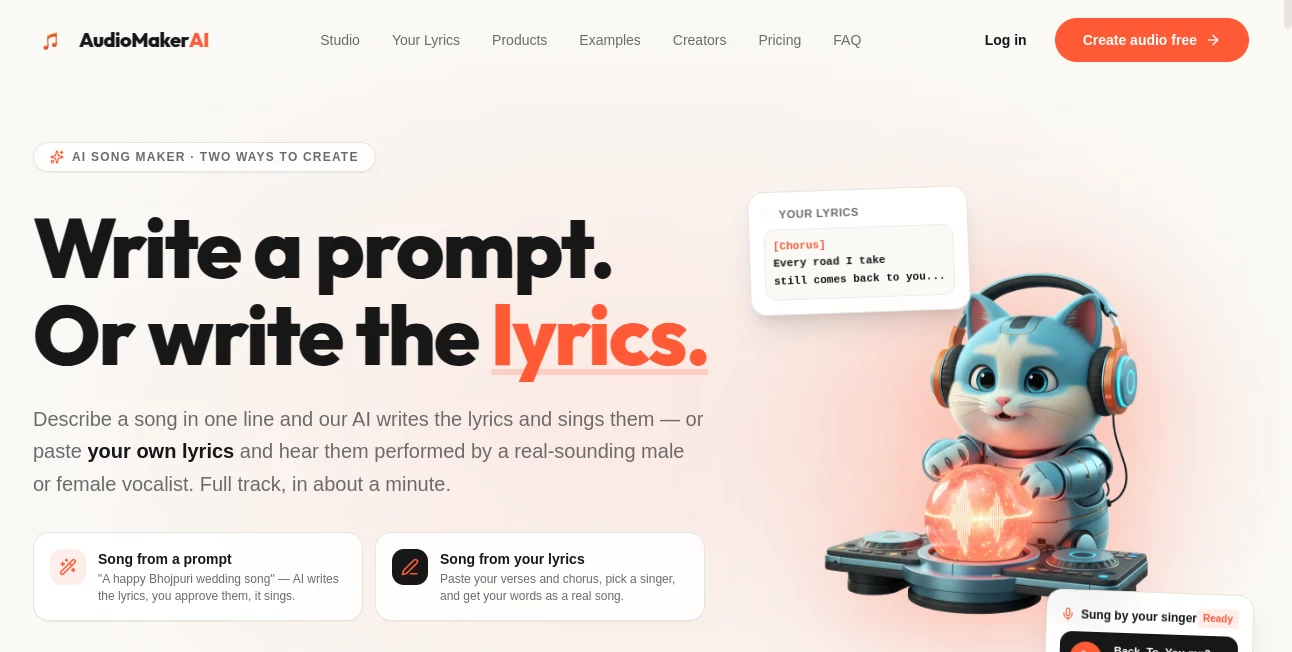
AudioMaker AI is a generative audio studio designed for creators, producers, developers, and anyone who wants to turn an idea into finished audio without starting from an empty timeline. The platform brings music creation, singing voiceovers, beats, sound effects, and voice narration into one creative environment.
What makes the service interesting is the way it treats text prompts as a starting point for audio creation. Instead of searching through large sound libraries or spending hours building a track from scratch, users can describe what they want and let the platform translate that direction into sound. This makes it useful for everything from a quick background track to more specialized audio for videos, games, social content, and digital projects.
The platform also puts a strong emphasis on royalty-free generation, which can be particularly useful for creators who need original audio for published content. Its range goes beyond conventional music generation, with specialized sound creation and vocal capabilities available as part of the broader studio.
Key Features
- AI-powered music generation from text-based creative ideas.
- Song creation with AI-generated singing voices.
- Generation of beats for different creative projects.
- AI sound effects for video, games, apps, and other media.
- Voice narration and neural voice generation.
- Specialized audio generation for different genres, languages, and creative scenarios.
- Royalty-free audio generation for supported content creation workflows.
User Interface
The experience is built around the idea of moving quickly from an idea to an audio result. Rather than requiring every user to understand professional production software, the workflow centers on describing the desired result and working with the generated audio.
This approach can be especially appealing to content creators who know what they want to hear but do not necessarily want to spend their time learning complex music-production tools. A creator working on a short video, for example, can focus on the mood and purpose of the soundtrack instead of manually assembling every musical element.
The broader studio concept also gives the platform a practical advantage. Music, voices, beats, and effects are treated as parts of the same creative workflow rather than completely separate tasks.
Accuracy & Performance
Audio generation is highly dependent on the quality and specificity of the prompt. Clear descriptions of mood, genre, instruments, vocal style, pacing, or intended use generally give the generation system more useful direction.
The platform's range of dedicated audio generators suggests that it is designed for more than generic background music. Its specialized sound-generation pages cover use cases such as notification tones and cinematic sound effects, while its music tools support different musical styles and languages.
For creators, this means the practical value comes from experimentation. A first generation can provide the foundation, while small changes to the description can help move the result closer to the desired sound.
Capabilities
Music creation is one of the platform's central capabilities. Users can work from lyrics or text prompts to create original songs and musical pieces. The service also supports specialized song-generation experiences for different languages and musical traditions, including Portuguese and Vietnamese music.
Its vocal capabilities extend beyond ordinary text-to-speech. The platform promotes neural singing voices and voice narration, making it possible to explore both musical vocals and spoken audio within the same ecosystem.
Sound design is another notable part of the platform. Creators can generate effects for scenes, games, applications, and short-form content instead of relying entirely on pre-recorded sound libraries. Even small details such as an app notification tone can be generated from a natural-language description.
This combination makes the platform useful when a project needs several kinds of audio. A video creator could need music, narration, and sound effects for the same project, while a game developer might need environmental effects, character-related audio, and interface sounds.
Security & Privacy
As with any cloud-based generative media service, users should review the platform's current privacy and usage policies before uploading sensitive material or commercially important source content. The public-facing service emphasizes generated audio and royalty-free output, but licensing, ownership, retention, and permitted commercial uses can depend on the applicable plan and terms.
For professional projects, it is sensible to check the current terms before publishing generated material, particularly when the audio will be used commercially or as part of a larger branded production.
Use Cases
There are plenty of practical situations where an AI audio studio can save time. YouTube creators can use generated music and narration for videos, while social media creators can produce short tracks that fit the tone of a Reel, TikTok, or promotional clip.
Video producers can also use generated sound effects to fill gaps in a soundtrack. Instead of searching for a suitable effect and worrying about whether it matches the scene, they can describe the desired sound and generate a custom version.
Game developers are another natural audience. Footsteps, impacts, environmental sounds, interface notifications, and dramatic effects can all be important parts of an interactive experience. A specialized generator can make early prototyping much faster.
Podcasters and marketers can benefit from the voice and narration capabilities, especially when a project requires spoken audio alongside music. Small businesses can also experiment with original audio branding, background music, and short promotional clips without hiring a full production team for every piece of content.
For example, imagine a creator producing a 30-second travel video. Instead of finding a soundtrack, recording narration, and separately hunting for transition effects, the creator can use one audio-focused workspace to develop several of those elements and keep the creative direction consistent.
Pros and Cons
Pros:
- Combines several AI audio capabilities in one platform.
- Supports music, beats, vocals, narration, and sound effects.
- Useful for creators who do not have professional audio-production skills.
- Text prompts make experimentation relatively straightforward.
- Supports specialized music-generation experiences for different languages and styles.
- Royalty-free generation is a useful feature for many content-creation workflows.
Cons:
- Generated audio can still require experimentation before reaching the desired result.
- Professional producers may want deeper manual control than a prompt-driven workflow provides.
- Commercial users should carefully review the current licensing and usage terms for their particular plan.
- The quality of a generation can depend heavily on how clearly the creative request is described.
Pricing Plans
Pricing and available usage options can change as the service evolves, so users should check the current plans directly on the platform before making a purchase. This is particularly important for creators who need a specific number of generations, commercial usage rights, or higher-volume production.
For casual experimentation, the most important consideration is how much audio can be generated within the available allowance. Professional and commercial users should also compare generation limits and licensing terms rather than choosing a plan based solely on its price.
How to Use AudioMaker AI
- Open the audio generation studio and choose the type of audio you want to create.
- Describe the desired result using a clear text prompt.
- Include useful details such as genre, mood, instruments, vocal style, atmosphere, or intended use.
- Generate the audio and listen carefully to the result.
- Adjust the creative direction if the first version does not match your idea.
- Download or use the resulting audio according to the applicable plan and licensing terms.
A useful approach is to start with the core idea rather than writing an unnecessarily complicated prompt. For example, a request for an upbeat electronic track for a fast-paced product video gives the generator a clear creative direction. From there, additional details can be introduced if the result needs refinement.
Comparison with Similar Tools
Many AI audio services concentrate on one particular task, such as music generation, voice synthesis, or sound-effect creation. This platform takes a broader approach by bringing several of those functions together.
That distinction matters depending on the project. Someone who only needs a quick song may prefer a highly specialized music generator, while a creator working on an entire video project may appreciate having music, narration, vocals, and effects available within the same ecosystem.
The platform is particularly interesting for users who regularly move between different audio tasks. Instead of maintaining separate workflows for background music, voiceovers, and sound design, they can explore multiple forms of generated audio from one creative environment.
Conclusion
AI audio generation has moved beyond simply producing background music, and this platform is a good example of that broader direction. By combining music creation, singing voices, narration, beats, and sound effects, it gives creators a flexible starting point for projects that need more than one type of audio.
Its prompt-driven approach is especially appealing to people who have a clear creative idea but do not want to spend hours learning traditional production software. Whether the goal is a soundtrack for a video, a custom sound effect for a game, a narrated piece of content, or an original song, the platform offers a convenient place to experiment.
The best results will still come from users who treat generation as a creative process rather than a one-click replacement for production. With thoughtful prompts and a little iteration, the service can become a useful part of a modern content-production workflow.
Frequently Asked Questions (FAQ)
What can this AI audio platform generate?
It can generate several types of audio, including music, beats, singing voiceovers, voice narration, and sound effects.
Can I create music from a text prompt?
Yes. Text prompts can be used to describe the desired musical direction, making it possible to start a track from a written creative idea.
Does it support AI singing voices?
Yes. Neural singing voice generation is one of the capabilities promoted by the platform, alongside ordinary voice narration.
Can it generate sound effects?
Yes. The service includes dedicated sound-effect generation for scenarios such as cinematic effects, games, applications, and notification sounds.
Can creators use the generated audio commercially?
The platform promotes royalty-free generated audio, but creators should review the current licensing and usage terms for the specific plan and type of content before commercial publication.
Is it useful for video creators?
Yes. Video creators can use generated music, narration, vocals, and sound effects to build different parts of a video's soundtrack.
Can it create songs in different languages?
Yes. The platform provides specialized song-generation experiences for multiple languages and musical traditions, including Portuguese and Vietnamese.
Is this suitable for professional musicians?
It can be useful as a creative and production aid, particularly for generating ideas, demos, background material, vocals, and sound effects. Professional musicians who require detailed manual control may still want to combine it with a traditional digital audio workstation.
AI Text to Music , AI Music Generator , AI Voice & Audio Editing .
These classifications represent its core capabilities and areas of application. For related tools, explore the linked categories above.
AudioMakerAI details
Website unavailable — View Alternatives
Pricing
- Freemium
Apps
- Web App
Categories

AudioMakerAI Alternatives Product

Flow Song

Lyrics to So…

Melodank

Lyria3 AI

AI Song Maker

MusicGPT AI

Voice To Ins…

lyria 3

Omni Voice